Marine / Aquatic マリン
Sea-air, briny, expansive. Mostly synthetic molecules (Calone, Helional). Natural oils are rare in this family.
Representative oils
— not yet in the library
The scent wheel is a visual taxonomy of essential oils and aroma molecules, organised by family and facet. It serves as a mental map for perfumers, cosmetic makers, and anyone learning where a given scent sits in the larger field.
The version below follows a 21-family structure from modern perfumery. Each family links to representative oils in our 400-oil library.
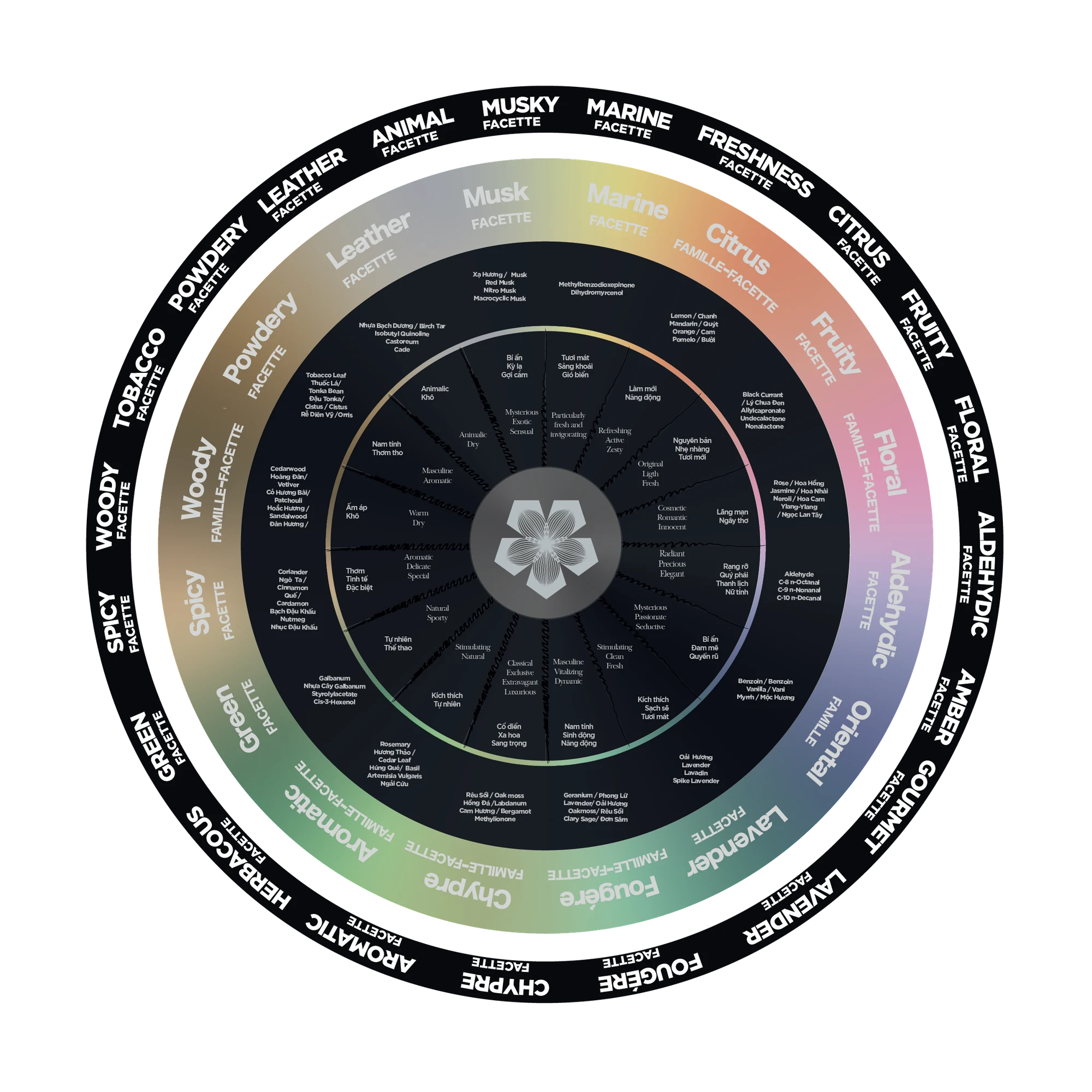
21 families · 4 concentric rings: mood → family → facet → representative oils
The wheel has four concentric layers. Read from outside in: the outermost band is the colour-coded family ring. Next comes the 21 family names. Inside that, each family is divided into smaller facettes. The innermost ring carries the mood word evoked by each family.
Adjacent families on the wheel share a sensory closeness and tend to harmonise. Families that sit opposite each other create contrast. This is the foundational principle when composing a fragrance.
Each family has a distinct character. The oils listed below are representative entries from our 400-oil library — click any chip to open the full profile.
Sea-air, briny, expansive. Mostly synthetic molecules (Calone, Helional). Natural oils are rare in this family.
Representative oils
Cool, clean, invigorating. Includes mint, eucalyptus.
Representative oils
Cold-pressed citrus peel. Bright, fast-flying, classical opening notes.
Representative oils
Soft sweet fruit flesh: peach, pear, blackcurrant, apricot. Mostly lactones, esters, absolutes.
Representative oils
Fresh petals. The main axis of perfumery: rose, jasmine, neroli, ylang-ylang.
Representative oils
Fatty aldehydes (C-8, C-9, C-10) combined with florals — the clean lift of Chanel No.5.
Representative oils
Warm resins, vanilla, balsam. A warm, long-lasting base.
Sugar, vanilla, chocolate, caramel. Edible, dessert-like.
Its own family due to its historical weight in cologne and fougère structures.
Representative oils
“Fern-like”. Classic masculine accord: lavender + oakmoss + coumarin + geranium.
Representative oils
Bergamot + oakmoss + labdanum + patchouli accord. Named after Cyprus.
Mediterranean aromatic herbs: rosemary, basil, thyme, sage.
Representative oils
Soft green herbs, not sharp: tarragon, marjoram, helichrysum.
Representative oils
Crushed leaves, cut grass, green sap. Galbanum is the classic.
Representative oils
Kitchen spices: cinnamon, clove, ginger, cardamon, pepper.
Representative oils
Heartwood, roots, bark. Sandalwood, cedarwood, vetiver, patchouli — the stable base axis of perfumery.
Dry tobacco leaf, honey, dry leather. Tonka and cistus often appear.
Talc-like, soft powder. Orris (iris root), violet leaf, heliotrope.
Representative oils
Dry leather, smoke, charred wood. Birch tar, cade, castoreum, isobutyl quinoline.
Representative oils
Civet, castoreum, ambergris — traditional animal sources. Modern perfumery uses synthetic substitutes.
Representative oils
Musks: heavy, long-wearing molecules linked to skin-scent. Mostly synthetics (nitro musks, macrocyclic, polycyclic).
Representative oils
The innermost ring pairs each family with a mood word it commonly evokes. This is the psychological angle of scent — useful when briefing a product or translating brand messaging into olfactory language.
When composing a fragrance, the wheel poses three foundational questions: 1/ Which family is the main axis? 2/ Which two adjacent families extend the richness? 3/ Is an opposing family needed to create contrast?
When substituting an oil (see the Substitution chart), pick from the same family or an adjacent one on the wheel. Within facette work, stay close to the original facette.