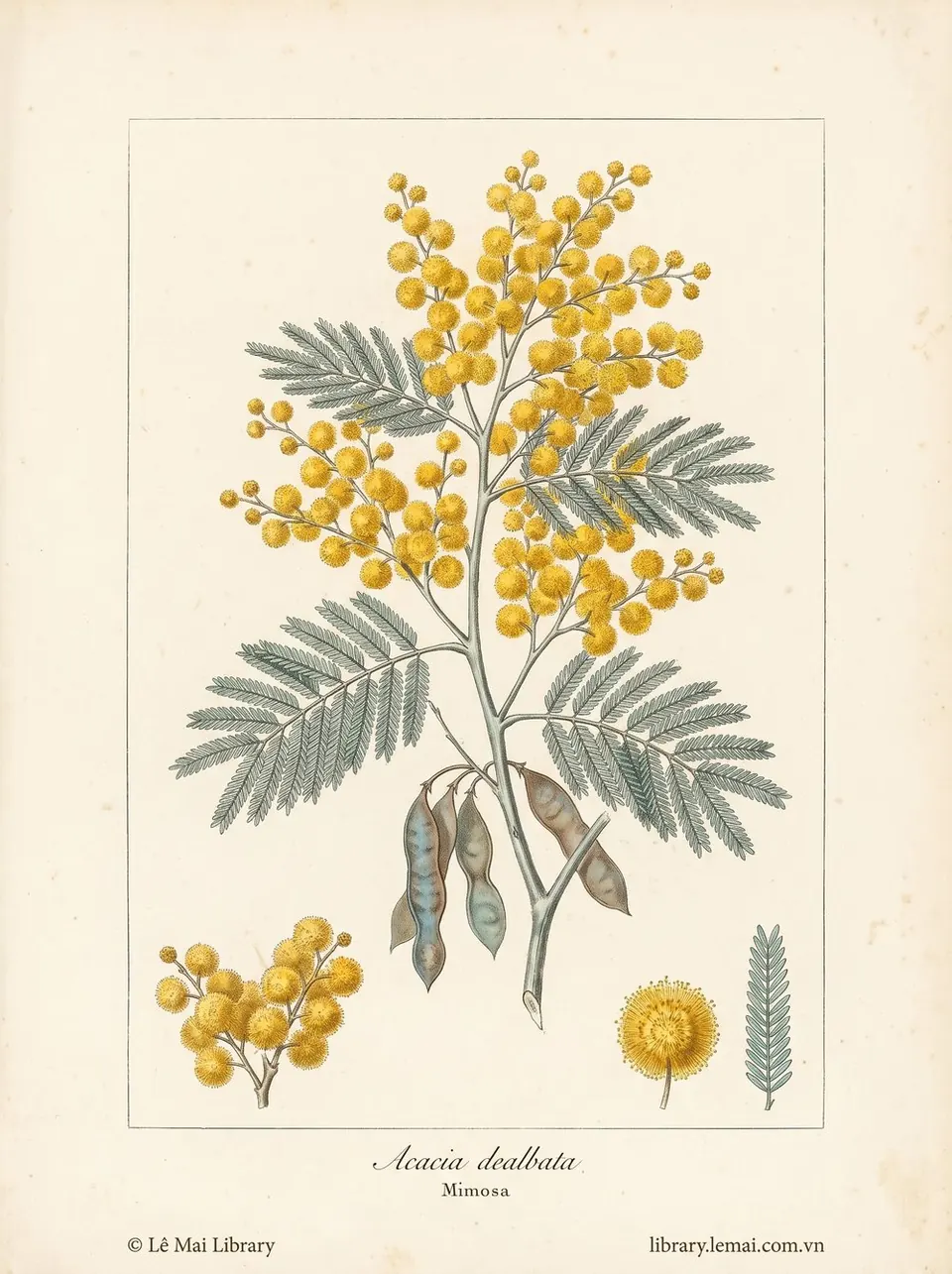
ミモザ
Hoa mimosa
Acacia dealbata
Silver wattle, Acacia decurrens
Mimosa absolute is solvent-extracted from the fresh flowers of Acacia dealbata, an Australian tree in the legume family, with most production in Provence (France), Morocco and Italy. It is a very thick, intense material that smells floral, sweet and slightly honeyed; much of it is heavy material such as palmitic acid (about 15 to 25%) and heneicosane. Its risk of skin sensitization is low, and it suits perfume and candles.
Updated 6 Nov 2026 · Lê Mai Team
Low risk of skin sensitization. Mimosa absolute is a very thick, intensely aromatic material.
No data indicates hazard in pregnancy.
Store in dark, sealed container.
| Palmitic acid | 15.0 – 25.0 % |
| Heneicosane | 10.0 – 20.0 % |
| Tricosane | 8.0 – 15.0 % |
| Octadecanol | 5.0 – 10.0 % |
| Methyl palmitate | 3.0 – 7.0 % |
Acacia dealbata is a medium-sized tree native to Australia, cultivated as an ornamental in the Mediterranean. Small bright-yellow flowers grow in clusters, blooming in late winter and early spring.
Mimosa absolute is solvent-extracted from fresh flowers. Most production is in Provence (France), Morocco, and Italy.
Family Fabaceae (Leguminosae).
| Une Fleur de Cassie | Malle · 2000 · heart |
| Mimosa Tanneron | Perris Monte Carlo · 2020 · main note |
| L'Eau Papier | main note |
| Park Avenue | Bond No. 9 · main note |
| Cassili | heart |
Based on note lists published by each house. Fragrance names and marks belong to their owners.
Mimosa aroma: sweet, floral, slightly honeyed, characteristic of classical French perfumery. Important in 'mimosa', 'cassie', and traditional floral bouquet fragrances.
Distinct from cassie (Acacia farnesiana, under letter C), both are Acacia but the absolutes have different chemistry and aroma.