ネロリ
Neroli, Hoa cam đắng
Citrus x aurantium var. amara
Orange blossom, Bitter orange blossom
Neroli is classified as GRAS by the US FDA. No specific IFRA restriction.
Very low risk of skin sensitization. Safe for sensitive skin.
Not phototoxic, unlike citrus oils expressed from peel. Neroli is distilled from flowers and contains no furocoumarins.
No data indicates hazard in pregnancy. Considered among the safest oils for pregnant women and children.
Linalool oxidation products may sensitize skin. Store in dark, sealed, refrigerated container and add antioxidant when formulating.
Suited for aromatherapy aimed at relaxation, anxiety reduction, and sleep support.
| Linalool | 31.4 – 54.3 % |
| (+)-Limonene | 6.0 – 17.9 % |
| Linalyl acetate | 0.6 – 10.0 % |
| β-Pinene | 3.5 – 13.0 % |
| (E)-β-Ocimene | 4.6 – 7.0 % |
| α-Terpineol | 1.1 – 5.8 % |
| Geranyl acetate | 0.7 – 4.1 % |
| (E)-Nerolidol | 1.3 – 4.0 % |
| Geraniol | 0.8 – 3.6 % |
| (E,E)-Farnesol | 0.7 – 3.2 % |
| β-Myrcene | 1.4 – 3.1 % |
| Sabinene | 0.4 – 2.8 % |
| Neryl acetate | 0.3 – 2.1 % |
| Nerol | 0.5 – 1.3 % |
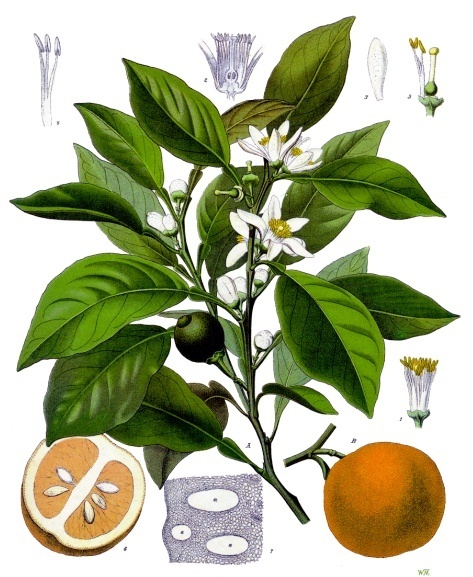
Citrus x aurantium var. amara is the bitter orange tree. The tree yields three distinct essential oils: neroli (flowers, steam-distilled), bitter orange (peel, cold-pressed, phototoxic), and petitgrain bigarade (leaves and young twigs, distilled).
The pure white orange blossoms are intensely fragrant. Each small flower must be hand-picked in the early morning while dew remains.
Oil yield is low, about 0.1 percent of fresh flower weight. About 1,000 kg of bitter orange blossoms are needed for 1 kg of neroli oil.
Main production: Morocco, Tunisia, Egypt, France, Italy, Spain. Egyptian neroli and Spanish neroli are the two traditional benchmarks.
The name 'neroli' comes from Anna Maria de la Tremoille, Princess of Nerola (1646-1700, Italy), who loved and popularized the orange-blossom scent among European nobility.
Family Rutaceae, same family as bergamot, lemon, lime, and mandarin.
Neroli oil is expensive and frequently adulterated. Reconstituted oils (synthesized from individual components) may be added or sold as neroli.
A common adulteration is distilling a mix of leaves and young twigs along with flowers, the result is closer to petitgrain than true neroli in chemistry and aroma.
Egyptian neroli has higher linalool (43-54%) than Spanish neroli (31-47%). Spanish has higher (+)-limonene (13-18% vs 6-10%).
Verify quality by chiral GC-MS analysis. The enantiomer ratio of linalool and linalyl acetate is an important indicator.
True neroli aroma: pristine floral, fresh, lightly sweet, with a green note and slight bitterness, not perfectly replicable by synthesis.
In perfumery, neroli is one of the central notes of classical Eau-de-Cologne and the traditional German '4711'. Also an important note in modern fine fragrance.
In aromatherapy, neroli has been studied for anxiolytic effects, mild antihypertensive action, and sleep support. Bitter orange blossom was traditionally used as a mild laxative and sedative in European medicine.
In cosmetics, neroli is a premium ingredient for sensitive skin care, pregnancy-safe products, and night creams.
Two byproducts of neroli distillation: orange flower water (the aqueous phase separated after distillation), used in Middle Eastern and North African cuisine; and orange flower absolute, solvent-extracted from flowers, with a deeper aroma than neroli.