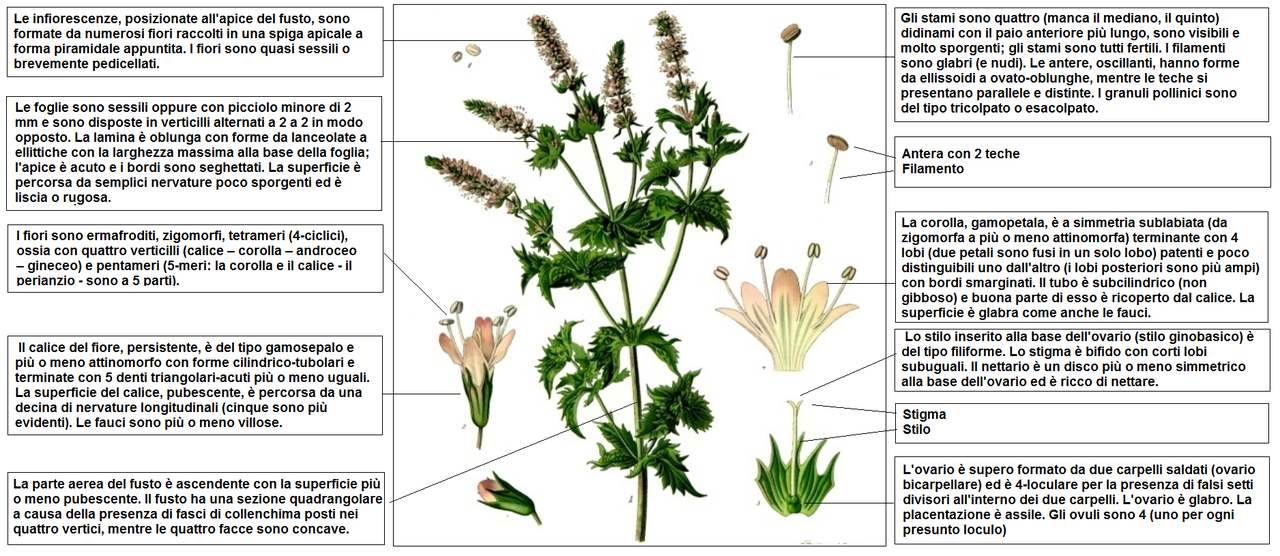
スペアミント
Bạc hà lục
Mentha spicata / Mentha cardiaca
Native spearmint, Scotch spearmint, Mentha viridis, Mentha crispa
Spearmint is classified as GRAS by the US FDA.
(-)-Carvone comprises 50-72 percent. Low skin sensitization risk.
Different from peppermint: no significant (-)-menthol, aroma sweeter and more 'chewing-gum mint' than sharply cooling.
Does not cause laryngospasm like peppermint, safer for children.
Can be used at higher concentrations than peppermint.
(+)-Limonene oxidation products may sensitize. Store properly.
No data indicates hazard in pregnancy, suitable for pregnancy and children at usual concentrations.
| (-)-Carvone (Mentha cardiaca) | 60.9 – 71.6 % |
| (-)-Carvone (Mentha spicata) | 50.0 – 65.0 % |
| (+)-Limonene | 11.4 – 21.2 % |
| (Z)-Dihydrocarvone | 1.0 – 4.9 % |
| Menthone | 0.4 – 1.7 % |
| 1,8-Cineole | 0.8 – 1.5 % |
| β-Myrcene | 0.5 – 1.5 % |
| 3-Octanol | 1.3 – 2.6 % |
Mentha spicata (native spearmint) and Mentha cardiaca (Scotch spearmint) are the two common commercial species/cultivars. Mentha cardiaca has higher carvone.
The essential oil is distilled from leaves. Oil yield is about 0.3-0.5 percent of fresh leaf weight.
Main production: USA (Midwest, Indiana, Wisconsin, Washington, largest volume), China, India. Each source gives a different carvone profile.
In cuisine, spearmint is a seasoning for lamb, salads, tabbouleh (Middle East), and mint tea (Morocco).
Family Lamiaceae (Labiatae), same family as peppermint, basil, and rosemary.
Spearmint oil may be adulterated with synthetic carvone or cornmint blends.
Verify chemotype by chiral GC-MS analysis. True (-)-carvone has a characteristic structure, synthetic is typically racemic.
Mentha cardiaca (Scotch spearmint) has the highest (-)-carvone, the gold standard for perfumery and food.
Freshly distilled has a 'green' fresh note. Six months of storage develops a rounder, fuller character.
Spearmint differs markedly from peppermint despite the shared Mentha genus. Spearmint contains no menthol (carvone has a different structure), no sharp cooling sensation.
In cosmetics, spearmint is a safer alternative to peppermint for children's formulations, pregnancy, and sensitive skin. Suited to toothpaste, chewing gum, and body care products.
In aromatherapy, spearmint is used for digestion and mental fatigue. Aroma is fresh and uplifting but not as stimulating as peppermint.
(-)-Carvone has natural insecticide activity, spearmint oil is sometimes used in mosquito-repellent products.
In Vietnam, spearmint is less common than peppermint. Potential for commercial cultivation for the essential oil industry.