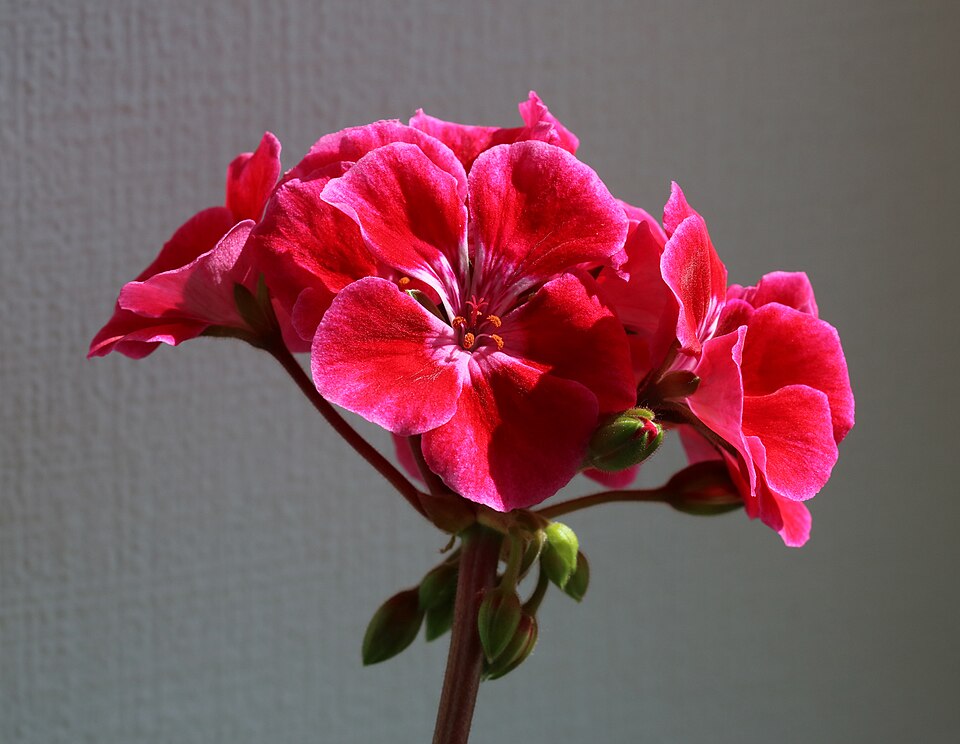
ゼラニウム
Phong lữ
Pelargonium × asperum
Rose geranium, Pelargonium graveolens, Pelargonium capitatum, Pelargonium roseum
Theoretical drug interaction. Low risk of skin sensitization.
Oral: caution with diabetes medication (geranium oil lowers blood glucose in rat studies), drugs metabolized by CYP2B6.
GRAS status. No irritation or sensitization at 10 percent test level. Non-phototoxic.
Maximum dermal use level 17.5 percent, based on 30.3 percent geraniol and a dermal limit of 5.3 percent.
Mouse local lymph node assay: geranium oil is an extremely weak sensitizer.
| Citronellol | 18.6 – 47.7 % |
| Geraniol | 7.3 – 30.3 % |
| Linalool | 0.5 – 13.8 % |
| Citronellyl formate | 4.8 – 12.4 % |
| Isomenthone | 3.4 – 9.8 % |
| Geranyl formate | 1.6 – 7.6 % |
| Guaia-6,9-diene | 0.1 – 6.8 % |
| 10-epi-γ-Eudesmol | 0 – 8.9 % |
| α-Caryophyllene | 0.4 – 6.0 % |
| Geranyl acetate | 0.2 – 4.4 % |
| Menthone | 0.1 – 2.4 % |
| (Z)-Rose oxide | 0.3 – 1.4 % |
Pelargonium × asperum is a hybrid of P. capitatum and P. radens, the species used for most commercial oil. Aromatherapy literature commonly cites P. graveolens, but P. graveolens (containing 30 to 83 percent isomenthone) is not in fact the main commercial source.
Large-scale production in China, Egypt, Morocco, Crimea, Ukraine, Georgia, India, Madagascar, South Africa.
The name 'rose geranium' originally referred to geranium oil from Réunion (Bourbon cultivar); Bourbon production is now very small and not on the open market. 'Rose geranium' is now a commercial name from various sources.