ガルバナム
Galbanum
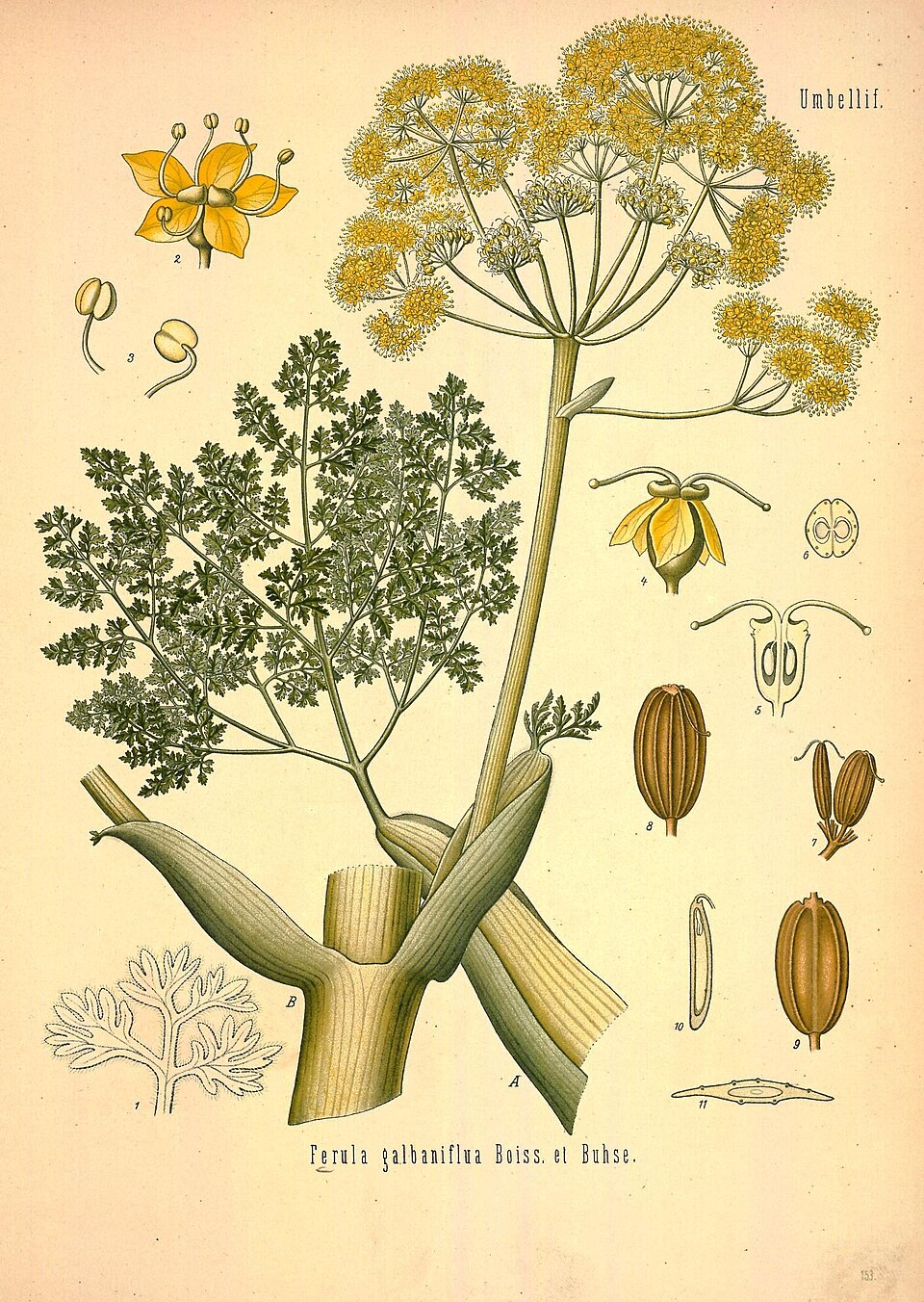
Ferula galbaniflua
Ferula gummosa, Ferula erubescens
Oxidation products of α-pinene, δ-3-carene and (+)-limonene may sensitize skin.
Store in dark, sealed, refrigerated container. Add an antioxidant.
No irritation or sensitization at 4 percent test level.
Likely not hazardous in pregnancy based on data for α-pinene, β-pinene, β-myrcene and (+)-limonene.
| β-Pinene | 45.1 – 58.8 % |
| δ-3-Carene | 2.0 – 12.1 % |
| α-Pinene | 5.7 – 12.0 % |
| Sabinene | 0 – 6.4 % |
| β-Myrcene | 0 – 4.6 % |
| (+)-Limonene | 2.7 – 4.0 % |
| γ-Elemene | 0 – 2.4 % |
| 1,3,5-Undecatriene | 1.6 – 1.8 % |
| (Z)-β-Ocimene | 0 – 1.2 % |
Ferula galbaniflua is a perennial herb of the Middle East, particularly Iran, Turkey, Afghanistan. The resin is collected by cutting the stems.
The oil is steam-distilled from the resin. Mainly produced in Iran and Turkey. May also come from Ferula rubicaulis.
Family Apiaceae. Same genus as asafoetida and ferula (F. jaeschkeana), but markedly different chemistry, galbanum is pinene-rich (simple terpenes), asafoetida is sulfur-rich.
Galbanum was used in classical Greek perfumery and the Old Testament (a component of the Jewish Temple incense). Green, sharp, characteristic aroma.
The oil does not age very rapidly, but when it does it tends to polymerize.