サンバック ジャスミン
Hoa lài Sambac, lài Ả Rập
Jasminum sambac
Arabian jasmine
Theoretical drug interaction via CYP2D6, as farnesene inhibits this enzyme.
Oral: caution with drugs metabolized by CYP2D6.
Low risk of skin sensitization. GRAS status.
Maximum dermal use level 4.0 percent per IFRA, higher than jasmine grandiflorum due to different chemistry.
Main production in India and China.
| α-Farnesene | 18.4 % |
| Indole | 14.1 % |
| Linalool | 13.9 % |
| Methyl anthranilate | 5.5 % |
| Benzyl acetate | 4.3 % |
| Methyl benzoate | 2.6 % |
| 2-Phenylethanol | 2.4 % |
| (3Z)-Hexen-1-yl benzoate | 2.3 % |
| Methyl palmitate | 2.3 % |
| Benzyl alcohol | 1.3 % |
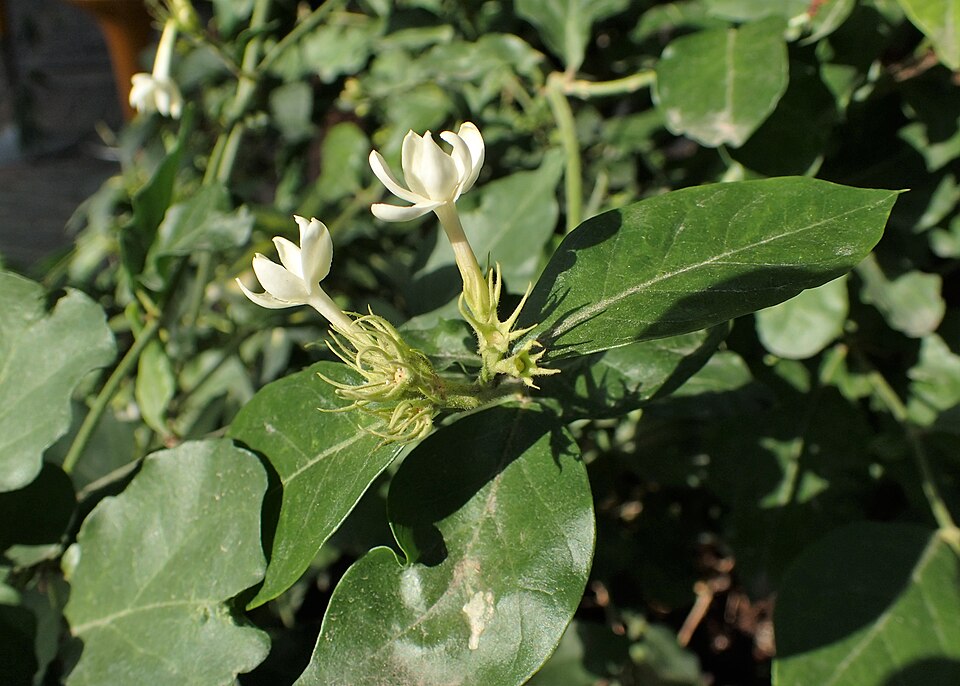
Jasminum sambac is a tropical Asian shrub with small white flowers. National flower of the Philippines (sampaguita) and one of three national flowers of Indonesia (melati).
Although in the same genus as jasmine grandiflorum, the chemistry is markedly different, sambac is farnesene and indole-rich, grandiflorum is benzyl acetate-rich.
Main products: absolute (solvent extraction) and hydrodistilled oil. Indian hydrodistilled oil is benzyl acetate, (3Z)-hexen-1-yl benzoate and linalool-rich.
Family Oleaceae.