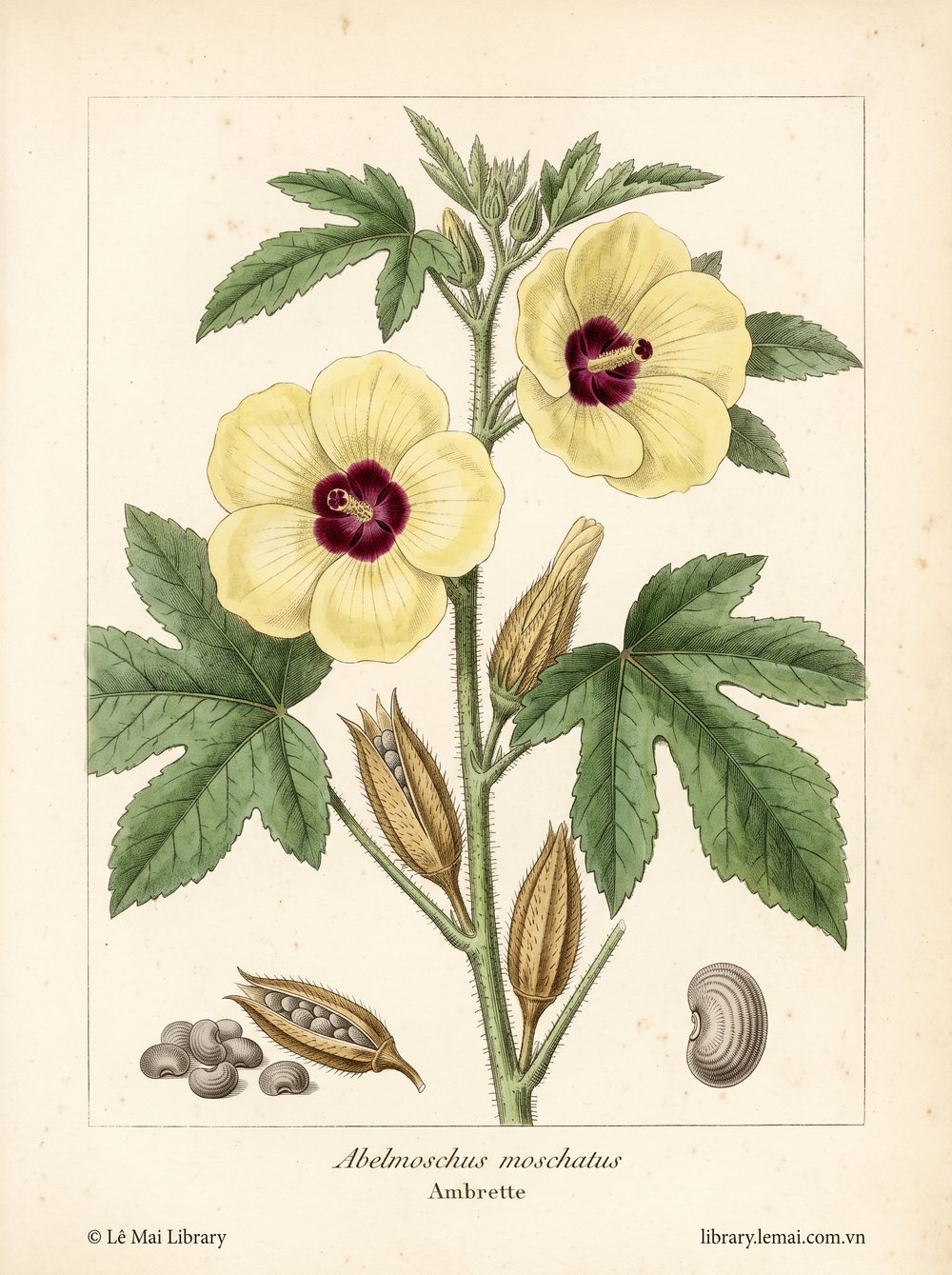
アンブレット
Hoa hồng xạ, Ambrette
Abelmoschus moschatus
Ambrette seed, Musk seed
No known hazards for ambrette seed oil.
Undiluted ambrette was non-irritating to rabbits and mice. Tested at 1% on 25 volunteers, neither irritating nor sensitizing.
Non-phototoxic.
Avoid old or oxidized oils.
| (E,E)-Farnesyl acetate | 30.0 – 65.3 % |
| (E,E)-Farnesol | 3.4 – 39.0 % |
| Ambrettolide | 7.6 – 14.7 % |
| (Z,E)-Farnesyl acetate | 2.6 – 5.8 % |
| Decyl acetate | 0 – 5.6 % |
| Dodecyl acetate | 0.2 – 4.0 % |
| (Z,E)-Farnesol | 0.3 – 3.3 % |
| (E)-Nerolidol | 0.1 – 2.0 % |
Abelmoschus moschatus belongs to the Malvaceae family, related to cotton and hibiscus.
Seeds are harvested, dried, then steam-distilled to obtain the oil.
Mainly produced in India, Madagascar, Indonesia.
Ambrette oil is prone to oxidation due to high farnesol and farnesyl acetate content.
Ambrette absolute and CO₂ extracts are also available — different scent profiles.
Scent resembles animal musk — hence the name musk seed. Ambrettolide is the molecule carrying the natural musk note.
Ambrette is a premium perfumery material, used as fixative in fragrance compositions.