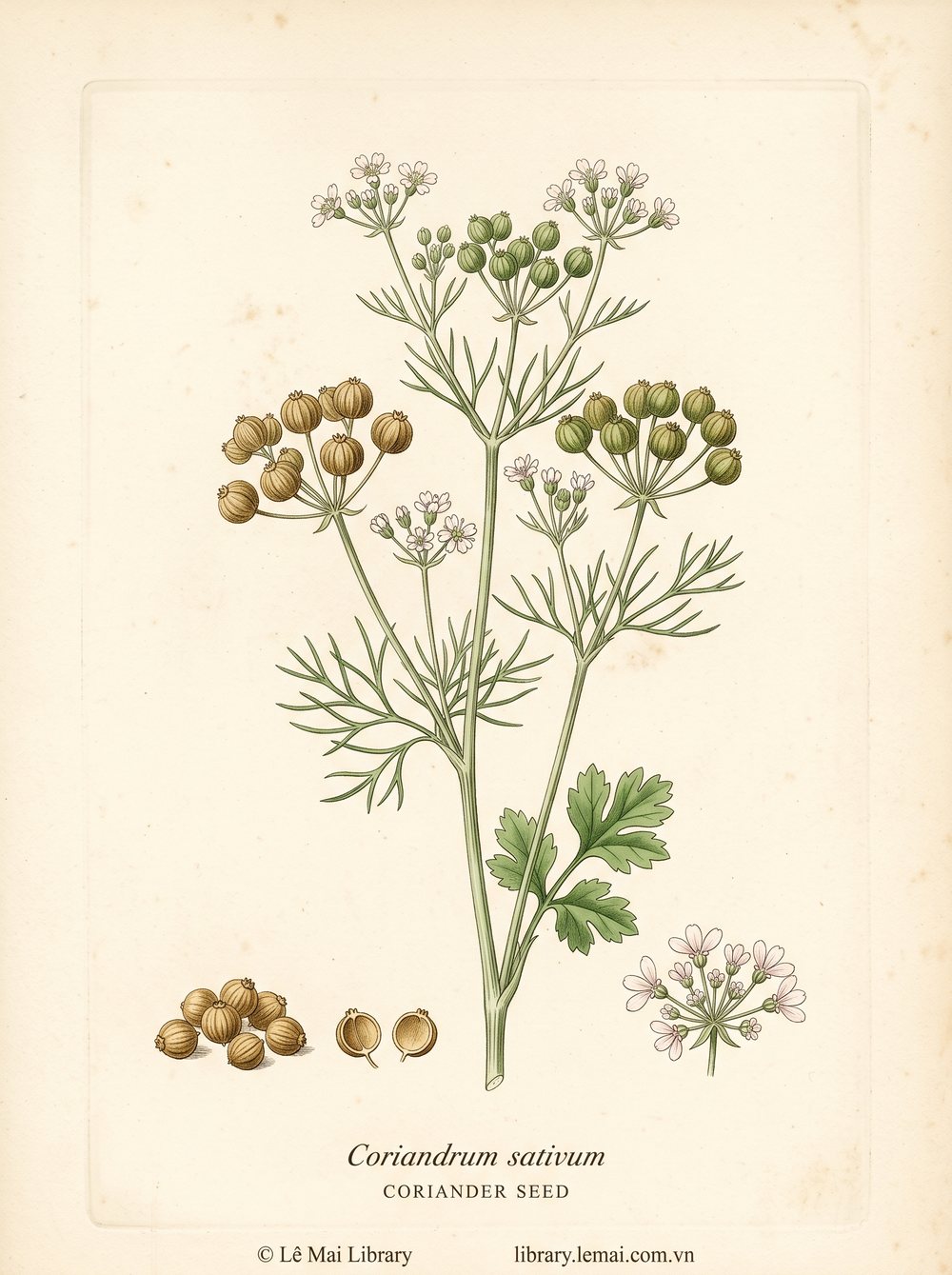
コリアンダーシード
Mùi, Ngò (hạt)
Coriandrum sativum
No specific contraindications in available data.
GRAS status. No irritation or sensitization at tested levels.
28-day reproductive study in rats: maternal NOAEL below 250 mg per kg per day, offspring NOAEL 500 mg per kg per day. No effects on offspring development.
Oxidation products of linalool may sensitize.
| Linalool | 59.0 – 87.5 % |
| α-Pinene | 0.1 – 10.5 % |
| γ-Terpinene | 0.1 – 9.1 % |
| β-Pinene | 0.1 – 8.6 % |
| p-Cymene | 0 – 8.4 % |
| Camphor | 1.6 – 7.7 % |
| Geraniol | 0.3 – 5.3 % |
| Camphene | tr – 4.6 % |
| (+)-Limonene | 0.2 – 3.2 % |
| Geranyl acetate | 0 – 3.1 % |
| Terpinen-4-ol | tr – 3.0 % |
| α-Terpineol | 0.1 – 2.2 % |
Coriandrum sativum is an annual herb. Both seeds and leaves are used but carry markedly different flavors, seeds warm, citrus-spice; leaves fresh, herbal-green.
The oil is steam-distilled from dried seeds. Produced mainly in France, India and the Netherlands. The French oil is generally preferred in perfumery.
Family Apiaceae. Same family as caraway, cumin, anise, dill.
May be adulterated with natural or synthetic linalool.