バニラ
Vani
Vanilla planifolia
Bourbon vanilla, Madagascar vanilla, Vanilla fragrans
Vanilla is classified as GRAS by the US FDA, one of the most known and used flavors.
Very low skin sensitization risk. Vanillin may mildly sensitize highly sensitive individuals.
Not phototoxic.
No data indicates hazard in pregnancy, vanilla is generally considered one of the safest essential oils/absolutes.
Suited to sensitive skin, children, elderly.
Note: vanilla absolute is dark brown, may slightly stain fabric and skin.
| Vanillin | 1.0 – 3.5 % |
| 4-Hydroxybenzaldehyde | 0.05 – 0.15 % |
| p-Hydroxybenzyl methyl ether | 0.05 – 0.10 % |
| Anisic acid | 0.03 – 0.08 % |
| Anisaldehyde | 0.01 – 0.05 % |
| Vanillic acid | 0.01 – 0.05 % |
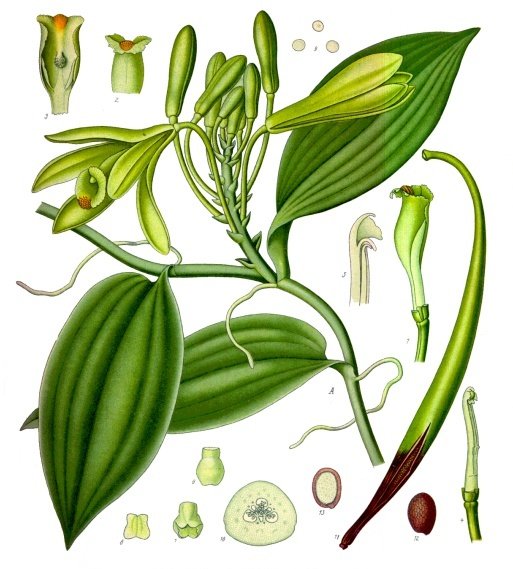
Vanilla planifolia is a climbing orchid native to Mexico. The only orchid yielding a large commercial food product.
Green pods are picked before ripening, then go through a complex 6-9 month curing process, killing, sweating, slow drying, conditioning. This develops vanillin and other aromatic compounds.
Bourbon vanilla (Madagascar, Réunion, Comoros) is the gold standard, Madagascar produces 80 percent of the world's vanilla. Tahitian vanilla (V. tahitensis) differs, high anisaldehyde, floral aroma.
Vanilla flowers must be hand-pollinated (the native Mexican bee species is absent elsewhere). One flower yields one pod. Yield is very low.
Vanilla absolute and oleoresin contain about 1-3 percent vanillin, more concentrated than culinary vanilla extract.
Vanilla prices fluctuate sharply, from 200 USD/kg (2014) to 600 USD/kg (2018) due to Madagascar supply shortage. Currently 300-500 USD/kg for high-quality pods.
Family Orchidaceae, orchids, with over 25,000 species. Vanilla is one of very few with major commercial use.
Vanilla is frequently adulterated, synthetic vanillin (produced from wood lignin or petrochemicals) is hundreds of times cheaper than natural vanilla. EU 'natural vanilla' labeling requires real origin.
Verify quality by chiral GC-MS analysis. Synthetic vanillin has a different carbon-14 ratio from natural vanilla. The vanillin/4-hydroxybenzaldehyde ratio is also a marker.
Madagascar Bourbon vanilla is the gold standard for perfumery and premium food. Tahitian is a premium alternative with distinctive floral notes.
Vanilla absolute (alcohol extraction) differs from vanilla oleoresin (ethanol from ground pods) and CO2 extract (supercritical CO2). Each form has a slightly different profile.
Vanilla is the world's most beloved flavor, vanilla ice cream, vanilla extract, perfumery base note. Over 95 percent of commercial 'vanilla flavor' is synthetic vanillin.
In perfumery, vanilla is an important oriental and gourmand base note, Shalimar (Guerlain 1925), Angel (Thierry Mugler 1992), Hypnotic Poison (Dior 1998). Vanilla is a widespread 'comfort note' in modern fragrance.
In Vietnam, vanilla is not commercially cultivated but trials exist in the Central Highlands (Dak Lak, Lam Dong). Tropical climate suitable.
In cosmetics, vanilla absolute is a premium ingredient for fine fragrance, body lotion, and pregnancy products (safest of the absolutes). A luxurious aroma loved by almost everyone.
For the Lê Mai brand, vanilla is a potential signature ingredient for warm/comfort lines. Pairs well with sandalwood, amber, tonka, frankincense, and rose.