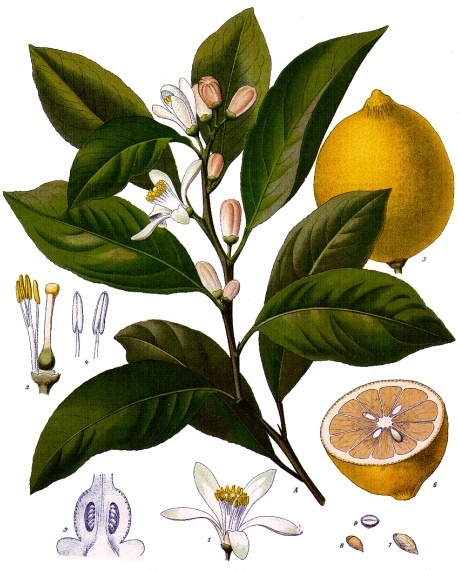
レモン圧搾
Chanh vàng, ép
Citrus x limon
Citrus limonum
Expressed lemon is low-risk phototoxic. Phototoxicity is primarily due to bergapten and oxypeucedanin. Furocoumarin content varies up to 20-fold between sources.
Clinical report: a woman sustained minor burns on one arm and leg after a sauna with a few drops of expressed lemon oil in a pot (not on her skin), followed by 20 minutes in a sunbed.
Skin reaction rate is low. In 1,409 patients suspected of fragrance allergy, only 4 (0.29 percent) reacted positively to 2 percent lemon oil. Most reactions were mild.
Oxidation products of (+)-limonene can sensitize skin. Proper storage is required.
A 65-year-old aromatherapist with multiple essential oil sensitivities reacted to 5 percent lemon oil but not 1 percent. A barman who handled fresh lemons developed hand eczema and patch-tested positive to lemon oil, lemongrass oil, and geraniol.
No data indicates hazard in pregnancy, (+)-limonene, β-pinene, α-pinene, and sabinene all have low reproductive toxicity.
| (+)-Limonene | 56.6 – 76.0 % |
| β-Pinene | 6.0 – 17.0 % |
| γ-Terpinene | 3.0 – 13.3 % |
| α-Terpineol | 0.1 – 8.0 % |
| α-Pinene | 1.3 – 4.4 % |
| Geranial | 0.5 – 4.3 % |
| Sabinene | 0.5 – 2.4 % |
| p-Cymene | tr – 2.3 % |
| β-Myrcene | tr – 2.2 % |
| Neral | 0.4 – 2.0 % |
| Terpinen-4-ol | tr – 1.9 % |
| Neryl acetate | 0.1 – 1.5 % |
| Oxypeucedanin | 0.09 – 0.82 % |
| Bergamottin | 0.16 – 0.54 % |
| 5-Geranoxy-7-methoxycoumarin | 0.18 – 0.28 % |
| Citropten | 0.05 – 0.17 % |
| Byakangelicol | 0.006 – 0.16 % |
| 8-Geranyloxypsoralen | 0.01 – 0.045 % |
| Bergapten | 0.0001 – 0.035 % |
| Isopimpinellin | 0 – 0.011 % |
Citrus x limon is a small citrus tree native to Asia, widely cultivated across the Mediterranean. Italy and Sicily are the main producers, alongside Argentina, Spain, and the United States.
The essential oil is extracted from fresh peel by cold expression. No heat is applied, preserving the furocoumarin compounds.
The tree fruits year-round in tropical regions, seasonally in temperate zones. Each ton of peel yields approximately 5-8 kg of essential oil.
Family Rutaceae, same family as bergamot, orange, grapefruit, and lime.
Lemon oil may be adulterated with natural or synthetic limonene, natural or synthetic citral, and many other cheap by-products.
Common adulterants include orange terpenes, lemon terpenes, or by-products from other citrus production.
GC-MS analysis is needed to verify quality. Sicilian Italian lemon is regarded as the gold standard.
Furocoumarin content and phototoxicity level vary widely between sources, Californian lemon has lower phototoxicity than lemon from Italy, Greece, or Côte d'Ivoire.
Lemon oil is not mutagenic in the Ames test. Does not produce chromosomal aberrations in Chinese hamster fibroblasts.
Notable anticarcinogenic activity in vitro: cytotoxic to prostate, lung, and breast cancer cells with IC50 values of 0.08, 0.06, and 0.14 percent respectively.
In mouse studies, lemon oil inhibited forestomach and lung neoplasia induced by B[a]P, and inhibited NNK-induced pulmonary adenoma formation.
Lemon oil has not been studied for long-term photo-genotoxic or photocarcinogenic effects.
Lemon oil is among the most widely used essential oils in fine fragrance, cosmetics, perfumery, and food flavoring. Global production is large.