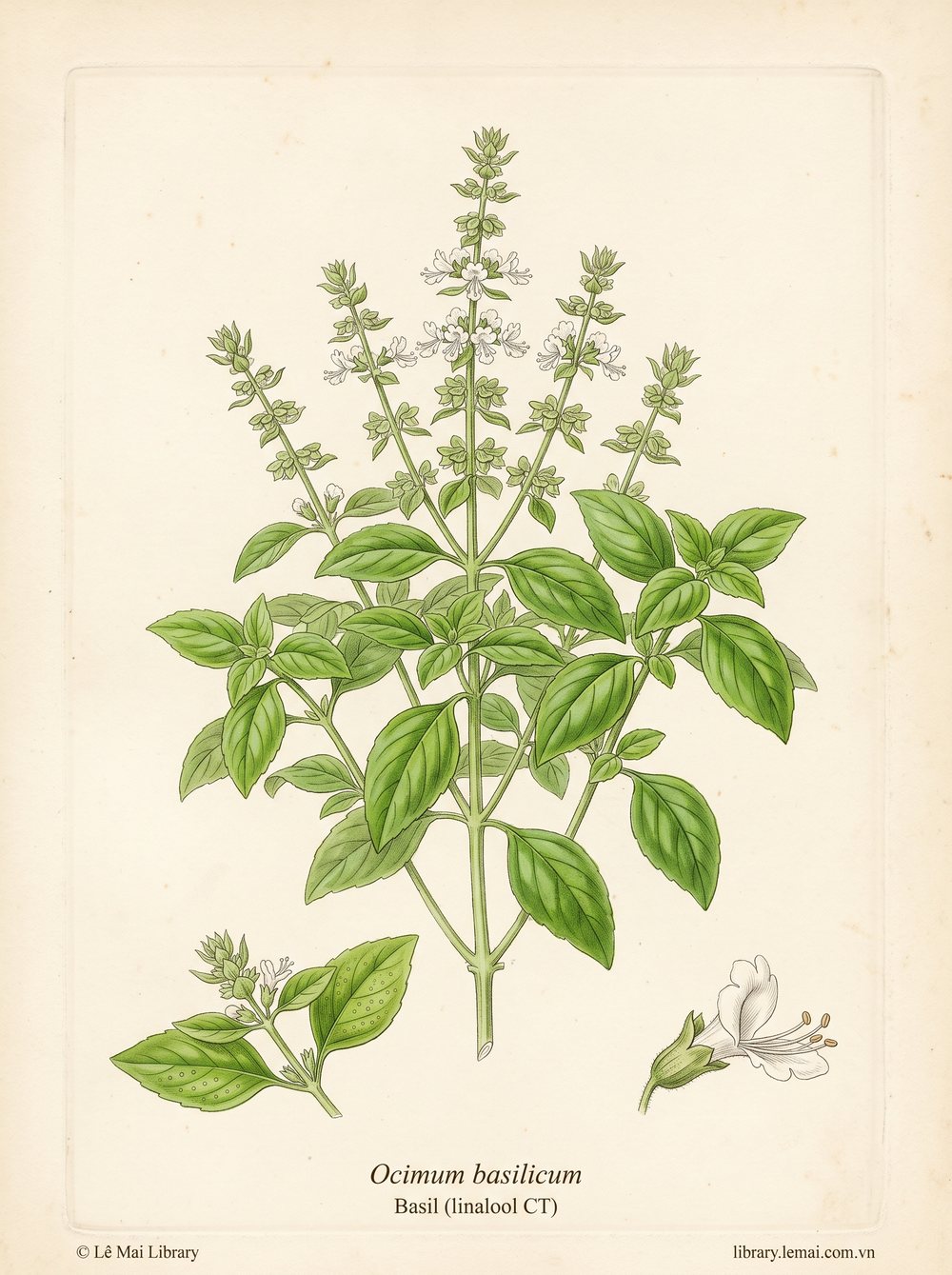
バジル リナロール CT
Húng quế
Ocimum basilicum
European basil, French basil, Sweet basil (culinary)
Low risk of skin sensitization. Oxidation products of linalool may sensitize, but eugenol and 1,8-cineole in this oil are antioxidants.
No specific contraindications.
Maximum dermal use level 3.3 percent, based on 15.2 percent eugenol and a limit of 0.5 percent for eugenol.
Although it contains estragole, this oil shows antimutagenic activity and induces glutathione. No specific limit for carcinogen risk.
| Linalool | 53.7 – 58.3 % |
| Eugenol | 9.4 – 15.2 % |
| 1,8-Cineole | 6.0 – 6.7 % |
| (E)-α-Bergamotene | 2.0 – 3.8 % |
| Germacrene D | 2.0 – 3.0 % |
| T-Cadinol | 2.6 – 3.0 % |
| Estragole | 0.2 – 2.0 % |
| α-Bulnesene | 1.3 – 1.8 % |
| β-Elemene | 0.9 – 1.5 % |
| δ-Cadinene | 0.9 – 1.4 % |
| (E)-β-Ocimene | 1.0 – 1.3 % |
| Bornyl acetate | 0.8 – 1.2 % |
| Methyleugenol | tr, 0.1 % |
The linalool chemotype of Ocimum basilicum is produced primarily in Europe, North America and parts of North Africa. This is the basil most familiar in European cuisine, named 'sweet basil' in cookbooks.
The oil is steam-distilled from the leaves. May be adulterated by addition of synthetic linalool.
Family Lamiaceae. Same species as the estragole chemotype, but with markedly different chemistry.
May be adulterated by addition of synthetic linalool. Request a GC-MS certificate of analysis from the supplier.
An absolute (solvent-extracted) form is also produced, containing 34.4 percent linalool, 33.7 percent eugenol, and 9.7 percent linoleic plus linolenic acids.