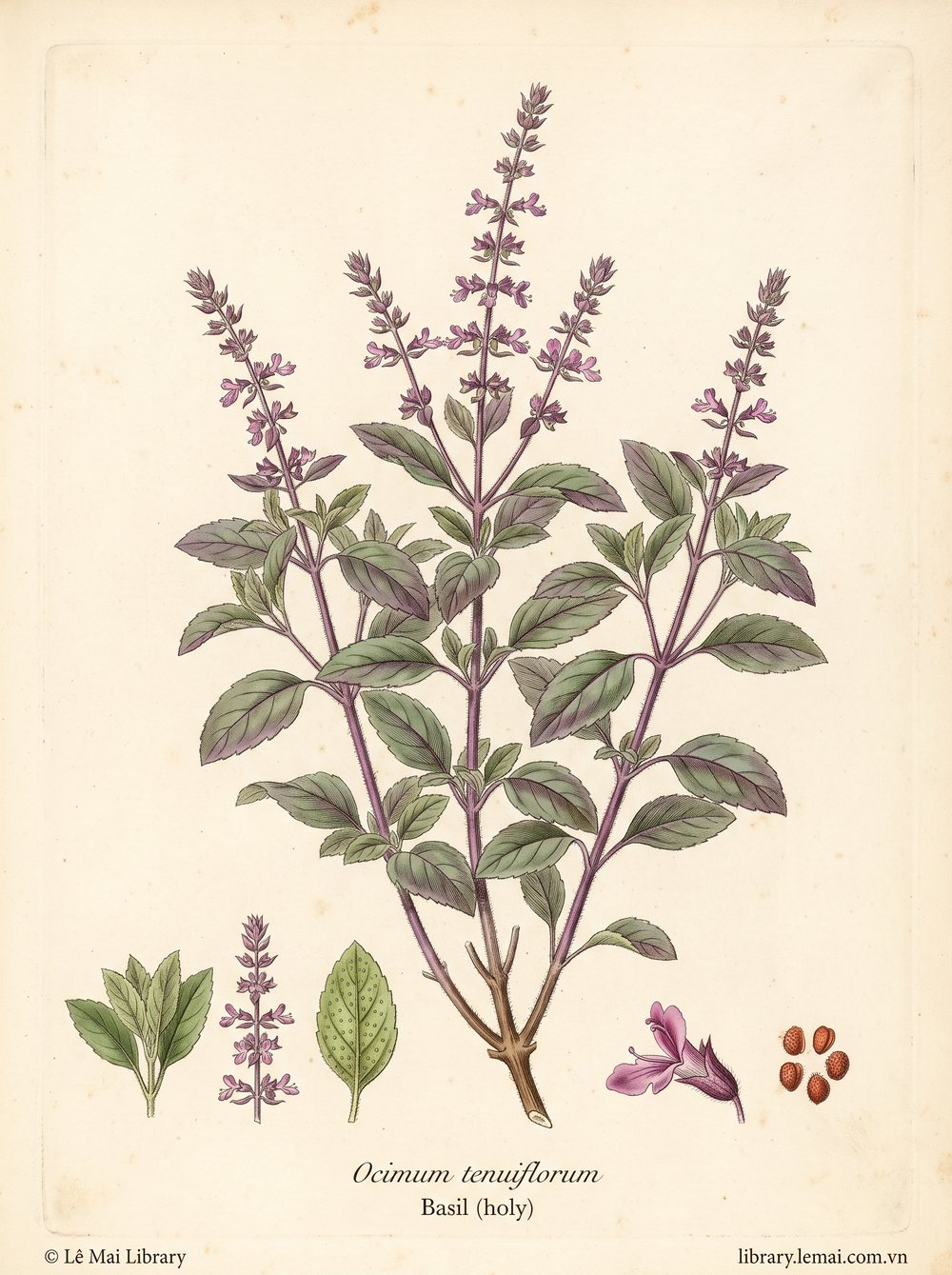
バジル ホーリー
Húng quế thiêng
Ocimum tenuiflorum
Sacred basil, Tulsi, Ocimum sanctum
May contain methyleugenol. Drug interactions and potential to inhibit blood clotting due to eugenol.
Moderate risk of skin sensitization. Low risk of mucous membrane irritation.
Oral: avoid with pethidine, MAOIs, SSRIs. Avoid with anticoagulant medication, before major surgery, peptic ulcer, hemophilia.
Although holy basil contains two potential carcinogens, estragole and methyleugenol, it also shows significant anticarcinogenic activity. Researchers suggest eugenol and other constituents counteract the carcinogenic risk.
Maximum dermal use level 1.0 percent, based on 50.4 percent eugenol content and a dermal limit of 0.5 percent for eugenol.
| Eugenol | 31.9 – 50.4 % |
| 1,8-Cineole | 12.6 – 16.5 % |
| Estragole | 9.7 – 12.9 % |
| β-Bisabolene | 9.7 – 10.5 % |
| (Z)-α-Bisabolene | 6.5 – 6.8 % |
| (E)-β-Ocimene | 3.4 – 6.2 % |
| Chavicol | 0.7 – 2.0 % |
| β-Caryophyllene | 1.3 – 1.5 % |
| Camphene | 0.9 – 1.5 % |
| α-Caryophyllene | 0.4 – 1.5 % |
| Methyleugenol | 0.2 – 0.3 % |
Ocimum tenuiflorum, called tulsi in Hindi, is a sacred plant in Hinduism. Distribution across India and Southeast Asia.
The current commercial oil is the eugenol chemotype. A methyleugenol chemotype exists but is flagged by researchers for clearer carcinogenic risk.
The botanical synonym Ocimum sanctum remains common in older literature and on product labels. Family Lamiaceae.
A methyleugenol chemotype with over 70 percent methyleugenol is under commercial development (Kothari et al 2005). The certificate of analysis must be read carefully.
Research recorded that holy basil increased glutathione S-transferase activity in the stomach, liver and esophagus of mice by more than 78 percent, and significantly inhibited B[a]P-induced squamous cell stomach carcinoma.