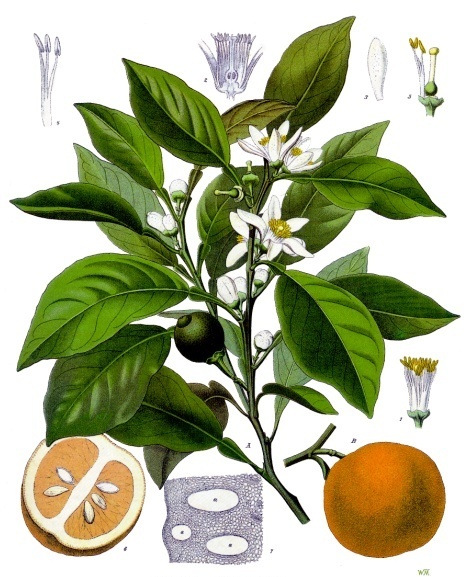
ビターオレンジ
Cam đắng
Citrus x aurantium var. amara
Seville orange, Sour orange
Low-level phototoxic due to bergapten and furocoumarins. Lower content than bergamot or expressed lime.
(+)-Limonene oxidation products may sensitize skin. Store properly.
Same tree yields three distinct products: bitter orange (peel, phototoxic), neroli (flowers, not phototoxic), and petitgrain bigarade (leaves and young twigs, not phototoxic).
No data indicates specific hazard in pregnancy when used within dermal limits.
| (+)-Limonene | 85.0 – 95.0 % |
| β-Myrcene | 1.5 – 3.0 % |
| α-Pinene | 0.5 – 1.5 % |
| Sabinene | 0.3 – 1.0 % |
| Bergapten | 0.01 – 0.07 % |
| Aurapten | 0.02 – 0.08 % |
Citrus x aurantium var. amara is the bitter orange tree, originating from Southeast Asia, widely cultivated in the Mediterranean. Small fruit, bitter taste, inedible fresh.
The essential oil is expressed from fresh peel. Main production: Italy, Spain, North Africa.
Bitter orange peel is famous in liqueurs: Cointreau, Grand Marnier, and Curaçao all use it as a main ingredient.
Family Rutaceae.
Traditional English Seville orange marmalade uses bitter orange as the standard ingredient.
Bitter orange has a more pronounced citrus character than sweet orange, with a bitter and lightly spicy note.