タラゴン
Ngải giấm
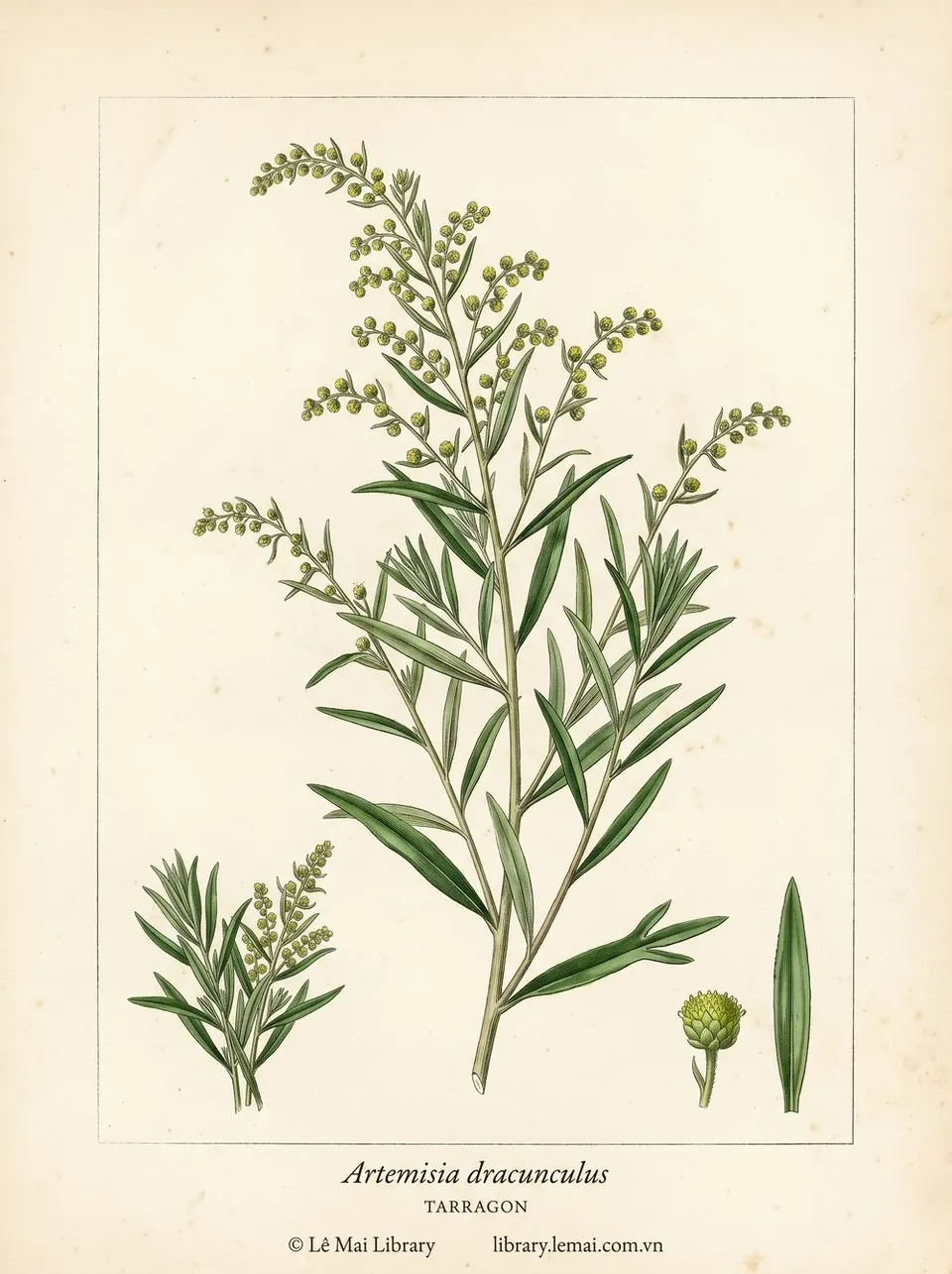
Artemisia dracunculus
French tarragon
Tarragon essential oil is steam-distilled from the aerial parts of Artemisia dracunculus, a daisy-family culinary herb central to French cooking, produced mainly in Provence, Hungary, Iran and the US. It smells sweet, herbal and anise-like; its main component is estragole, up to 80% in French tarragon. Use only at low concentration, and avoid it during pregnancy and breastfeeding.
Updated 4 Nov 2026 · Lê Mai Team
Estragole up to 80 percent in French tarragon. Estragole is a suspected carcinogen.
Low dermal concentration recommended.
Contraindicated in pregnancy and breastfeeding.
Russian tarragon (different cultivar) has lower estragole but higher sabinene and methyl eugenol, also not recommended commercially.
| Estragole | 60.5 – 80.0 % |
| (Z)-β-Ocimene | 5.0 – 15.0 % |
| (E)-β-Ocimene | 3.0 – 12.0 % |
| Methyleugenol | 0.1 – 1.0 % |
Artemisia dracunculus is a European culinary herb, distinctive in French cuisine. French tarragon is the cultivar used for oil, Russian tarragon has inferior aroma.
Main production: France (Provence), Hungary, Iran, USA.
Family Asteraceae.
| Yerbamate | Lorenzo Villoresi · 2001 · top |
| Mandarino di Amalfi | Tom Ford · 2014 · top |
| Esencia | top |
| Eau Fugace | main note |
| Buveur de Vent | top |
Based on note lists published by each house. Fragrance names and marks belong to their owners.
In French cuisine, tarragon is a foundational herb, bearnaise sauce, tarragon vinegar, fines herbes.
In cosmetics, tarragon oil is not recommended due to estragole.