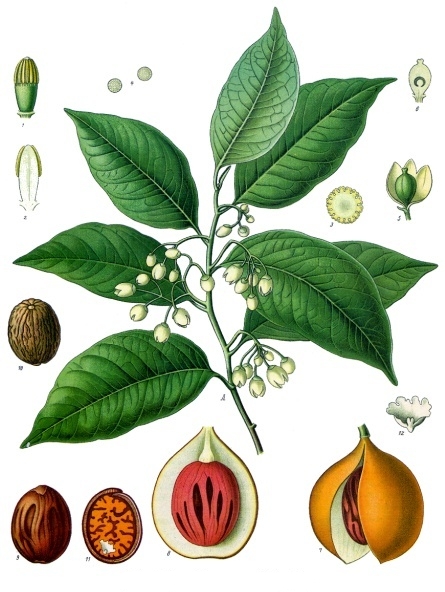
イーストインディアンナツメグ
Nhục đậu khấu Đông Ấn
Myristica fragrans
Indonesian nutmeg, Banda nutmeg
Myristicin and safrole are the main toxicity-related constituents. High doses can produce psychoactive effects, nausea, and hallucinations.
Methyl eugenol may be present (0.1-1.2%), a suspected carcinogen.
In a mouse study, high-dose East Indian nutmeg oil reduced fertility from 95 percent (control) to 32 percent (highest dose). Chromosomal damage was seen in some male offspring.
Low dermal concentration recommended.
Not recommended in pregnancy and breastfeeding.
Avoid large oral doses, clinical cases of nutmeg poisoning from recreational use are documented.
| Sabinene | 15.0 – 36.0 % |
| α-Pinene | 10.0 – 22.0 % |
| β-Pinene | 7.0 – 18.0 % |
| Myristicin | 5.0 – 12.0 % |
| (+)-Limonene | 2.7 – 4.1 % |
| α-Terpineol | 0.1 – 1.4 % |
| Terpinen-4-ol | 0.5 – 3.0 % |
| Safrole | 0.3 – 3.3 % |
| Elemicin | 0.5 – 4.0 % |
| Methyleugenol | 0.1 – 1.2 % |
Myristica fragrans is a tropical tree native to the Banda Islands, Indonesia. East Indian nutmeg refers to oil from Indonesia, Sri Lanka, or other Southeast Asian regions.
The seed is the inner part of the fruit, surrounded by the red aril which is mace.
The essential oil is distilled from dried seeds. Main production: Indonesia.
Family Myristicaceae.
East Indian has higher safrole and methyl eugenol than West Indian, a more hazardous toxicology profile.
Strong antioxidant activity (DPPH IC50 of 0.13 μL/mL).
Nutmeg oil contains both carcinogens (methyl eugenol, safrole) and anticarcinogens ((+)-limonene, myristicin). Not mutagenic in the Ames test.