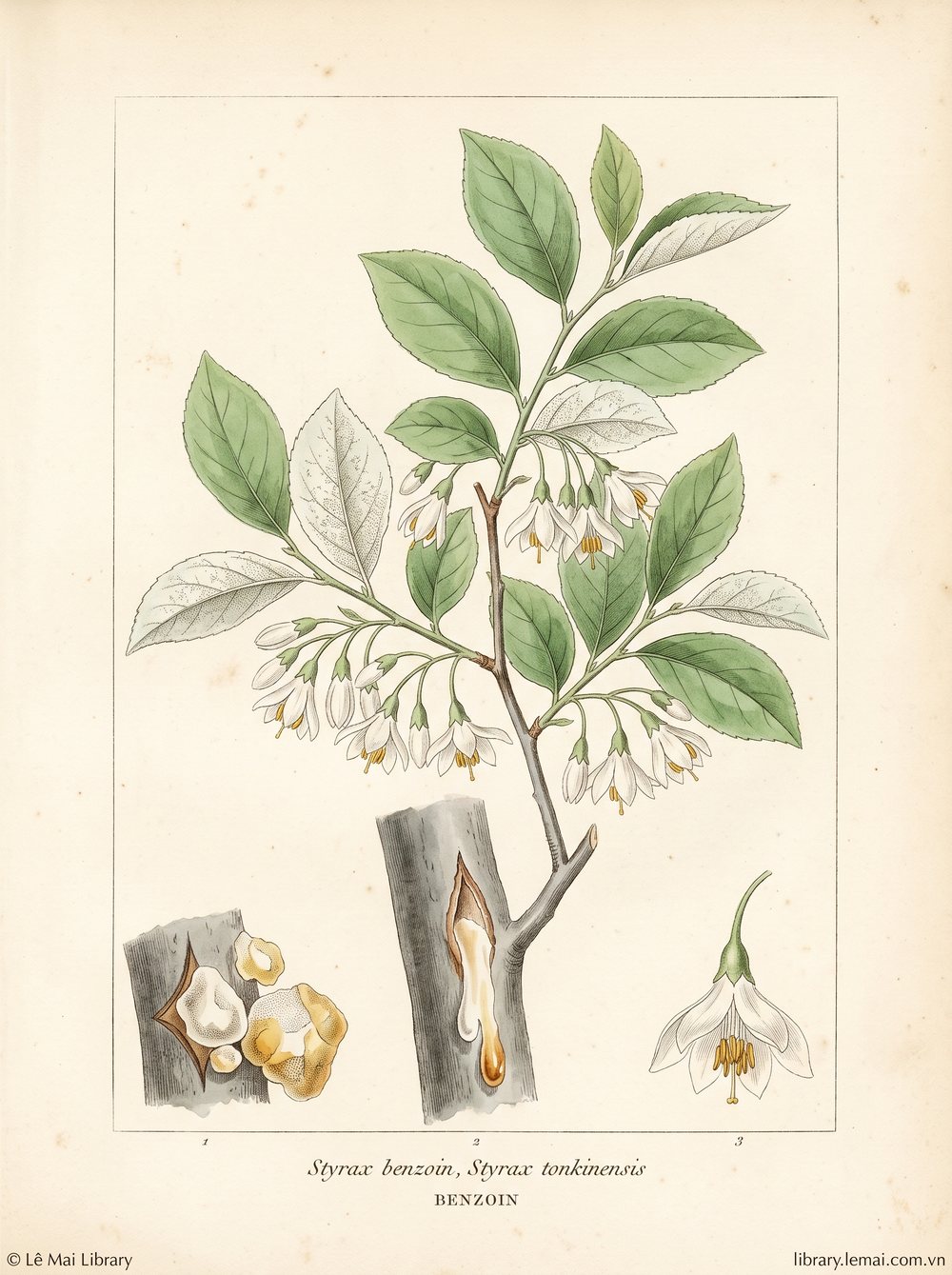
ベンゾイン
An tức hương
Styrax benzoin, Styrax tonkinensis
Gum Benjamin, Sumatra benzoin, Siam benzoin
Low risk of skin sensitization.
Dermal caution on hypersensitive, diseased or damaged skin, and on children under 2 years.
Maximum adult oral dose 368 mg daily, based on a limit of 5 mg per kg for 'benzoic acid equivalents' which constitute up to 95 percent of benzoin.
Maximum dermal use level 2 percent.
Coniferyl benzoate, a non-volatile constituent (up to 75 percent of the raw gum), may contribute to sensitization in some preparations.
Cross-reactions occur between Siam benzoin and balsam of Peru; patients sensitive to one often react to the other.
| Benzyl benzoate | 39.3 – 50.7 % |
| Benzyl alcohol | 38.8 – 43.4 % |
| Benzoic acid | 0.1 – 18.4 % |
| (Z)-Cinnamyl (E)-cinnamate | 1.5 % (Sumatra) |
| Cinnamic acid | 1.4 % (Sumatra) |
| Ethyl cinnamate | 0.8 – 1.0 % |
Benzoin is the dried resin of Styrax trees. Two commercial streams exist: Sumatra benzoin (Styrax benzoin, Styrax paralleloneurus) and Siam benzoin (Styrax tonkinensis).
Siam benzoin comes largely from the Luang Prabang region of Laos, with cultivation also in Cambodia and China.
No benzoin essential oil exists in the distilled sense. The commercial material is a resinoid or absolute, neither soluble in fixed oil.
Benzoin resinoid is a sticky solid. To be usable it is diluted to 50 percent in benzyl alcohol, benzyl benzoate, dipropylene glycol, or another solvent. Diethyl phthalate is less commonly used as a diluent today due to toxicity concerns.
Benzoic acid, benzyl cinnamate, ethyl cinnamate, and vanillin may be added as odorous adulterants.
Because of the shared Styrax botanical name, benzoin is sometimes confused with styrax (Liquidambar species).