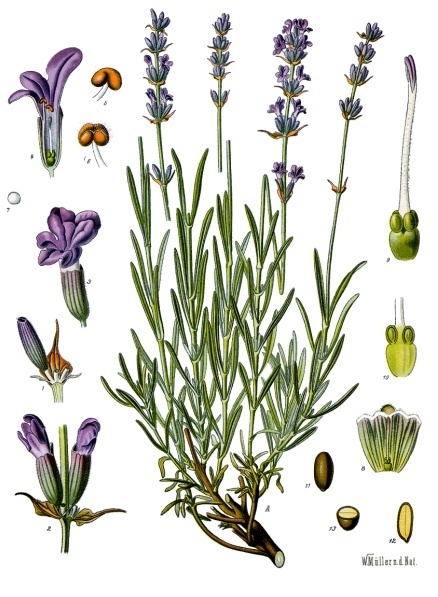
ラベンダー
Hoa oải hương
Lavandula angustifolia
Common lavender, English lavender, True lavender, Lavandula officinalis, Lavandula vera
Lavender essential oil is classified as GRAS by the US FDA. No specific dermal limit from IFRA.
Skin reaction rate is very low despite widespread use in aromatherapy. Sporadic contact dermatitis reports.
One confirmed clinical case of photoallergy with lavender oil tested at 2 percent. However, lavender oil is not phototoxic.
Linalool oxidation products can sensitize skin. Store in dark, sealed, refrigerated containers and add antioxidant when formulating.
No data indicates that lavender oil is hazardous in pregnancy.
Lavender absolute (solvent-extracted) has higher sensitization risk than the essential oil. Recommended dermal maximum 0.1 percent.
| Linalyl acetate | 25.0 – 45.0 % |
| Linalool | 20.0 – 38.0 % |
| (Z)-β-Ocimene | 3.0 – 9.0 % |
| Terpinen-4-ol | 1.5 – 6.0 % |
| β-Caryophyllene | 2.0 – 6.0 % |
| Lavandulyl acetate | 1.0 – 3.5 % |
| 3-Octanone | 2.0 – 5.0 % |
| (E)-β-Ocimene | 1.3 – 5.0 % |
| (E)-β-Farnesene | 1.0 – 3.0 % |
| 1,8-Cineole | 0.5 – 2.5 % |
| Camphor | 0.2 – 1.0 % |
| α-Terpineol | 0.5 – 2.0 % |
Lavandula angustifolia is true lavender, native to the Mediterranean, particularly Provence, France. A small shrub with violet-blue flowers and a soft aromatic character.
The essential oil is distilled from flowers and upper stems harvested in summer. Harvest timing and distillation method determine quality.
True lavender must grow at altitudes above 600m for optimal chemistry, high linalool, low camphor. Low-altitude lavender has higher camphor and a sharper aroma.
Main production: France (Provence), Bulgaria, England, Australia, Ukraine, Tasmania. Each region produces a subtly different aromatic profile.
Family Lamiaceae (Labiatae). Same family as basil, rosemary, and mint.
Lavender oil is commonly adulterated with lavandin oil, spike lavender, Spanish sage, white camphor fractions, rectified or acetylated ho oil, acetylated lavandin, and synthetic linalool and linalyl acetate.
Quality standard: linalool should comprise at least 85 percent of the (R)-(–)- enantiomer, and linalyl acetate should comprise at least 98 percent of the (R)-(–)- enantiomer.
One of the most common adulterations is blending lavandin Super into true lavender. Distinguished by GC-MS, paying particular attention to camphor and (Z)-β-ocimene.
Lavender from Provence carries AOC (Appellation d'Origine Contrôlée) certification ensuring origin and method.
ISO standards differ for each source, France, Bulgaria, Russian Federation. Australian lavender has its own profile, distinct from European lavender.
Lavender oil is the most studied of all essential oils. Over 200 clinical and in vitro studies on anxiolytic, sleep-supportive, and antimicrobial properties.
In vitro anticarcinogenic activity: lavender oil cytotoxic to prostate, lung, and breast cancer cells with IC50 values of 0.05, 0.13, and 0.14 percent respectively.
Contains no known carcinogens. Not mutagenic in standard Ames tests.
All cultivars of Lavandula angustifolia are selections of subsp. angustifolia.
Lavender oil also plays a major role in cosmetics, massage oils, bath products, creams, scented candles, perfume.
Two main forms: essential oil (distilled) and absolute (solvent-extracted). The absolute has a deeper aroma, closer to fresh flowers, but a higher sensitization risk.