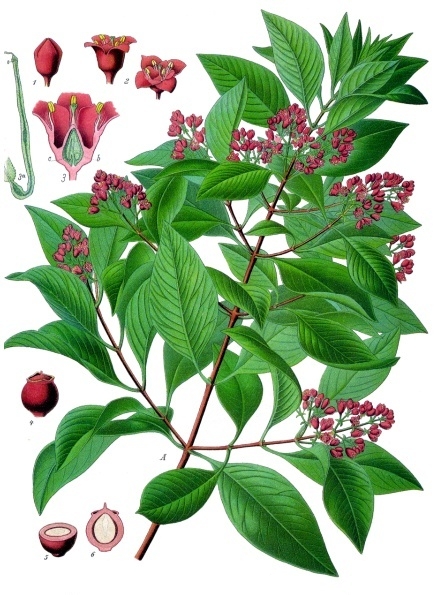
イーストインディアンサンダルウッド
Đàn hương Đông Ấn (Mysore)
Santalum album
White sandalwood, Yellow sandalwood, Chandan
Among the most classical and premium oils in perfumery. CITES Appendix II, requires certified sustainable source.
Low but rare skin sensitization risk. In 3,542 dermatitis patients, 12 reacted (0.34 percent) to 2 percent sandalwood oil.
Photoallergy risk, particularly in Japanese populations. Recommended maximum 2 percent dermal.
In 25 volunteers tested at 10 percent: not sensitizing.
No data indicates hazard in pregnancy.
Production dropped dramatically due to overharvesting in the 20th century, wild Indian sandalwood nearly depleted. Current supply primarily from managed cultivation.
| (Z)-α-Santalol | 46.2 – 59.9 % |
| (Z)-β-Santalol | 20.5 – 29.0 % |
| (Z)-Nuciferol | 1.1 – 5.5 % |
| epi-β-Santalol | 4.1 – 4.3 % |
| (Z)-α-trans-Bergamotol | < 3.9 % |
| α-Santalal | 0.5 – 2.9 % |
| β-Santalal | 0.6 – 1.9 % |
| (Z)-Lanceol | 1.5 – 1.7 % |
| (E)-β-Santalol | 1.5 – 1.6 % |
| β-Santalene | 0.6 – 1.4 % |
| α-Santalene | 0.8 – 1.1 % |
Santalum album is a small hemi-parasitic tree native to India and East Timor. The tree needs 30+ years for the heartwood to develop sufficient oil content. Trees over 60-80 years yield the highest-quality wood.
The essential oil is distilled from heartwood and roots. The outer sapwood does not yield quality oil.
Traditional production in Mysore, Karnataka, southern India, 'Mysore sandalwood' was once the gold standard. However, overharvesting from colonial times through the late 20th century nearly depleted the wild source.
Current supply mainly from East Timor, Sri Lanka, Indonesia, and particularly Australia (Western Australian plantation). The Indian government strictly manages domestic sources.
Family Santalaceae, a hemi-parasitic tree, with roots drawing nutrients from a host plant via haustoria. Requires a suitable host to develop.
East Indian sandalwood oil is severely adulterated. Common adulterants: synthetic sandalwood terpenes, Australian sandalwood, East African sandalwood, Indian bastard sandal (Erythroxylum monohynum), amyris oil, bleached copaiba balsam.
Non-aromatic adulterants: polyethylene glycol, castor oil, coconut oil, DEHP, purely for dilution and volume.
Verify quality by chiral GC-MS analysis. The ratio of (Z)-α-santalol and (Z)-β-santalol is the primary indicator. True East Indian has α-santalol 46-60% and β-santalol 20-29%.
True East Indian aroma: deep warm wood, characteristic creamy-milky note, lasting on skin for days. Different from Australian (Santalum spicatum), Australian is lighter, without the creamy depth.
Aged sandalwood (oil stored 3-5 years) is preferred over new, softer and more harmonious aroma.
East Indian sandalwood is among the most classical essential oils in world perfumery, used for over 4,000 years in Hindu, Buddhist, and Ayurvedic cultures.
In Indian culture, sandalwood (chandan) is a sacred ingredient for religious rituals, used as incense, anointing oil, and forehead-marking paste (tilaka). Considered a 'tree of the gods'.
In modern perfumery, sandalwood is an irreplaceable base note and fixative. Fragrance houses like Chanel, Dior, Guerlain, and Tom Ford all have at least one signature fragrance using sandalwood.
In cosmetics, sandalwood oil is a premium ingredient for fine fragrance, anti-ageing creams, and premium serums. Photoallergy occurs only rarely, still considered one of the safest woody oils.
For the Lê Mai brand, quiet luxury VN+JP sensibility, sandalwood (particularly sustainable Australian plantation) is a potential signature ingredient.
Sustainability note: avoid uncertified wild Indian sandalwood. Prefer Australian (Santalum spicatum) plantation or CITES-certified Santalum album from East Timor.