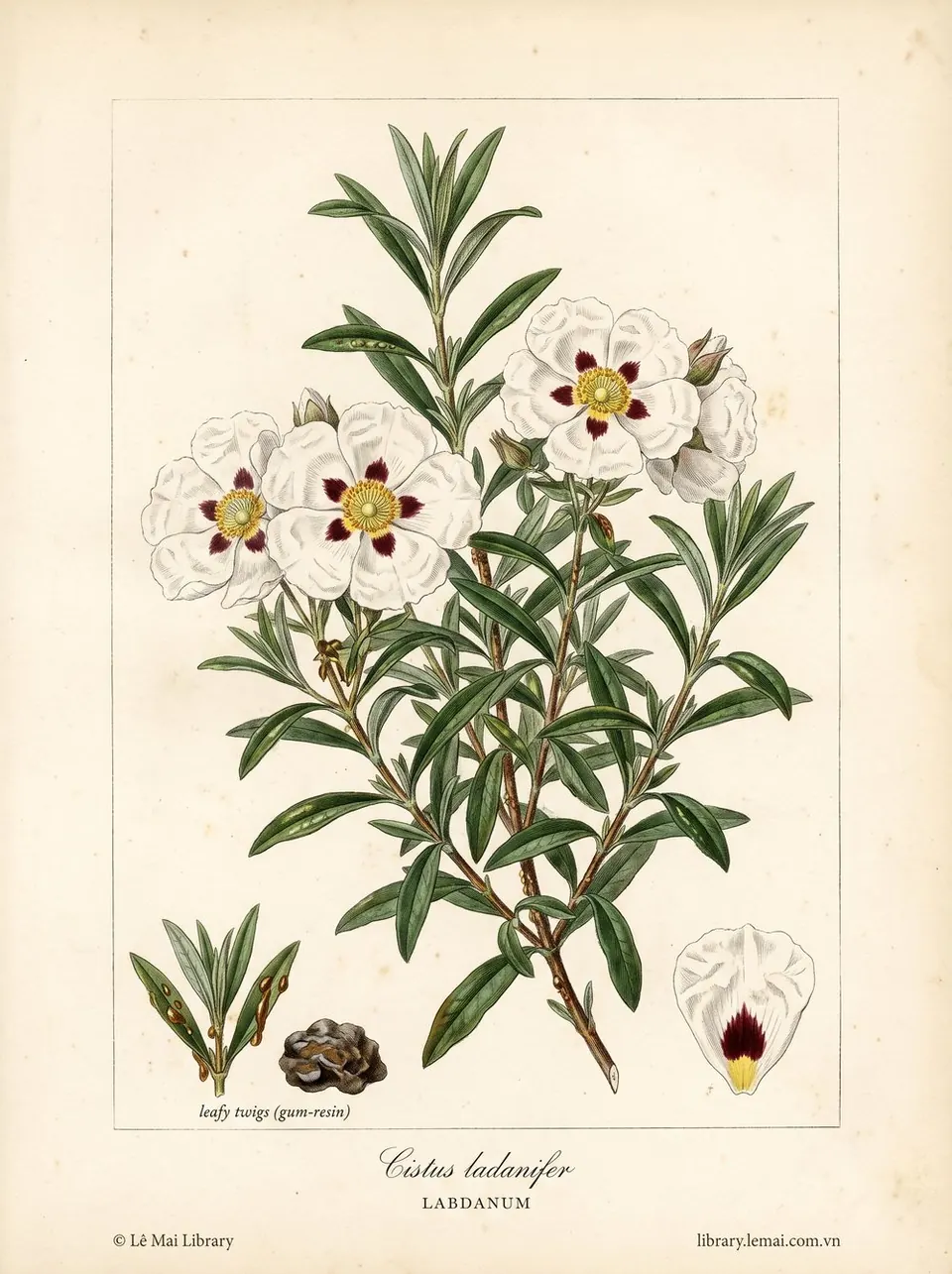
ラブダナム
Labdanum, Nhựa cistus
Cistus ladanifer
Cistus ladaniferus, Rockrose resin
Labdanum absolute is solvent-extracted from the twigs and leaves of Cistus ladanifer, a Mediterranean shrub in the rockrose family with leaves that secrete an aromatic resin; Spanish production leads the market. It smells warm, balsamic, amber-like and lightly leathery; in its volatile part, α-pinene makes up about 32.4 to 41%. Skin sensitization risk is low and no specific maximum is set, and it serves as a base note in classic perfumery.
Updated 4 Nov 2026 · Lê Mai Team
Low risk of skin sensitization. No specific maximum concentration recommended.
No data suggests hazard in pregnancy.
Contains no known carcinogens.
| α-Pinene | 32.4 – 41.0 % |
| Camphene | 3.8 – 4.2 % |
| Bornyl acetate | 2.6 – 3.4 % |
| trans-Pinocarveol | 2.8 – 3.1 % |
| Viridiflorol | 1.8 – 2.5 % |
| Ledol | 1.6 – 2.0 % |
Cistus ladanifer is a Mediterranean shrub. The leaves secrete an aromatic resin called labdanum.
Resin is collected by brushing dried leaves or boiling fresh leaves in water. Solvent extraction then yields concrete and absolute.
Family Cistaceae. Spain is the principal source.
| Youth-Dew | Lauder · 1953 · base |
| Opium | Yves Saint Laurent · 1977 · base |
| Antaeus | Chanel · 1981 · base |
| Poison | Dior · 1985 · heart |
| Ambre Sultan | Serge Lutens · 2000 · main note |
Based on note lists published by each house. Fragrance names and marks belong to their owners.
Labdanum has a warm, balsamic, amber character. Used as a base note in classical perfumery.
Distinct from Cistus essential oil (steam-distilled from the same plant). See Cistus entry under letter C.