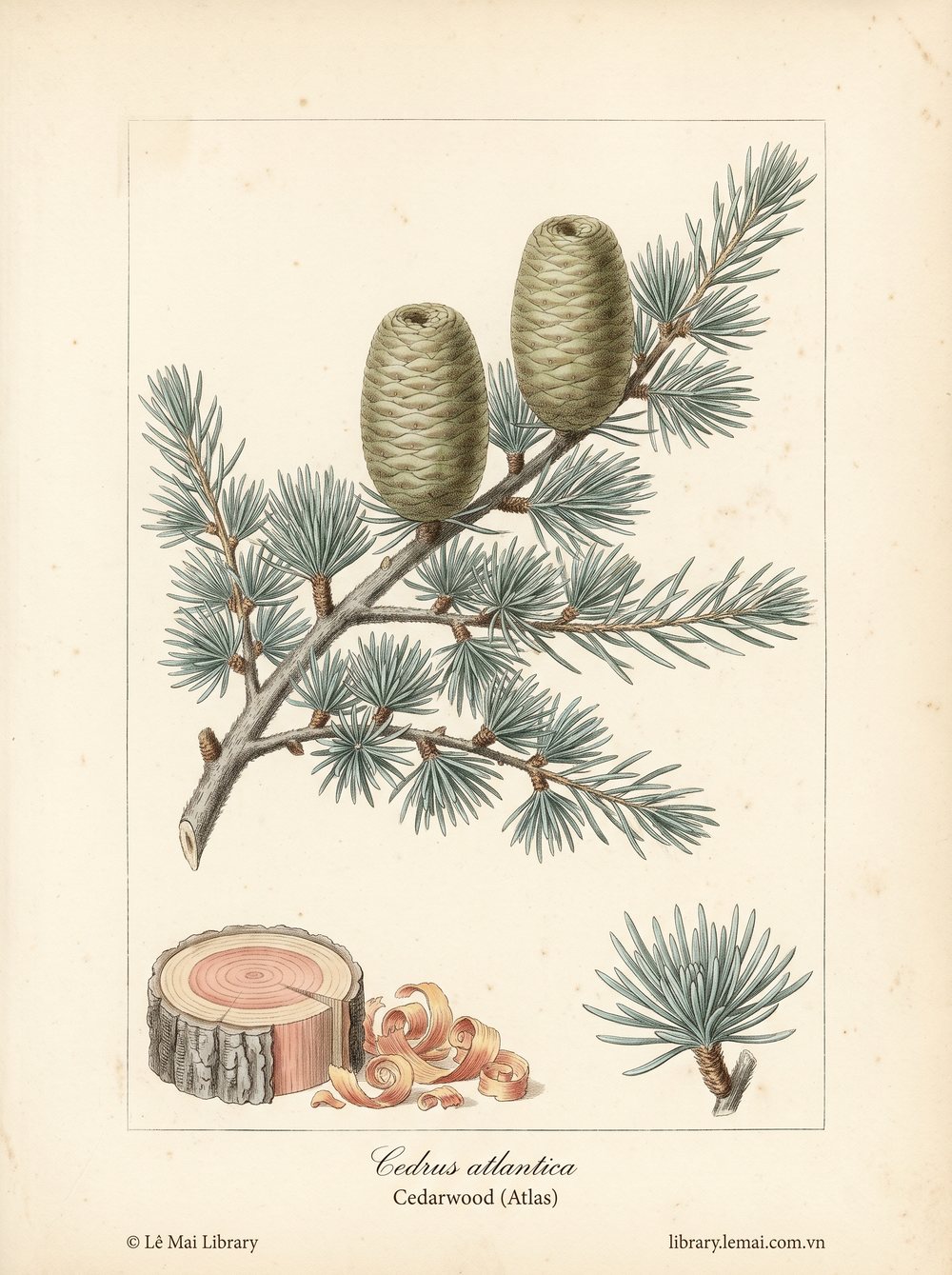
アトラスシダーウッド
Tuyết tùng Atlas
Cedrus atlantica
Atlantic cedar, Moroccan cedar
No specific contraindications in available data.
No irritation or sensitization at tested levels. Non-phototoxic.
In vitro research recorded Atlas cedarwood oil inhibits K562 leukemia cells with IC50 of 59.37 mg per mL.
| β-Himachalene | 30.8 – 40.4 % |
| α-Himachalene | 10.3 – 16.4 % |
| (E)-α-Atlantone | 5.2 – 13.4 % |
| γ-Himachalene | 6.7 – 9.7 % |
| Deodarone | 1.2 – 6.7 % |
| (E)-γ-Atlantone | 1.2 – 3.9 % |
| Himachalol | 1.7 – 3.7 % |
| Isocedranol | 1.2 – 3.1 % |
| (Z)-α-Atlantone | 1.0 – 2.8 % |
| δ-Cadinene | 0.5 – 2.6 % |
| 1-epi-Cubenol | 1.1 – 2.5 % |
| (Z)-trans-α-Bergamotol | 0 – 2.0 % |
| Cedranone | 0.7 – 1.7 % |
| α-Calacorene | 0.5 – 1.6 % |
Cedrus atlantica is a large tree of the Atlas mountains of Morocco and Algeria. Atlas and Himalayan cedars belong to the Pinaceae family, while all other cedars are Cupressaceae.
The oil is steam-distilled from the wood. Produced mainly in Morocco.
Family Pinaceae. Same genus Cedrus as Himalayan cedar (Cedrus deodara) and cedar of Lebanon.
Cedrus atlantica is on the IUCN threatened list. Sourcing should consider origin.