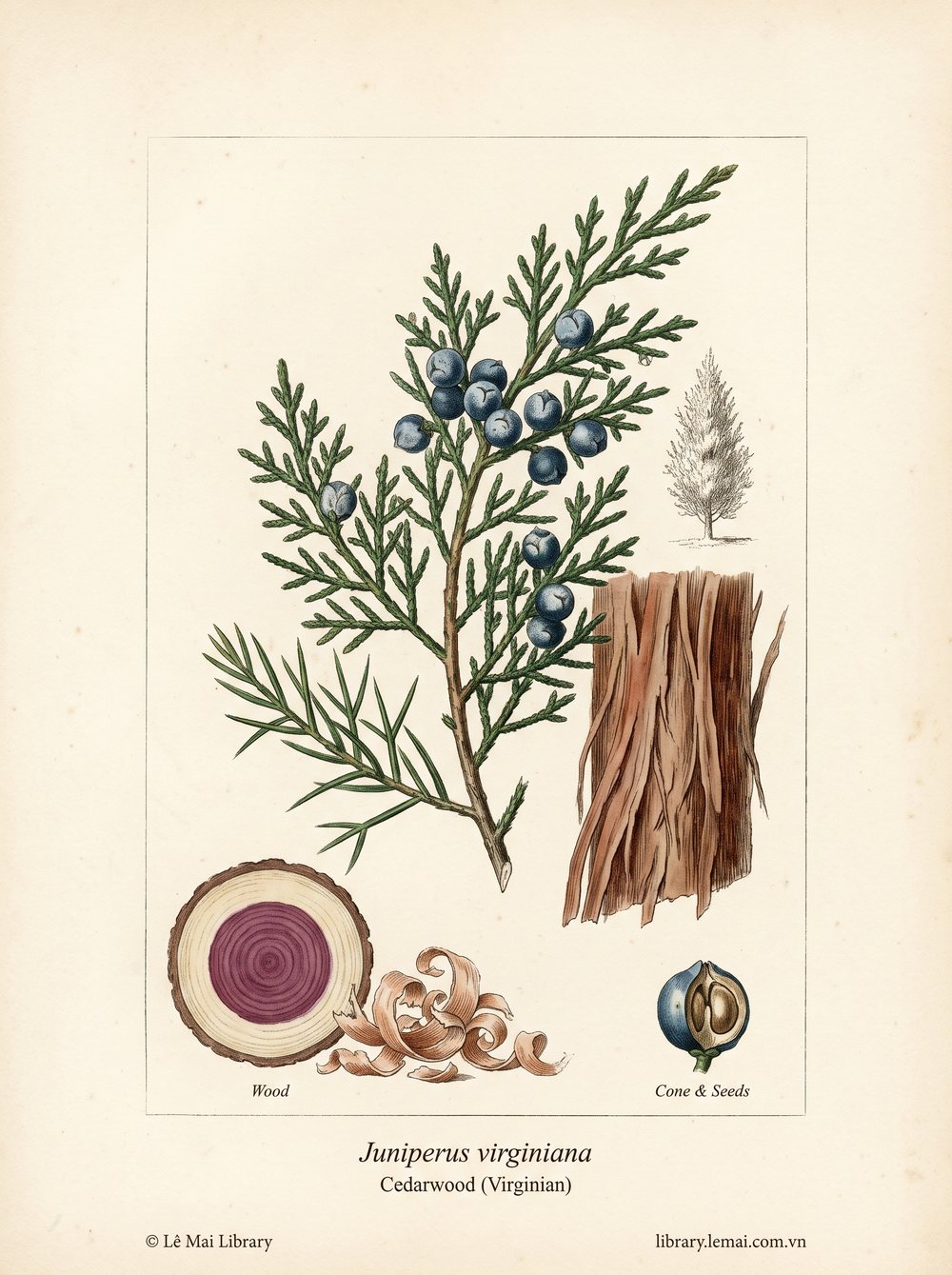
ヴァージニアンシダーウッド
Tuyết tùng Virginia
Juniperus virginiana
Red cedar, Eastern red cedar
No specific contraindications in available data.
Non-phototoxic. No irritation at 8 percent test level.
Patch test sensitization at 10 percent: 0.6 percent in 1,606 consecutive dermatitis patients, 0.67 percent in 747 patients suspected of fragrance allergy, 0.77 percent in 6,223 dermatitis patients suspected of fragrance allergy.
Patch test at 5 percent in 100 patients: no irritation or allergic reactions.
| α-Cedrene | 21.1 – 38.0 % |
| Thujopsene | 21.3 – 23.4 % |
| Cedrol | 12.3 – 22.2 % |
| β-Cedrene | 8.2 – 9.2 % |
| α-Selinene | 3.0 % |
| Widdrol | 1.9 – 2.3 % |
| β-Himachalene | 2.1 % |
| β-Chamigrene | 1.4 – 1.8 % |
| α-Chamigrene | 1.6 % |
| Cuparene | 0.9 – 1.6 % |
Juniperus virginiana is a juniper of eastern and central United States. The name 'red cedar' comes from the characteristic red-brown wood.
The oil is steam-distilled from the wood. Produced mainly in the USA.
Family Cupressaceae. Same genus as Texan cedarwood (J. ashei). The two species have similar composition and are sometimes mixed in commerce.
May be adulterated with Chinese cedarwood oil.