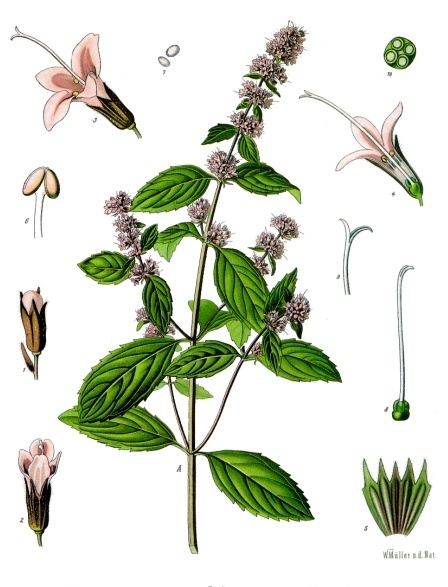
ペパーミント
Bạc hà cay
Mentha × piperita
Peppermint is classified as GRAS by the US FDA. One of the world's most widely used essential oils.
Choleretic, increases bile production. Contraindicated in cardiac fibrillation and G6PD (glucose-6-phosphate dehydrogenase) deficiency.
DO NOT apply near the face of children under 6 due to (-)-menthol causing laryngospasm and respiratory arrest.
Low mucous membrane irritation risk.
Skin reaction rate very low. In 380 eczema patients tested at 1 percent peppermint oil: 0 reactions. In 1,200 contact dermatitis patients tested at 2 percent: 3 reactions (0.25 percent). Allergic reactions rare, usually in those with a history of skin allergies.
Report: a worker who spilled undiluted peppermint oil on a hand previously injured by acid suffered substantial necrosis requiring skin grafts. Caution with undiluted oil.
Pulegone and menthofuran are present at low levels in peppermint (below 4-9 percent). The Council of Europe sets a group TDI of 0.1 mg/kg body weight.
No data indicates specific hazard in pregnancy at usual doses, but avoid large oral intake.
| (-)-Menthol | 19.0 – 54.2 % |
| Menthone | 8.0 – 31.6 % |
| (-)-Menthyl acetate | 2.1 – 10.6 % |
| Neomenthol | 2.6 – 10.0 % |
| 1,8-Cineole | 2.9 – 9.7 % |
| (6R)-(+)-Menthofuran | tr – 9.4 % |
| Isomenthone | 2.0 – 8.7 % |
| Terpinen-4-ol | 0 – 5.0 % |
| (1R)-(+)-β-Pulegone | 0.3 – 4.7 % |
| (+)-Limonene | 0.8 – 4.5 % |
| Germacrene D | tr – 4.4 % |
| β-Caryophyllene | 0.1 – 2.8 % |
| (E)-Sabinene hydrate | 0.2 – 2.4 % |
| β-Pinene | 0.6 – 2.0 % |
Mentha × piperita is a natural hybrid of Mentha aquatica (water mint) and Mentha spicata (spearmint). Commercially cultivated since the 17th century.
The essential oil is distilled from leaves and aerial parts immediately after cutting (fresh leaves). Oil yield is about 0.3-0.5 percent of fresh leaf weight.
Main production: USA (Oregon, Washington, Idaho, largest volume), India, China, Argentina, Morocco. American peppermint and European peppermint have different ISO standards.
ISO US oil standards: (-)-menthol 36-46%, menthone 15-25%, menthyl acetate 3-6.5%. ISO non-US oil: (-)-menthol 32-49%, menthone 13-28%, menthyl acetate 2-8%.
In Vietnam, mint (Mentha arvensis or Mentha × piperita) is grown as a culinary herb and medicine. Cornmint (Mentha arvensis) is a separate product.
Family Lamiaceae (Labiatae), same family as basil, rosemary, lavender, and thyme.
Peppermint oil is commonly adulterated with cornmint oil (Mentha arvensis), cornmint is cheaper and has higher menthol. The most common adulteration in the essential oil market.
Distinguished by chiral GC-MS analysis. True peppermint has characteristic (-)-menthol/(-)-menthone ratios, plus neomenthol and menthyl acetate signatures.
Demethylized peppermint oil (with menthofuran and pulegone removed) is the industrial version for food/pharmaceutical use with reduced risk profile.
American peppermint (Midwest USA) typically has higher (-)-menthol and lower menthone, a fresher profile.
Freshly distilled oil has a 'green', 'grassy' note. Storage of 6-12 months develops a rounded, balanced character.
Peppermint is one of the most extensively researched essential oils in medicine. Over 1,000 clinical and in vitro studies, particularly for irritable bowel syndrome (IBS), nausea, and headache.
In traditional medicine, peppermint is used for digestion, respiration, and headache. Modern medicine confirms the efficacy of enteric-coated peppermint capsules for IBS.
In cosmetics, peppermint oil is common in toothpaste, body wash, anti-ageing cosmetics, and cooling massage oils. The cooling sensation from (-)-menthol activates the TRPM8 receptor.
In perfumery, peppermint is a sharp top note, used in cologne, men's fragrance, and 'fresh' products.
Peppermint candy and mint chocolate are universal food applications. Mentha × piperita and spearmint (Mentha spicata) yield the two traditional 'mints'.
Despite popularity, peppermint oil requires caution with children, do not apply near the face of children under 6. This warning is often ignored in baby cosmetic products.