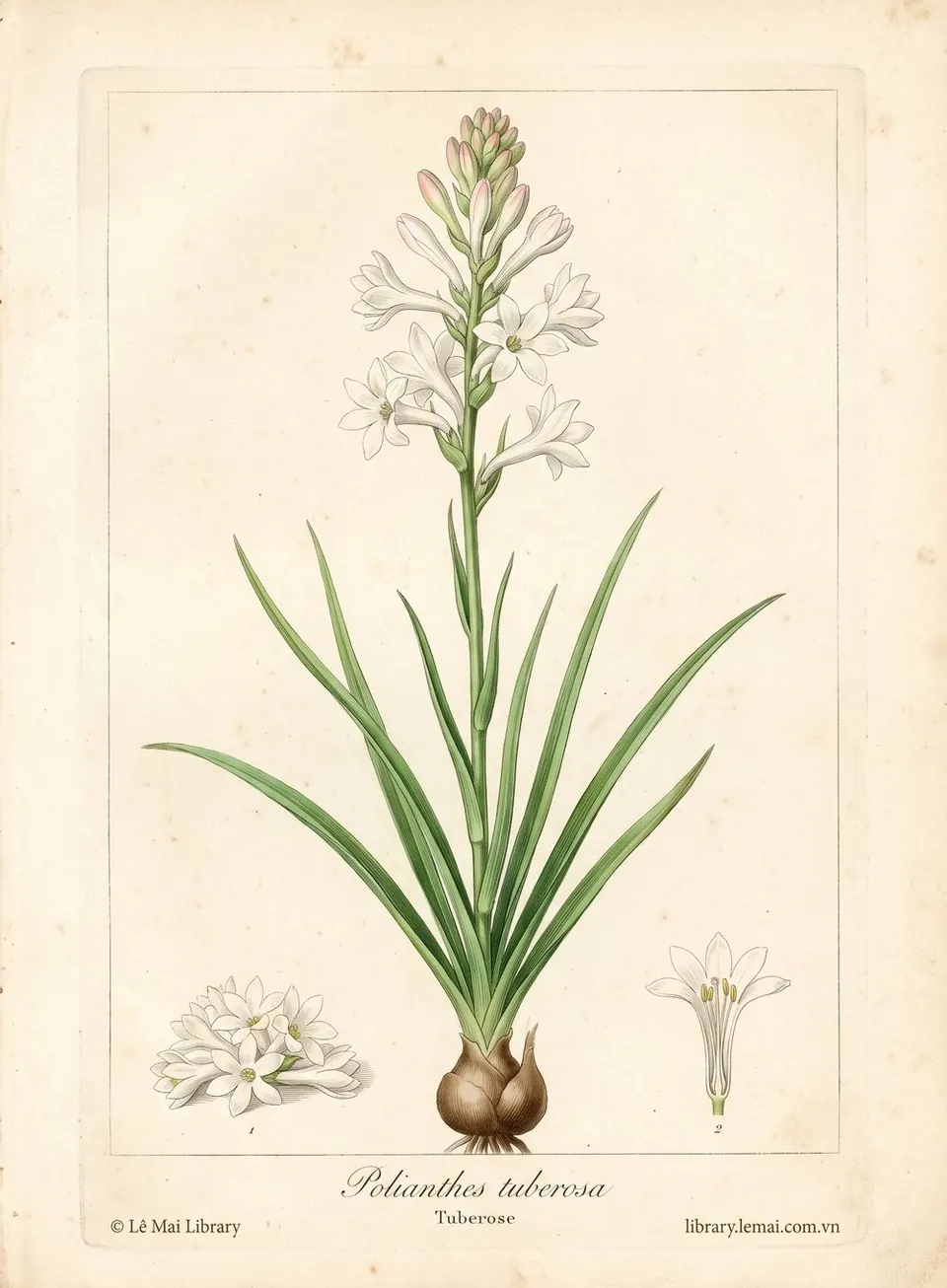
チューベローズ
Hoa huệ Mexico
Polianthes tuberosa
Agave amica
Tuberose absolute is solvent-extracted, via a concrete, from the flowers of Polianthes tuberosa, an asparagus-family plant native to Mexico and grown mainly in India, Morocco, Grasse, China and Egypt. The white flowers open and smell strongest at night and are hand-picked in the evening or early morning; the scent is rich, sweet white floral, led by methyl benzoate and benzyl benzoate. One of the costliest absolutes, it has a low sensitization risk and is a perfumery staple.
Updated 4 Nov 2026 · Lê Mai Team
Tuberose absolute is one of the most expensive and premium absolutes in perfumery. Low skin sensitization risk.
Methyl benzoate, benzyl alcohol, benzyl benzoate, and methyl anthranilate are main constituents.
No data indicates specific hazard in pregnancy.
Not phototoxic.
| Methyl benzoate | 10.0 – 20.0 % |
| Benzyl benzoate | 8.0 – 15.0 % |
| Benzyl alcohol | 5.0 – 12.0 % |
| Methyl anthranilate | 3.0 – 8.0 % |
| Indole | 0.5 – 3.0 % |
| Eugenol | 0.5 – 2.0 % |
Polianthes tuberosa is a herb native to Mexico, commercially cultivated mainly in India, Morocco, France (Grasse), China, and Egypt.
The pure white flowers open at night, most fragrant at night. Hand-picked in the evening/early morning.
Tuberose absolute yield is extremely low, about 1,000-2,000 kg of flowers for 1 kg of absolute. Premium Indian absolute can reach 7,000-15,000 USD/kg.
In Indian culture, tuberose (rajnigandha, 'night fragrance') is a symbol of purity. In French culture, it features in classical Grasse perfumery.
Family Asparagaceae (previously Agavaceae).
Tuberose absolute is frequently adulterated due to high price. Synthetic reconstructions with methyl benzoate, benzyl alcohol, and indole may be sold as tuberose.
Verify quality by chiral GC-MS analysis. Indole and methyl anthranilate ratios are key indicators.
Tamil Nadu Indian tuberose is regarded as the gold standard. Moroccan and French (Grasse) are also premium.
Tuberose can exist as concrete, absolute, or CO2 extract. Each form has a slightly different aromatic profile.
| Fracas | Robert Piguet · 1948 · main note |
| Tubéreuse Criminelle | Serge Lutens · 1999 · main note |
| Do Son | Diptyque · 2004 · main note |
| Carnal Flower | Malle · 2005 · main note |
| Gucci Bloom | Gucci · 2017 · heart |
Based on note lists published by each house. Fragrance names and marks belong to their owners.
Tuberose is a distinctive 'white floral' note, same group as jasmine, gardenia, and neroli. However tuberose is the most intense and 'intoxicating'.
In perfumery, tuberose is an important heart-base note. Signature tuberose fragrances: Robert Piguet Fracas (1948), Diptyque Do Son, Tom Ford Velvet Orchid.
The 'narcotic' character of tuberose comes from indole, also present in jasmine and orange flower. Indole is a natural 'animalic' marker.
In cosmetics, tuberose absolute is a premium ingredient for fine fragrance. Pricing is prohibitive for mass-market cosmetics.
In Indian culture, tuberose garlands (rajnigandha) are symbols of weddings and spiritual ceremonies. The fragrance is so strong a single bouquet can scent a room.