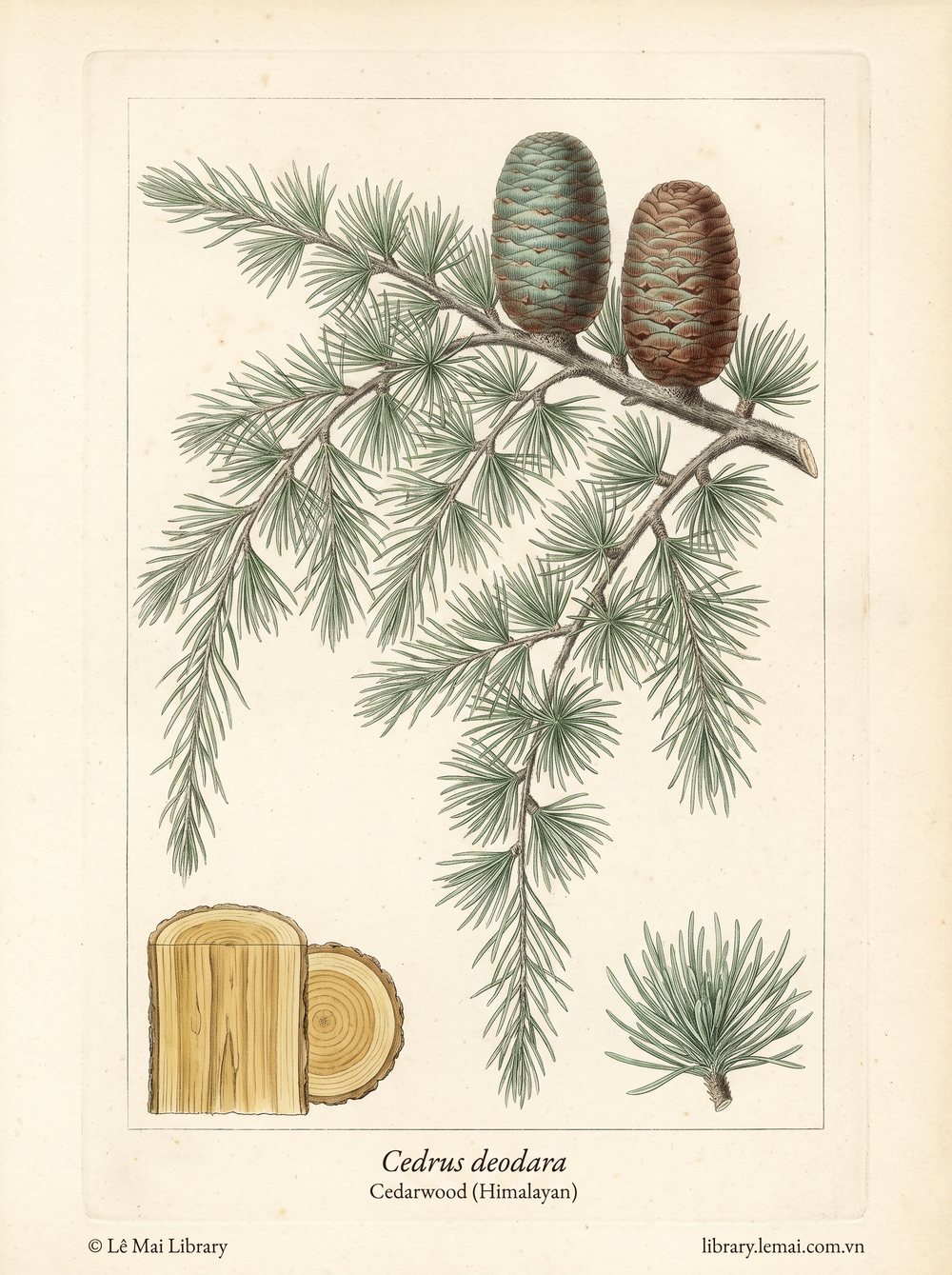
ヒマラヤンシダーウッド
Tuyết tùng Himalaya
Cedrus deodara
Deodar cedarwood
Potentially moderately toxic.
No specific contraindications.
At 15 percent in castor oil, Himalayan cedarwood oil was non-irritating to rabbit or sheep skin. In 200 dermatitis patients, three (1.5 percent) reacted to 2 percent Himalayan cedarwood oil on patch testing.
Himalayan cedarwood oil has anti-inflammatory effects, preventing histamine release and inhibiting type IV hypersensitivity.
Acute oral LD50 in mice 500 mg per kg, but this value may not be accurate, as subchronic rabbit data showed no toxicity and α-cedrene has an LD50 above 5 g per kg.
| α-Himachalene | 20.0 – 30.0 % |
| α-Cedrene | 12.0 – 16.0 % |
| β-Himachalene | 8.0 – 13.0 % |
| (E)-α-Atlantone | 5.0 – 7.0 % |
| Deodarone | 4.0 – 6.0 % |
| (Z)-α-Atlantone | 2.0 – 3.0 % |
| β-Cedrene | 0.5 – 1.5 % |
| allo-Himachalol | 0.5 – 1.5 % |
| Cedrol | 1.0 – 2.0 % |
| Himachalol | 1.0 – 2.0 % |
Cedrus deodara is a large tree of the Himalayas. The oil is distilled from the wood.
Family Pinaceae. Same genus Cedrus as Atlas cedar and cedar of Lebanon. The two Cedrus species are the only 'cedarwood' members of the Pinaceae, all other cedarwoods belong to Cupressaceae.
In traditional Indian and Tibetan medicine, Cedrus deodara is used for various disorders.
In vitro research: Himalayan cedarwood oil inhibits K562 leukemia cells with IC50 of 37.09 mg per mL, more effective than Atlas cedarwood.