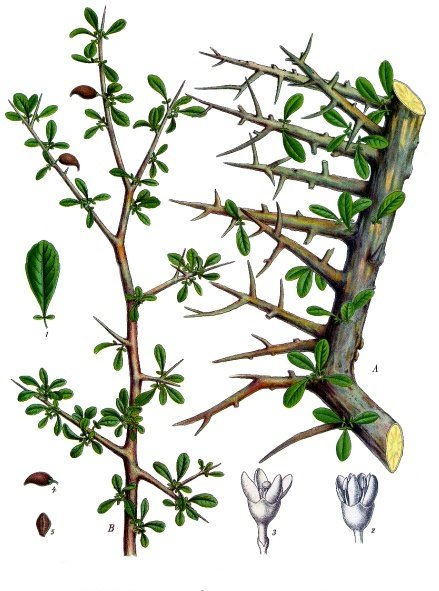
ミルラ
Mộc dược
Commiphora myrrha
Somalian myrrh, Commiphora molmol
Furanoeudesma-1,3-diene and furanodiene are the main constituents. β-Elemene and furanodiene have antiangiogenic activity (inhibiting new blood vessel formation).
Potentially fetotoxic due to β-elemene and furanodiene content. The link between antiangiogenic effects and reproductive toxicity is documented.
STRICTLY CONTRAINDICATED in pregnancy and breastfeeding, by all routes (dermal, oral, inhalation).
Not irritating to mice or pigs at high concentrations. In 25 volunteers at 8 percent: not irritating or sensitizing. However, a 65-year-old aromatherapist with multiple sensitivities reacted to both 1 percent and 5 percent myrrh oil.
Myrrh oil is not phototoxic. Furanodiene shows hepatoprotective activity in mouse studies, reducing liver injury induced by D-galactosamine/lipopolysaccharide or TNF-α.
Contains no known carcinogens.
| Furanoeudesma-1,3-diene | 34.0 % |
| Furanodiene | 19.7 % |
| Lindestrene | 12.0 % |
| β-Elemene | 8.7 % |
| Germacrene B | 4.3 % |
| Germacrene D | 3.2 % |
| δ-Elemene | 2.1 % |
| 2-Methoxyfuranodiene | 2.1 % |
| Isofuranogermacrene (curzerene) | 2.0 % |
| T-Cadinol | 1.6 % |
| β-Caryophyllene | 1.3 % |
| β-Bourbonene | 1.2 % |
| γ-Cadinene | 1.2 % |
| Furanoeudesma-1,4-diene | 1.2 % |
| γ-Elemene | 1.1 % |
Commiphora myrrha is a small tree from the semi-arid regions of Somalia, Ethiopia, Yemen, Sudan, and Kenya. Thorny tree with small leaves.
When the trunk bark is damaged, naturally or by tapping, pale yellow sap flows out, hardening in air into reddish-brown resin lumps. This is gum oleoresin myrrh.
Dried resin is harvested, cleaned, then steam-distilled for the essential oil. Yield is approximately 3-8 percent of resin weight.
Main production: Somalia, Ethiopia. Somalian myrrh is regarded as the aromatic and quality standard.
Family Burseraceae, same family as frankincense (Boswellia), elemi, palo santo, and linaloe wood.
Myrrh oil is often adulterated with myrrh from other Commiphora species (Commiphora gileadensis, Commiphora wightii). Each species yields a different profile, Somalian is the benchmark.
The raw resin (gum oleoresin) is an important product in its own right, often used in incense and traditional medicine. The distilled essential oil is a secondary product.
Myrrh oil has strong antioxidant activity, exceeding α-tocopherol in singlet oxygen tests.
Verify quality by GC-MS, the Somalian standard has characteristic furanoeudesma-1,3-diene and lindestrene.
Myrrh has a long cultural history. In the Bible, myrrh was one of the three gifts of the Magi to the infant Jesus. In ancient Egypt, myrrh was used in mummification and religious rites.
In Traditional Chinese Medicine, myrrh (没药 mo yao) is used for blood circulation, joint pain, and wounds. Often combined with frankincense.
In traditional dentistry, myrrh tincture has been used for gingivitis and mouth ulcers. Notable antibacterial activity.
In perfumery, myrrh is an important resinous base note, particularly in oriental, amber, and modern unisex fragrances.
In cosmetics, myrrh is widely used in anti-ageing skin care, eye creams, and lotions for dry skin. The pregnancy contraindication is very important to observe.