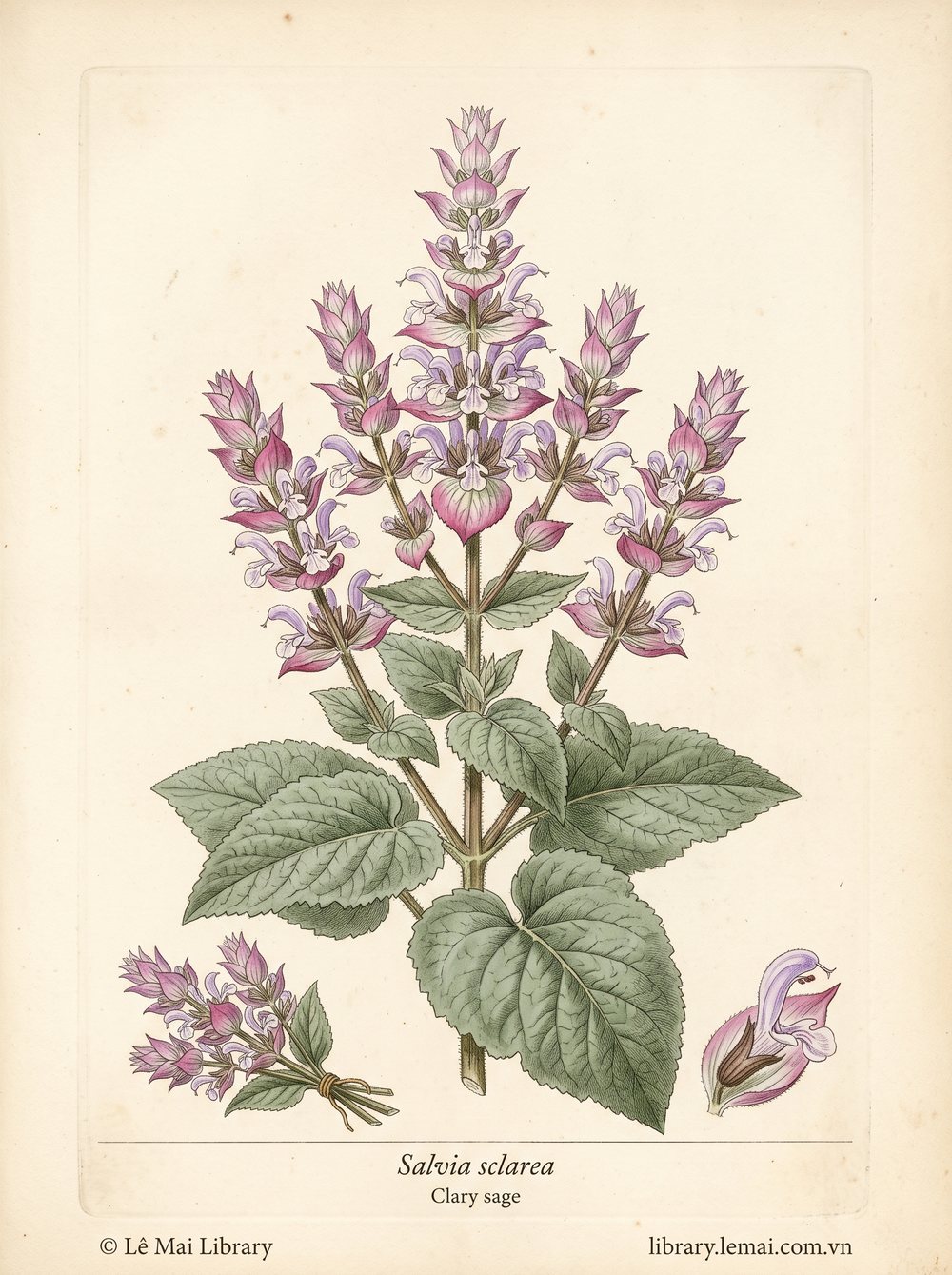
クラリーセージ
Xô thơm Clary
Salvia sclarea
Muscatel sage
No specific contraindications in available data.
GRAS status. No irritation or sensitization at 8 percent test level. Non-phototoxic.
Clary sage absolute has a higher sensitization profile, maximum level 0.25 percent based on research by Bouhlal et al (1988b). The distilled essential oil is much safer.
French and Russian oils are produced, with slightly different aroma and chemistry.
| Linalyl acetate | 45.3 – 73.6 % |
| Linalool | 9.0 – 19.3 % |
| Germacrene D | 0.7 – 2.0 % |
| β-Caryophyllene | 1.1 – 1.8 % |
| α-Terpineol | 1.2 – 2.5 % |
| Geranyl acetate | 0.8 – 1.2 % |
| Geraniol | 0.6 – 1.2 % |
Salvia sclarea is a Mediterranean herb, produced in France, Russia, Bulgaria, China and the USA. US production is primarily for solvent extraction to isolate sclareol for synthetic ambergris industry.
Some clary sage oils are produced from slightly fermented leaves, yielding a richer, more vegetable-like aroma.
Family Lamiaceae. Same genus as sage (Salvia officinalis) and Spanish sage (Salvia lavandulifolia).
May be adulterated with natural/synthetic mixtures containing linalool and linalyl acetate.
According to Franchomme & Penoel, clary sage oil is estrogen-like due to its sclareol content. However, the oil typically contains only 0.1 to 0.4 percent sclareol by GC analysis. Sclareol itself has no clear estrogen-like activity. The estrogen-like claim widespread in popular aromatherapy literature has a weak scientific basis.