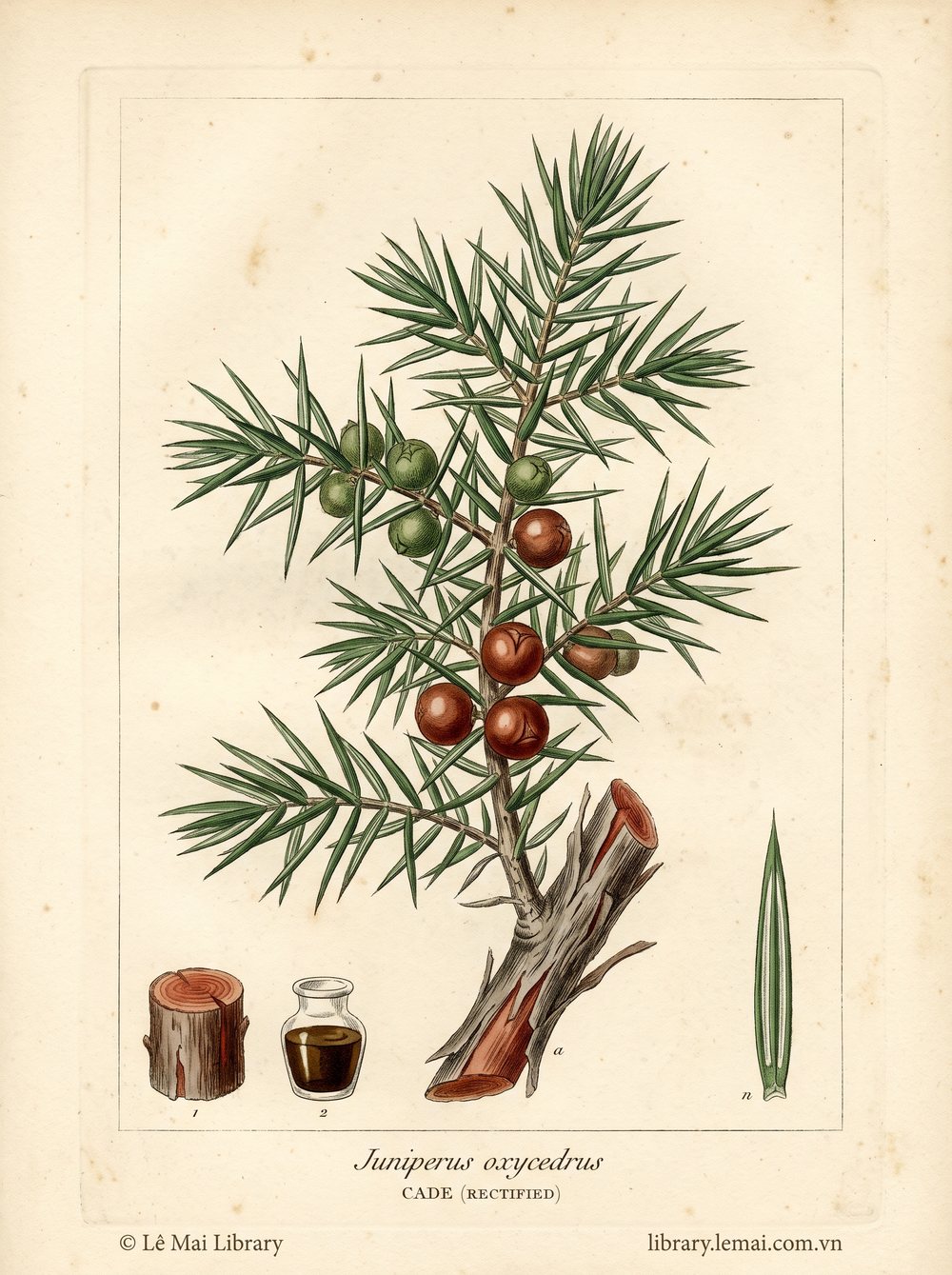
カデ レクティファイド
Cade, đã tinh chế
Juniperus oxycedrus
Juniper tar (rectified)
Toxicity. Only the rectified version is regulation-compliant.
Should not be taken orally.
Benzo[a]pyrene, a carcinogenic polynuclear hydrocarbon, may be present in rectified cade oil at up to 20 ppb. This level is lower than that found in some foodstuffs.
| δ-Cadinene | Principal constituent |
| α-Cedrene | < 15.0 % |
| β-Caryophyllene | Undetermined |
| γ-Muurolene | Undetermined |
Cade is the name of the oil. The source plant is Juniperus oxycedrus, called 'prickly juniper' in English.
Produced by destructive distillation without water or steam. This causes the wood to burn, producing polynuclear aromatic hydrocarbons (PAHs) in the crude oil.
As the essential oil in the wood distils over, it is followed by a tar-like material which dissolves in it. Commercial cade oil is a mixture of both. The rectification process removes most of the carcinogenic PAHs.
Cade and birch tar are the only essential oils produced by destructive distillation. Burning organic material, juniper wood or tobacco leaves, generally produces carcinogenic PAHs such as benzo[a]pyrene, the same class found in cigarette smoke.