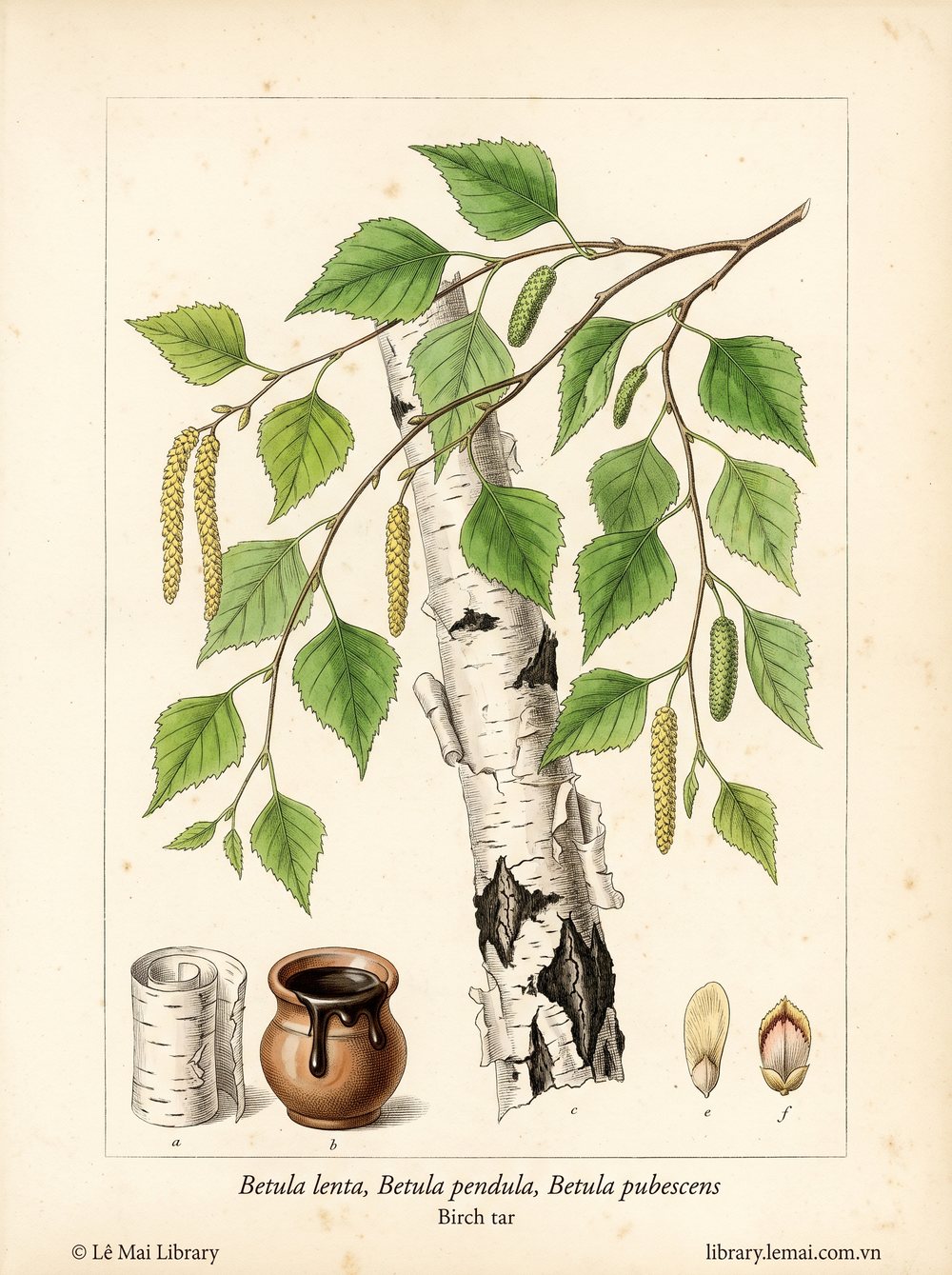
バーチタール
Bạch dương, hắc ín
Betula lenta, Betula pendula, Betula pubescens
Birch tar oil, Pyrolyzed birch
Toxicity. Unrectified oil potentially carcinogenic due to polynuclear aromatic hydrocarbons (PAHs).
Should not be taken orally due to toxicity of cresol isomers.
IFRA prohibits crude birch wood pyrolysate (raw birch tar oil) as a fragrance ingredient. Only rectified oil may be used, and total PAHs must not exceed 1 ppb in the finished product.
Cresols are prohibited as cosmetic ingredients in Canada.
| Cresol (isomer mix) | Major constituent |
| Guaiacol | Major constituent |
| Creosol | Undetermined |
| Pyrocatechol | Undetermined |
| Xylenol | Undetermined |
Birch tar oil is produced by destructive distillation (dry pyrolysis) of birch bark and wood. This is the only essential oil, together with cade oil, produced by this method.
Source trees include Betula lenta (sweet birch), Betula pendula (European white birch), and Betula pubescens (white birch).
The crude oil is a dark, viscous liquid. May contain trace phenol. The method produces carcinogenic PAHs such as benzo[a]pyrene and 1,2-benzanthracene, these must be removed by rectification.
Distinctive smoky leather note. Used in perfumery for dry leather accords and certain classic chypre compositions. Only the rectified version is regulation-compliant.
p-Cresol depletes hepatic intracellular glutathione in liver cells in vitro. Because birch tar oil contains p-cresol as a major constituent, it likely has a potential for hepatic glutathione depletion.