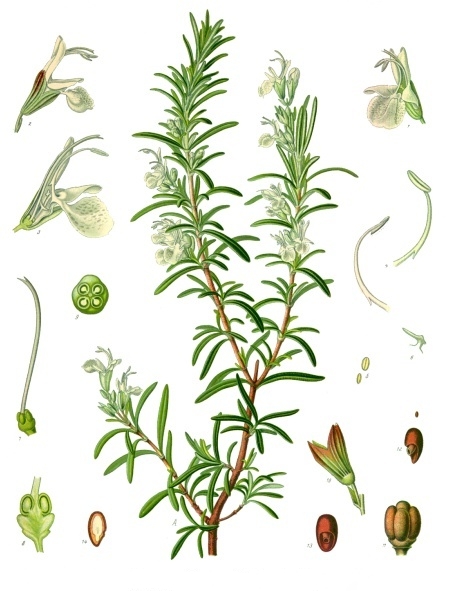
ローズマリー
Hương thảo
Rosmarinus officinalis
Rosemary is classified as GRAS by the US FDA. Has multiple chemotypes that differ markedly in safety and aroma.
May be neurotoxic due to camphor content. Caution with camphor CT and α-pinene CT (high camphor).
Verbenone CT contains isopinocamphone, neurotoxic at high doses.
1,8-Cineole CT: DO NOT apply near the face of infants and children due to risk of laryngospasm.
Low skin irritation risk in adults. In 25 volunteers tested at 10 percent: not irritating or sensitizing. Not phototoxic.
In rabbits given 25 mg/kg im rosemary oil: blood glucose increased 20-55 percent at 60-120 minutes, serum insulin decreased 30 percent. Interaction with antidiabetic drugs possible.
No evidence that rosemary oil raises blood pressure despite contraindication for hypertension in some aromatherapy books.
Recommended maximum doses by CT: Camphor CT 16.5 percent dermal / 513 mg oral; α-Pinene CT 22 percent dermal / 676 mg oral; Verbenone CT 6.5 percent dermal / 192 mg oral.
Borneol and verbenone have not been fully studied for reproductive toxicity, use verbenone CT with caution in pregnancy.
| 1,8-Cineole (cineole CT) | 39.0 – 57.7 % |
| Camphor (camphor CT) | 17.0 – 27.3 % |
| α-Pinene (α-pinene CT) | 19.1 – 35.8 % |
| Verbenone (verbenone CT) | 7.6 – 12.3 % |
| Borneol (borneol CT) | 15.6 % |
| β-Myrcene (β-myrcene CT) | 19.5 – 52.1 % |
| Camphor (other CTs) | 6.6 – 20.7 % |
| 1,8-Cineole (other CTs) | 15.0 – 25.1 % |
| Camphene | 2.8 – 10.0 % |
| β-Pinene | 0.3 – 7.8 % |
| Bornyl acetate | 0.4 – 7.6 % |
| α-Terpineol | 0 – 4.9 % |
| p-Cymene | 0.4 – 6.3 % |
| Methyleugenol (camphor CT) | 0 – 0.02 % |
Rosmarinus officinalis is a Mediterranean evergreen shrub, Spain, Morocco, Tunisia, Italy, France. Narrow elongated leaves with small blue-violet flowers.
The essential oil is distilled from aerial parts during or just before flowering. Yield is about 0.5-1.5 percent of fresh material weight.
Six main chemotypes occur depending on the production region: borneol CT, camphor CT, 1,8-cineole CT, β-myrcene CT, α-pinene CT, verbenone CT (Egyptian). Each chemotype has distinct chemistry and safety.
Cineole CT (Tunisian/Moroccan) is the most common commercially. Camphor CT typically from Spain. Verbenone CT is characteristic of Egypt.
In Mediterranean cuisine, rosemary is a foundational herb, grilled meats, potatoes, olive oil. Both dried and fresh leaves are used.
Family Lamiaceae (Labiatae), same family as basil, lavender, thyme, and marjoram.
Rosemary oil may be adulterated with eucalyptus oil, white camphor oil, turpentine oil, and their fractions.
Verify chemotype by GC-MS, mandatory because the different CTs have markedly different safety. Just 'rosemary oil' on the label is not enough, the exact chemotype is needed.
Cineole CT has 1,8-cineole 39-58%, chemically close to Spanish marjoram and niaouli cineole CT.
Verbenone CT is the rarest, most expensive chemotype, prized in age-renewal skin care.
Bulgarian rosemary has its own ISO standard. Tunisian rosemary commonly carries organic certification.
Rosemary is among the most extensively researched essential oils in medicine. Strong antioxidant activity, high DPPH. Notable antibacterial activity.
Memory and alertness enhancement, clinical studies show rosemary aroma improves accuracy in cognitive tests.
In cosmetics, rosemary cineole CT is common in shampoos (anti-dandruff), hair care, and muscle massage creams. Verbenone CT in anti-ageing skin care.
In European herbal tradition, rosemary is the 'herb of remembrance', linked to memory and learning. Shakespeare's Hamlet: 'There's rosemary, that's for remembrance'.
In the Lê Mai brand context, rosemary (particularly cineole CT) is a universal ingredient, suited to soap, body care, hair care. Verbenone CT can be used in premium serums.