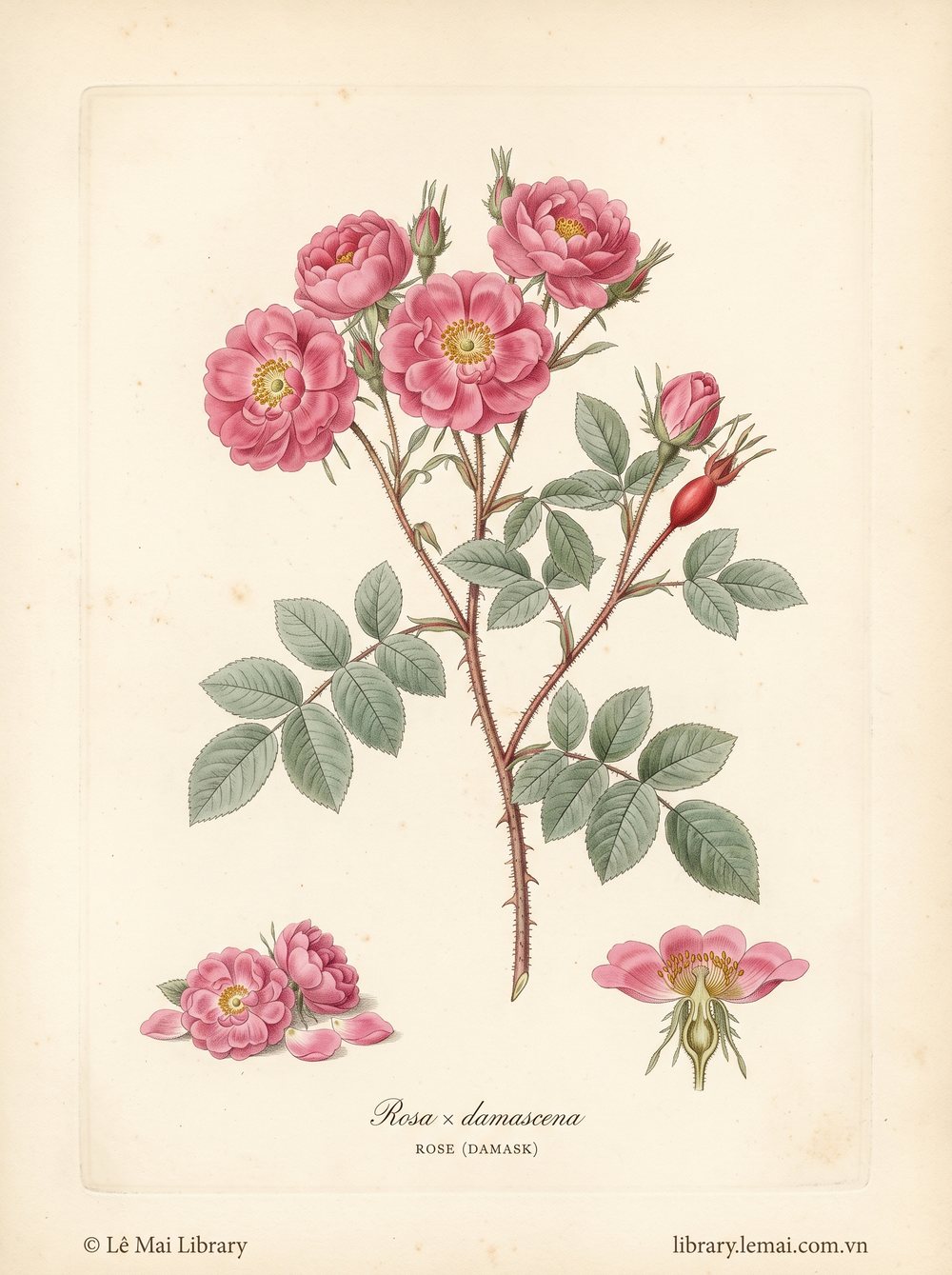
ダマスクローズ
Hoa hồng Damask
Rosa × damascena
Rose otto, Bulgarian rose, Turkish rose
Rose otto được xếp loại GRAS bởi FDA Hoa Kỳ. Methyl eugenol có thể có (0.5-3.3 phần trăm), chất nghi ngờ carcinogen.
Khuyến cáo dermal tối đa 0.6 phần trăm. IFRA giới hạn 0.012 phần trăm. EU giới hạn 0.006 phần trăm.
Liều oral tối đa hàng ngày 21 mg.
Khả năng nhạy ứng da rất thấp. Trong 1,483 bệnh nhân da liễu Nhật Bản nghi nhạy ứng cosmetic (99 phần trăm nữ): chỉ 0.4 phần trăm phản ứng dương tính với 2 phần trăm Bulgarian rose oil.
Không phototoxic.
Nghiên cứu trên chuột: cho oral Bulgarian rose otto 0.05 mL/kg/ngày trong 6 tháng không có dấu hiệu độc gan, liều này tương đương dưới 1.5 mg/kg/ngày methyleugenol, gấp 150 lần giới hạn an toàn của methyleugenol. Geraniol trong rose otto có thể chống lại tác dụng carcinogen của methyleugenol.
Hoạt tính chống ung thư đáng kể: cytotoxic với tế bào ung thư tuyến tiền liệt, phổi, vú với IC50 lần lượt 0.04, 0.05, 0.07 phần trăm.
Có thể dùng trong thai kỳ ở liều thông thường, không chống chỉ định.
Rose otto is classified as GRAS by the US FDA. Methyl eugenol may be present (0.5-3.3 percent), a suspected carcinogen.
Maximum dermal: 0.6 percent. IFRA limit 0.012 percent. EU limit 0.006 percent.
Maximum daily oral dose: 21 mg.
Very low skin sensitization risk. In 1,483 Japanese dermatitis patients suspected of cosmetic sensitivity (99 percent female): only 0.4 percent reacted positively to 2 percent Bulgarian rose oil.
Not phototoxic.
Rat study: oral Bulgarian rose otto 0.05 mL/kg/day for 6 months showed no hepatotoxic signs, equivalent to under 1.5 mg/kg/day methyleugenol, 150 times the methyleugenol safety limit. Geraniol in rose otto may counteract methyleugenol carcinogenicity.
Notable anticarcinogenic activity: cytotoxic to prostate, lung, and breast cancer cells with IC50 of 0.04, 0.05, and 0.07 percent respectively.
Can be used in pregnancy at normal doses, Not contraindicated.
| (-)-Citronellol (Bulgarian) | 16.0 – 35.9 % |
| (-)-Citronellol (Turkish) | 24.5 – 43.5 % |
| Geraniol (Bulgarian) | 15.7 – 25.7 % |
| Geraniol (Turkish) | 2.1 – 18.0 % |
| Alkenes & alkanes (Bulgarian) | 19.0 – 24.5 % |
| Nonadecane (Turkish) | 6.4 – 20.6 % |
| Nerol | 0.8 – 8.7 % |
| Heneicosane (Turkish) | 2.0 – 8.9 % |
| Methyleugenol | 0.5 – 3.3 % |
| Linalool | 0.2 – 3.1 % |
| Citronellyl acetate | 0.4 – 2.2 % |
| 2-Phenylethanol | 0.3 – 2.0 % |
| (E,E)-Farnesol | 0 – 1.5 % |
| β-Caryophyllene | 0.5 – 1.2 % |
| Eugenol | 0.3 – 1.3 % |
Rosa × damascena là loài hoa hồng lai cổ điển, được trồng tại Bulgaria, Thổ Nhĩ Kỳ, Iran, Maroc. Bulgaria và Thổ Nhĩ Kỳ là hai chuẩn truyền thống về chất lượng và sản lượng.
Hoa damask phải được hái bằng tay vào sáng sớm, khi mặt trời lên, hàm lượng tinh dầu giảm nhanh. Mỗi người hái khoảng 30-40 kg hoa/ngày.
Sản xuất tinh dầu: cần khoảng 3,000-5,000 kg hoa tươi cho 1 kg rose otto (chưng cất). Năng suất tinh dầu cực thấp, 0.02-0.04 phần trăm khối lượng hoa.
Hai dạng sản phẩm chính: Rose otto (chưng cất hơi, mùi tinh khiết hơn) và Rose absolute (chiết xuất dung môi, mùi đậm đà hơn nhưng có methyl eugenol cao hơn).
Rose otto Bulgaria có signature cocoa-honey đặc trưng nhờ sản xuất tại vùng Rose Valley (Kazanlak). Turkish rose otto từ vùng Isparta có note tươi mới hơn.
Có sản lượng nhỏ tại Iran và Maroc nhưng không xuất khẩu commercial.
Họ Rosaceae.
Rosa × damascena is a classical hybrid rose, cultivated in Bulgaria, Turkey, Iran, and Morocco. Bulgaria and Turkey are the two traditional benchmarks for quality and volume.
Damask flowers must be hand-picked at dawn, once the sun rises, oil content drops rapidly. Each picker handles about 30-40 kg of flowers per day.
Oil production: about 3,000-5,000 kg of fresh flowers are needed for 1 kg of rose otto (distilled). Oil yield is extremely low, 0.02-0.04 percent of flower weight.
Two main product forms: Rose otto (steam-distilled, more crystalline aroma) and Rose absolute (solvent-extracted, deeper aroma but higher methyl eugenol).
Bulgarian rose otto has a signature cocoa-honey character from the Rose Valley region (Kazanlak). Turkish rose otto from Isparta has a fresher note.
Small production occurs in Iran and Morocco but is not commercially exported.
Family Rosaceae.
Damask rose oil bị làm giả thường xuyên do giá cao, có thể tới 8,000-15,000 USD/kg cho rose otto chất lượng cao.
Adulterant phổ biến: ethanol, 2-phenylethanol, geranium oil fractions, rhodinol. Reconstructions với damascones, β-ionone, alkene/alkane, (-)-citronellol và các rose alcohol khác cũng được trộn hoặc bán dưới tên rose oil.
Verify chất lượng bằng GC-MS chiral analysis. Tỷ lệ enantiomer của (-)-citronellol và damascones là chỉ dấu quan trọng. Phân tích chromatographic 2D có thể phân biệt natural và synthetic.
Rose otto Bulgaria có ISO standard riêng, Kazanlak Rose Valley có chứng nhận PDO (Protected Designation of Origin).
Mùi damask rose thật: hoa hồng tinh khiết, sâu, có note cocoa-honey không thể tổng hợp giả mạo. Synthetic rose chỉ bắt được một phần spectrum mùi.
Damask rose oil is frequently adulterated due to high price, premium rose otto can reach 8,000-15,000 USD/kg.
Common adulterants: ethanol, 2-phenylethanol, geranium oil fractions, rhodinol. Reconstructions with damascones, β-ionone, alkenes/alkanes, (-)-citronellol, and other rose alcohols are mixed in or sold as rose oil.
Verify quality by chiral GC-MS analysis. The enantiomer ratio of (-)-citronellol and damascones is a key indicator. 2D chromatographic analysis can distinguish natural from synthetic.
Bulgarian rose otto has its own ISO standard, Kazanlak Rose Valley carries PDO (Protected Designation of Origin) certification.
True damask rose aroma: pure floral rose, deep, with a cocoa-honey note not replicable by synthesis. Synthetic rose captures only part of the aromatic spectrum.
| Joy | Jean Patou · 1930 · nốt giữa heart |
| J'adore | Dior · 1999 · nốt giữa heart |
| Portrait of a Lady | Frédéric Malle · 2010 · nốt chính main note |
| Idôle | Lancôme · 2019 · nốt giữa heart |
| Sa Majesté la Rose | Serge Lutens · nốt chính main note |
Theo danh sách nốt hương do nhà sản xuất công bố. Tên nước hoa và thương hiệu thuộc chủ sở hữu tương ứng.Based on note lists published by each house. Fragrance names and marks belong to their owners.
Damask rose là một trong những tinh dầu cổ điển và đắt nhất trong perfumery. Lịch sử trồng damask rose tại Bulgaria có từ thế kỷ 17.
Trong perfumery, rose otto là note giữa-cuối (heart-base) không thể thay thế. Hàng nghìn fragrance dùng rose otto hoặc rose absolute làm thành phần chính.
Trong aromatherapy, rose otto được nghiên cứu cho tác dụng giảm lo âu, hỗ trợ tâm trạng, hỗ trợ phụ khoa và thai kỳ. Là một trong số ít essential oils GRAS có thể dùng trong thai kỳ.
Trong cosmetic, rose otto và rose absolute là nguyên liệu cao cấp cho fine fragrance, kem dưỡng anti-ageing, serum cao cấp, body oil. Phù hợp cho da nhạy cảm.
Damascones, hợp chất tạo mùi đặc trưng cho rose, được phát hiện trong rose oil năm 1970 bởi Edouard Demole tại Firmenich. Damascones cách mạng hóa perfumery hiện đại, nhiều fragrance từ 1970s tới nay đều có damascones (tự nhiên hoặc synthetic).
Trong Lê Mai brand context, rose otto là nguyên liệu signature tiềm năng, phù hợp với positioning quiet luxury và sensibility nữ tính.
Damask rose is among the most classical and expensive essential oils in perfumery. Bulgarian damask rose cultivation dates to the 17th century.
In perfumery, rose otto is an irreplaceable heart-base note. Thousands of fragrances use rose otto or rose absolute as a main ingredient.
In aromatherapy, rose otto has been studied for anxiolytic effects, mood support, and gynecological/pregnancy support. One of the few GRAS essential oils that can be used in pregnancy.
In cosmetics, rose otto and rose absolute are premium ingredients for fine fragrance, anti-ageing creams, premium serums, and body oils. Suited to sensitive skin.
Damascones, the signature aroma compounds of rose, were discovered in rose oil in 1970 by Edouard Demole at Firmenich. Damascones revolutionized modern perfumery, many fragrances since the 1970s use damascones (natural or synthetic).
In the Lê Mai brand context, rose otto is a potential signature ingredient, aligned with quiet luxury positioning and feminine sensibility.