Eugenol
2-Methoxy-4-(2-propenyl)phenol
2-Methoxy-4-allylphenol · 4-Allylguaiacol · Eugenic acid
化学組成 · Constituent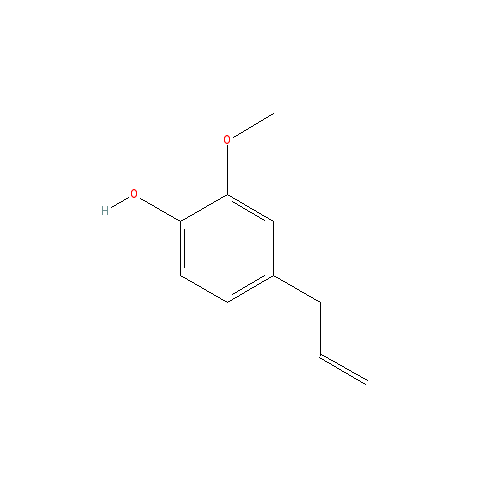
2-Methoxy-4-(2-propenyl)phenol
2-Methoxy-4-allylphenol · 4-Allylguaiacol · Eugenic acid
化学組成 · Constituent
Eugenol là cấu tử chủ đạo trong tinh dầu đinh hương, quế lá, pimenta và bay West Indian. Là một phenol thay thế, hợp chất có tính axit yếu, có thể ăn mòn mô ở nồng độ cao. EU liệt kê eugenol là một trong 26 chất gây dị ứng hương liệu cần khai báo.
Trên da. Patch test ở 8 phần trăm trên 25 tình nguyện viên không gây mẫn cảm. Trong 11.632 patch test với sản phẩm tiêu dùng chứa eugenol hoặc tinh dầu đinh hương lá, chỉ có một ca cảm ứng và một ca mẫn cảm có sẵn. Tỷ lệ phản ứng trong bệnh nhân viêm da dao động 0.4 đến 2.0 phần trăm tuỳ nồng độ test.
Niêm mạc. Eugenol nguyên chất gây tổn thương niêm mạc miệng và lưỡi đáng kể, kèm hoại tử tế bào. Liều thấp lại có tác dụng kháng viêm và gây tê tại chỗ trên tuỷ răng. Liều cao gây độc tế bào và tổn thương mô rộng.
Đường uống. LD50 cấp tính qua đường uống 2.13 g/kg ở chuột lang, 2.68 g/kg ở chuột và 3.0 g/kg ở chuột nhắt. Ngộ độc nặng đã được báo cáo ở trẻ em sau khi nuốt 5 đến 20 mL tinh dầu đinh hương, gây suy gan cấp.
Gan. Eugenol đường uống ở 900 mg/kg gây độc gan. Ở 600 mg/kg có thể gây độc gan ở chuột nhắt đã cạn glutathione. Ở 100 mg/kg lại bảo vệ gan khỏi tổn thương do iron quá tải hoặc carbon tetrachloride. Tính chất phụ thuộc liều rất rõ rệt.
Tương tác thuốc. Eugenol ức chế MAO-A người, gợi ý khả năng tương tác với MAOI và SSRI khi dùng đường uống. Ức chế kết tập tiểu cầu mạnh ở liều trung bình.
Ung thư. Trong nghiên cứu hai năm, eugenol gây tăng u gan ở chuột nhắt đực, đặc biệt ở nhóm liều thấp. Mặt khác có nhiều bằng chứng chống ung thư, gồm ức chế ung thư da, vú và dạ dày trên mô hình động vật.
Eugenol is the dominant constituent in clove, cinnamon leaf, pimenta and West Indian bay oils. As a substituted phenol it is a weak acid that can corrode tissues at high concentrations. The EU lists eugenol as one of 26 fragrance allergens requiring declaration.
Skin. An 8 percent patch test on 25 volunteers produced no sensitization. Out of 11,632 patch tests with consumer products containing eugenol or clove leaf oil, only one case of induced and one of pre-existing sensitization were noted. Reaction rates among dermatitis patients vary from 0.4 to 2.0 percent depending on test concentration.
Mucous membranes. Undiluted eugenol causes significant damage to oral and lingual mucosa with cell necrosis. Low doses are anti-inflammatory and locally anesthetic on dental pulp. High concentrations cause cytotoxicity and extensive tissue damage.
Oral. Acute oral LD50 is 2.13 g/kg in guinea pigs, 2.68 g/kg in rats and 3.0 g/kg in mice. Severe poisoning has been reported in children after swallowing 5 to 20 mL of clove oil, with acute liver failure.
Liver. Oral eugenol at 900 mg/kg is hepatotoxic. At 600 mg/kg it may be hepatotoxic in glutathione-depleted mice. At 100 mg/kg it protects the liver from iron overload or carbon tetrachloride damage. The dose-dependent nature is striking.
Drug interactions. Eugenol inhibits human MAO-A, suggesting potential interactions with MAOI and SSRI drugs taken orally. Strong antiplatelet aggregation activity at moderate doses.
Cancer. In a two-year study, eugenol increased liver tumors in male mice, particularly in the low-dose group. Conversely, there is substantial anticancer evidence including inhibition of skin, breast and stomach cancers in animal models.
| Đinh hương (nụ) · Clove bud | 73.5 – 96.9 % |
| Đinh hương (lá) · Clove leaf | 77.0 – 88.0 % |
| Quế (lá) · Cinnamon leaf | 68.6 – 87.0 % |
| Đinh hương (cành) · Clove stem | 76.4 – 84.8 % |
| Hồ tiêu Jamaica (lá) · Pimento leaf | 66.0 – 84.0 % |
| Hồ tiêu Jamaica · Pimento berry | 67.0 – 80.0 % |
| Tejpat | 78.0 % |
| Húng quế cay · Basil (pungent) | 62.9 % |
| Nguyệt quế Tây Ấn · Bay (West Indian) | 44.4 – 56.2 % |
| Húng quế thiêng · Basil (holy) | 31.9 – 50.4 % |
| Trầu (lá) · Betel | 20.5 – 33.2 % |
| Húng quế · Basil (linalool CT) | 9.4 – 15.2 % |
| Quế (vỏ) · Cinnamon bark | 2.0 – 13.3 % |
| Cẩm chướng · Carnation | 1.7 – 3.6 % |
| Nguyệt quế (lá) · Laurel leaf | 1.2 – 3.0 % |
| Hoa nhài · Jasmine | 1.1 – 3.0 % |
| Hoa hồng Provence · Rose (Provence) | 0.7 – 2.8 % |
| Cistus | 0 – 2.3 % |
| Bạch đậu · Ginger lily | 1.4 % |
| Hoa hồng Damask · Rose (Damask) | tr – 1.3 % |
| Húng quế · Basil (estragole CT) | tr – 1.2 % |
| Hoa hồng Nhật · Rose (Japanese) | 1.0 % |
| Thông Huon · Pine (huon) | 0.5 – 1.0 % |
Trên người, eugenol được hấp thu nhanh và chuyển hoá nhanh. Sau liều uống 150 mg, 95 phần trăm được bài tiết qua nước tiểu, khoảng 55 phần trăm dưới dạng glucuronide và sulfate liên hợp. Chỉ 0.1 phần trăm hợp chất không đổi.
Eugenol có thể được chuyển hoá thành các hợp chất độc bao gồm eugenol 2',3'-epoxide và 1'-hydroxyeugenol, tương tự như cách chuyển hoá acetaminophen. Tuy nhiên epoxide bị thuỷ phân nhanh hơn nhiều ở gan người so với gan chuột, tạo biên an toàn rộng cho người.
Epoxidation và 1'-hydroxylation của eugenol kém quan trọng hơn nhiều so với safrole và estragole, điều này giải thích hồ sơ ung thư khác biệt giữa các phenylpropenoid này.
In humans, eugenol is rapidly absorbed and metabolized. After a 150 mg oral dose, 95 percent is excreted in urine, with about 55 percent as glucuronide and sulfate conjugates. Only 0.1 percent of unchanged eugenol is detected.
Eugenol can be metabolized to toxic compounds including eugenol 2',3'-epoxide and 1'-hydroxyeugenol, analogous to acetaminophen metabolism. However, the epoxide is hydrolyzed much more rapidly in human liver than in rat liver, giving a wide margin of safety in humans.
Epoxidation and 1'-hydroxylation of eugenol are significantly less important than for safrole and estragole, which explains the different cancer profiles among these phenylpropenoids.
Eugenol thể hiện tính phụ thuộc liều đặc biệt rõ. Nồng độ thấp bảo vệ gan, chống oxi hoá và chống viêm. Nồng độ cao là chất tiền oxi hoá, có thể gây độc gan, độc tế bào và tổn thương mô.
Một quan sát thú vị là eugenol có thể giảm tính mẫn cảm da với cinnamaldehyde khi hai chất được dùng cùng nhau, có lẽ qua cạnh tranh thụ thể hoặc tác dụng kháng viêm của eugenol.
Eugenol shows particularly striking dose-dependent behavior. Low concentrations are hepatoprotective, antioxidant and anti-inflammatory. High concentrations act as a pro-oxidant and can cause hepatotoxicity, cytotoxicity and tissue damage.
An interesting observation is that eugenol can reduce skin sensitization to cinnamaldehyde when the two are applied together, possibly through receptor competition or the anti-inflammatory action of eugenol.