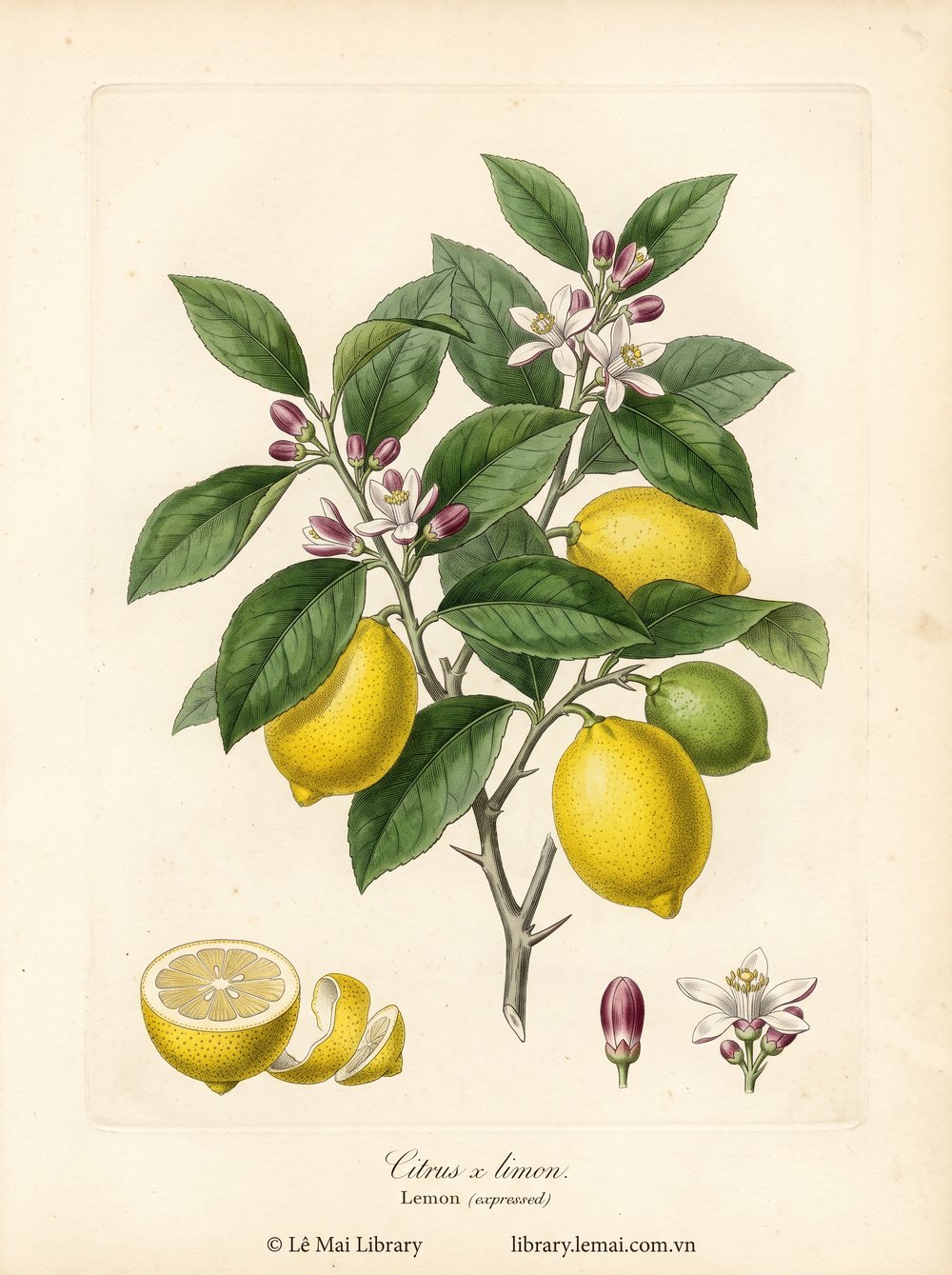
レモン圧搾
Chanh vàng, ép
Citrus x limon
Citrus limonum
Lemon ép lạnh phototoxic mức thấp. Phototoxicity chủ yếu do bergapten và oxypeucedanin. Hàm lượng furocoumarin biến thiên tới 20 lần giữa các nguồn.
Báo cáo lâm sàng: một phụ nữ bị bỏng nhẹ trên cánh tay và chân sau khi tắm sauna với vài giọt expressed lemon oil nhỏ trong nồi sauna, không bôi lên da, rồi vào sunbed 20 phút.
Tỷ lệ phản ứng da thấp. Trong 1,409 bệnh nhân nghi nhạy ứng hương liệu, chỉ 4 người (0.29 phần trăm) phản ứng dương tính với 2 phần trăm lemon oil. Đa số phản ứng ở mức nhẹ.
Sản phẩm oxy hóa của (+)-limonene có thể gây nhạy ứng da. Bảo quản đúng cách bắt buộc.
Một aromatherapist 65 tuổi với nhiều nhạy ứng tinh dầu khác nhau phản ứng với lemon 5 phần trăm nhưng không phản ứng với 1 phần trăm. Một thợ pha rượu thường xuyên tiếp xúc với lemon tươi bị eczema bàn tay, patch test dương tính với lemon oil, lemongrass oil và geraniol.
Không có dữ liệu cho thấy nguy hiểm trong thai kỳ, (+)-limonene, β-pinene, α-pinene, sabinene đều có độc tính sinh sản thấp.
Expressed lemon is low-risk phototoxic. Phototoxicity is primarily due to bergapten and oxypeucedanin. Furocoumarin content varies up to 20-fold between sources.
Clinical report: a woman sustained minor burns on one arm and leg after a sauna with a few drops of expressed lemon oil in a pot (not on her skin), followed by 20 minutes in a sunbed.
Skin reaction rate is low. In 1,409 patients suspected of fragrance allergy, only 4 (0.29 percent) reacted positively to 2 percent lemon oil. Most reactions were mild.
Oxidation products of (+)-limonene can sensitize skin. Proper storage is required.
A 65-year-old aromatherapist with multiple essential oil sensitivities reacted to 5 percent lemon oil but not 1 percent. A barman who handled fresh lemons developed hand eczema and patch-tested positive to lemon oil, lemongrass oil, and geraniol.
No data indicates hazard in pregnancy, (+)-limonene, β-pinene, α-pinene, and sabinene all have low reproductive toxicity.
| (+)-Limonene | 56.6 – 76.0 % |
| β-Pinene | 6.0 – 17.0 % |
| γ-Terpinene | 3.0 – 13.3 % |
| α-Terpineol | 0.1 – 8.0 % |
| α-Pinene | 1.3 – 4.4 % |
| Geranial | 0.5 – 4.3 % |
| Sabinene | 0.5 – 2.4 % |
| p-Cymene | tr – 2.3 % |
| β-Myrcene | tr – 2.2 % |
| Neral | 0.4 – 2.0 % |
| Terpinen-4-ol | tr – 1.9 % |
| Neryl acetate | 0.1 – 1.5 % |
| Oxypeucedanin | 0.09 – 0.82 % |
| Bergamottin | 0.16 – 0.54 % |
| 5-Geranoxy-7-methoxycoumarin | 0.18 – 0.28 % |
| Citropten | 0.05 – 0.17 % |
| Byakangelicol | 0.006 – 0.16 % |
| 8-Geranyloxypsoralen | 0.01 – 0.045 % |
| Bergapten | 0.0001 – 0.035 % |
| Isopimpinellin | 0 – 0.011 % |
Citrus x limon là cây cam quýt nhỏ, có nguồn gốc từ Châu Á, được trồng rộng rãi khắp vùng Địa Trung Hải. Italy, Sicily là sản xuất chính cùng với Argentina, Tây Ban Nha, Mỹ.
Tinh dầu lấy từ vỏ quả tươi bằng phương pháp ép lạnh (expression). Không qua nhiệt, giữ nguyên hợp chất furocoumarin.
Cây cho quả quanh năm tại vùng nhiệt đới, theo mùa tại vùng ôn đới. Mỗi tấn vỏ cho khoảng 5-8 kg tinh dầu.
Họ Rutaceae, cùng họ với bergamot, orange, grapefruit, lime.
Citrus x limon is a small citrus tree native to Asia, widely cultivated across the Mediterranean. Italy and Sicily are the main producers, alongside Argentina, Spain, and the United States.
The essential oil is extracted from fresh peel by cold expression. No heat is applied, preserving the furocoumarin compounds.
The tree fruits year-round in tropical regions, seasonally in temperate zones. Each ton of peel yields approximately 5-8 kg of essential oil.
Family Rutaceae, same family as bergamot, orange, grapefruit, and lime.
Lemon oil có thể bị làm giả bằng limonene tự nhiên hoặc tổng hợp, citral tự nhiên hoặc tổng hợp, và nhiều by-product rẻ khác.
Adulterant phổ biến gồm orange terpenes, lemon terpenes, hoặc by-product từ quá trình sản xuất citrus khác.
Yêu cầu phân tích GC-MS để xác định chất lượng. Lemon Italian Sicilian được xem là chuẩn vàng.
Hàm lượng furocoumarin và mức phototoxic biến thiên rất lớn giữa các nguồn, lemon từ California có phototoxicity thấp hơn lemon từ Italy, Greece, Côte d'Ivoire.
Lemon oil may be adulterated with natural or synthetic limonene, natural or synthetic citral, and many other cheap by-products.
Common adulterants include orange terpenes, lemon terpenes, or by-products from other citrus production.
GC-MS analysis is needed to verify quality. Sicilian Italian lemon is regarded as the gold standard.
Furocoumarin content and phototoxicity level vary widely between sources, Californian lemon has lower phototoxicity than lemon from Italy, Greece, or Côte d'Ivoire.
| 4711 Echt Kölnisch Wasser | 4711 · 1799 · nốt đầu top |
| Eau de Cologne Impériale | Guerlain · 1853 · nốt đầu top |
| Colonia | Acqua di Parma · 1916 · nốt đầu top |
| Eau Sauvage | Dior · 1966 · nốt đầu top |
| Light Blue | Dolce&Gabbana · 2001 · nốt đầu top |
Theo danh sách nốt hương do nhà sản xuất công bố. Tên nước hoa và thương hiệu thuộc chủ sở hữu tương ứng.Based on note lists published by each house. Fragrance names and marks belong to their owners.
Lemon oil không bị mutagenic trong Ames test. Không gây CA trong fibroblast hamster Trung Quốc.
Hoạt tính chống ung thư đáng kể in vitro: cytotoxic với tế bào ung thư tuyến tiền liệt, phổi, vú với IC50 lần lượt 0.08, 0.06, 0.14 phần trăm.
Trong nghiên cứu trên chuột, lemon oil ức chế khối u dạ dày trước và phổi do B[a]P gây ra, ức chế adenoma phổi do NNK gây ra.
Lemon oil chưa được nghiên cứu dài hạn về tác dụng photo-genotoxic hoặc photocarcinogenic.
Tinh dầu lemon được dùng phổ biến nhất trong fine fragrance, cosmetic, perfumery, hương vị thực phẩm. Sản lượng toàn cầu lớn.
Lemon oil is not mutagenic in the Ames test. Does not produce chromosomal aberrations in Chinese hamster fibroblasts.
Notable anticarcinogenic activity in vitro: cytotoxic to prostate, lung, and breast cancer cells with IC50 values of 0.08, 0.06, and 0.14 percent respectively.
In mouse studies, lemon oil inhibited forestomach and lung neoplasia induced by B[a]P, and inhibited NNK-induced pulmonary adenoma formation.
Lemon oil has not been studied for long-term photo-genotoxic or photocarcinogenic effects.
Lemon oil is among the most widely used essential oils in fine fragrance, cosmetics, perfumery, and food flavoring. Global production is large.