(+)-Limonene
(R)-(+)-1-Methyl-4-(1-methylethenyl)cyclohexene
d-Limonene · (R)-(+)-Limonene · p-Mentha-1,8-diene · 1,8-p-Menthadiene · Cinene
化学組成 · Constituent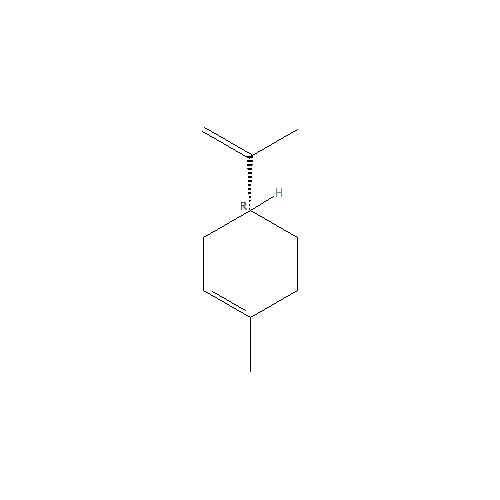
(R)-(+)-1-Methyl-4-(1-methylethenyl)cyclohexene
d-Limonene · (R)-(+)-Limonene · p-Mentha-1,8-diene · 1,8-p-Menthadiene · Cinene
化学組成 · Constituent
(+)-Limonene là một trong những cấu tử phổ biến nhất trong tinh dầu, chiếm tỷ lệ rất cao trong nhóm Citrus. Hợp chất tinh khiết an toàn ở mức sử dụng thông thường, nhưng dạng bị oxi hoá lại tăng đáng kể nguy cơ gây mẫn cảm da.
Trên da. Thử nghiệm patch ở 8 phần trăm trên 25 người tình nguyện không gây mẫn cảm. Ở 20 phần trăm trên 20 bệnh nhân viêm da, limonene 98 phần trăm tinh khiết không gây kích ứng. Ở nồng độ 1 đến 3 phần trăm trên hàng nghìn bệnh nhân viêm da, tỷ lệ phản ứng dị ứng dao động 0 đến 0.56 phần trăm.
Oxi hoá làm tăng tính gây mẫn cảm. Sản phẩm oxi hoá chính bao gồm limonene 1,2-oxide, carvone, carveol và limonene-2-hydroperoxide, trong đó các hydroperoxide là chất gây dị ứng tiếp xúc mạnh. Trong các nghiên cứu trên hàng nghìn bệnh nhân viêm da, limonene đã oxi hoá ở 3 phần trăm gây phản ứng dị ứng ở 0.9 đến 2.8 phần trăm. Tổng hợp dữ liệu cho thấy oxi hoá có thể tăng tính gây dị ứng lên khoảng mười lần.
Đường uống. LD50 cấp tính trên chuột vượt 5 g/kg. Liều đơn 100 mg/kg trên người tình nguyện khoẻ mạnh không gây độc.
Thận. Liều cao đường uống gây tổn thương thận ở chuột đực Wistar và F344, qua tích tụ a2u-globulin. Hiệu ứng này đặc thù cho chuột đực, không xảy ra ở người hay các loài có vú khác.
Sinh sản. Liều uống cao gây độc cho mẹ và một số bất thường cốt hoá xương ở thai chuột và chuột nhắt, nhưng không gây dị tật bẩm sinh. NOAEL sinh sản 591 mg/kg/ngày ở chuột nhắt và 250 mg/kg/ngày ở thỏ.
Ung thư. Trong nghiên cứu dài hạn, limonene gây ung thư thận chỉ ở một dòng chuột đực F344/N, cơ chế không có ý nghĩa với người. Trên người và động vật khác, (+)-limonene cho thấy hoạt tính chống ung thư rộng, gồm vú, dạ dày, tuỵ và phổi.
(+)-Limonene is one of the most abundant constituents in essential oils, dominant in the Citrus family. Pure material is safe at standard use levels, but oxidized limonene significantly increases skin sensitization risk.
Skin. A 8 percent patch test on 25 volunteers showed no sensitization. At 20 percent on 20 dermatitis patients, 98 percent pure (+)-limonene was non-irritating. At 1 to 3 percent across thousands of dermatitis patients, allergic reaction rates ranged 0 to 0.56 percent.
Oxidation increases allergenicity. Primary oxidation products include limonene 1,2-oxide, carvone, carveol and limonene-2-hydroperoxide, with the hydroperoxides acting as strong contact allergens. In studies on thousands of dermatitis patients, oxidized limonene at 3 percent caused allergic reactions in 0.9 to 2.8 percent. Combined data suggest oxidation may raise allergenicity roughly tenfold.
Oral. Acute oral LD50 in rats exceeded 5 g/kg. A single 100 mg/kg dose in healthy human volunteers was non-toxic.
Kidney. High oral doses cause renal injury in male Wistar and F344 rats through a2u-globulin accumulation. This effect is specific to male rats and does not occur in humans or other mammals.
Reproductive. High oral doses caused maternal toxicity and some skeletal ossification delays in rat and mouse fetuses, but no teratogenicity. Reproductive NOAEL was 591 mg/kg/day in mice and 250 mg/kg/day in rabbits.
Cancer. In long-term studies, limonene caused kidney cancer only in male F344/N rats through a mechanism not relevant to humans. In humans and other species, (+)-limonene shows broad anticancer activity including breast, stomach, pancreatic and lung cancers.
Sau khi uống, (+)-limonene được hấp thu nhanh và chuyển hoá rộng. Ở thỏ, 72 phần trăm liều được bài tiết qua nước tiểu trong 72 giờ, 7 phần trăm qua phân. Không phát hiện limonene nguyên dạng trong nước tiểu, chứng tỏ chất được chuyển hoá hoàn toàn thành các sản phẩm oxi hoá và liên hợp tan trong nước.
Ở người, các chất chuyển hoá tuần hoàn chính theo thứ tự ưu thế giảm dần là perillic acid, dihydroperillic acid, limonene-1,2-diol, uroterpenol và một đồng phân của perillic acid. (+)-Limonene cảm ứng các enzyme CYP và làm giảm hoạt tính HMG-CoA reductase.
Có sự khác biệt giữa loài trong con đường oxi hoá. Ở chó, thỏ và chuột lang, (+)-limonene chuyển hoá thành carveol, perillyl alcohol và carvone. Ở chuột nhắt, chuột cống, khỉ và người, chỉ tạo carveol và perillyl alcohol, không có carvone.
After oral dosing, (+)-limonene is rapidly absorbed and extensively metabolized. In rabbits, 72 percent of the dose is excreted in urine within 72 hours, with 7 percent in feces. No unchanged limonene is detected in urine, confirming complete metabolism to oxidation products and water-soluble conjugates.
In humans, the predominating circulating metabolites in descending order are perillic acid, dihydroperillic acid, limonene-1,2-diol, uroterpenol and an isomer of perillic acid. (+)-Limonene induces CYP enzymes and reduces HMG-CoA reductase activity.
Species differences exist in the oxidation pathway. In dogs, rabbits and guinea pigs, (+)-limonene converts to carveol, perillyl alcohol and carvone. In mice, rats, monkeys and humans, only carveol and perillyl alcohol are produced, with no carvone.
(+)-Limonene là một trong 26 chất gây dị ứng hương liệu được EU yêu cầu khai báo trên nhãn. Lưu trữ lạnh trong bình kín có thể ngăn oxi hoá đến 12 tháng. Thêm BHT hoặc tocopherol kéo dài thêm thời hạn nhưng không phải mãi mãi.
Tinh dầu giàu limonene nên dùng song song chất chống oxi hoá và đóng gói chống ánh sáng. Một khi sự oxi hoá bắt đầu, quá trình tiến triển nhanh chóng.
(+)-Limonene is one of 26 EU-listed fragrance allergens requiring label declaration. Cold dark storage in sealed containers prevents oxidation for up to 12 months. Addition of BHT or tocopherol extends shelf life but not indefinitely.
Limonene-rich oils should be paired with antioxidants and light-proof packaging. Once oxidation begins, the process progresses rapidly.