p-Cymene
1-Methyl-4-(1-methylethyl)benzene
4-Isopropyl toluene · Dolcymene
化学組成 · Constituent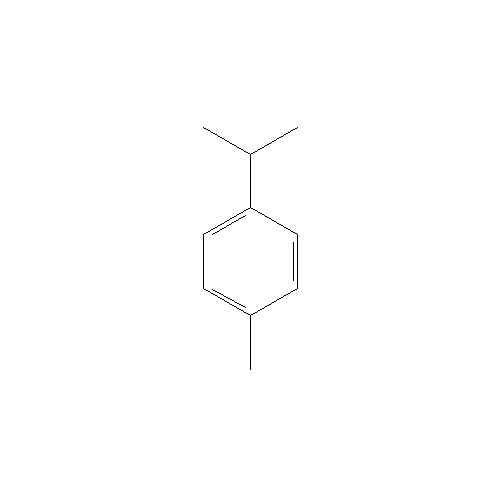
1-Methyl-4-(1-methylethyl)benzene
4-Isopropyl toluene · Dolcymene
化学組成 · Constituent
p-Cymene là hydrocarbon đơn vòng phổ biến trong tinh dầu họ Lamiaceae. Hợp chất cũng là sản phẩm phân huỷ tự nhiên của các monoterpene khác.
Trên da. Patch test 4 phần trăm trên 25 tình nguyện không kích ứng và không mẫn cảm, mặc dù đã được báo cáo là chất kích ứng cơ bản. Bôi nguyên chất kích ứng vừa da thỏ. Trong nhóm bệnh nhân nhạy tea tree, một trong bảy phản ứng với 1 phần trăm. Trong nhóm khác 11 bệnh nhân, 5 phần trăm không gây phản ứng.
Đường uống và da. LD50 cấp tính chuột 4.75 g/kg; LD50 da thỏ vượt 5 g/kg.
p-Cymene thường xuất hiện như sản phẩm thoái hoá của γ-terpinene, α-terpinene và những monoterpene khác. Nồng độ tăng theo tuổi của tinh dầu là dấu hiệu oxi hoá.
p-Cymene is a monocyclic hydrocarbon common in Lamiaceae oils. The compound is also a natural degradation product of other monoterpenes.
Skin. A 4 percent patch test on 25 volunteers caused no irritation or sensitization, although it has been reported as a primary irritant. Undiluted application was moderately irritant to rabbit skin. Among tea tree sensitive patients, one of seven reacted to 1 percent. In a separate group of 11 patients, 5 percent caused no reactions.
Oral and dermal. Acute oral LD50 in rats is 4.75 g/kg; rabbit dermal LD50 exceeds 5 g/kg.
p-Cymene often appears as a degradation product of γ-terpinene, α-terpinene and other monoterpenes. Rising concentration with oil age is a marker of oxidation.
p-Cymene có khác biệt loài rõ rệt trong chuyển hoá, với 23 chất chuyển hoá được xác định. Chất chuyển hoá chính ở chuột là cumic acid; ở chuột lang là cuminuric acid. p-Cymen-8-ol và p-cymen-9-ol là chất chuyển hoá thiểu số ở cả hai loài. Ở thỏ, hợp chất được chuyển hoá thành myrcene-3(10)-glycol, uroterpenol và p-cymene-9-carboxylic acid.
p-Cymene shows marked species differences in metabolism, with 23 metabolites identified. The major metabolite in rats is cumic acid; in guinea pigs cuminuric acid. p-Cymen-8-ol and p-cymen-9-ol are minor in both. In rabbits, the compound is metabolized to myrcene-3(10)-glycol, uroterpenol and p-cymene-9-carboxylic acid.
p-Cymene là cấu tử dấu chỉ cho tinh dầu giàu thymol và carvacrol. Hợp chất ổn định hơn các tiền chất terpene và là tín hiệu của tinh dầu được lưu trữ lâu.
Hợp chất cũng được tìm thấy ở mức thấp trong hơn 200 tinh dầu khác.
p-Cymene is a marker constituent for thymol- and carvacrol-rich oils. The compound is more stable than its terpene precursors and signals an aged or oxidized oil.
It is also found at low levels in over 200 other essential oils.