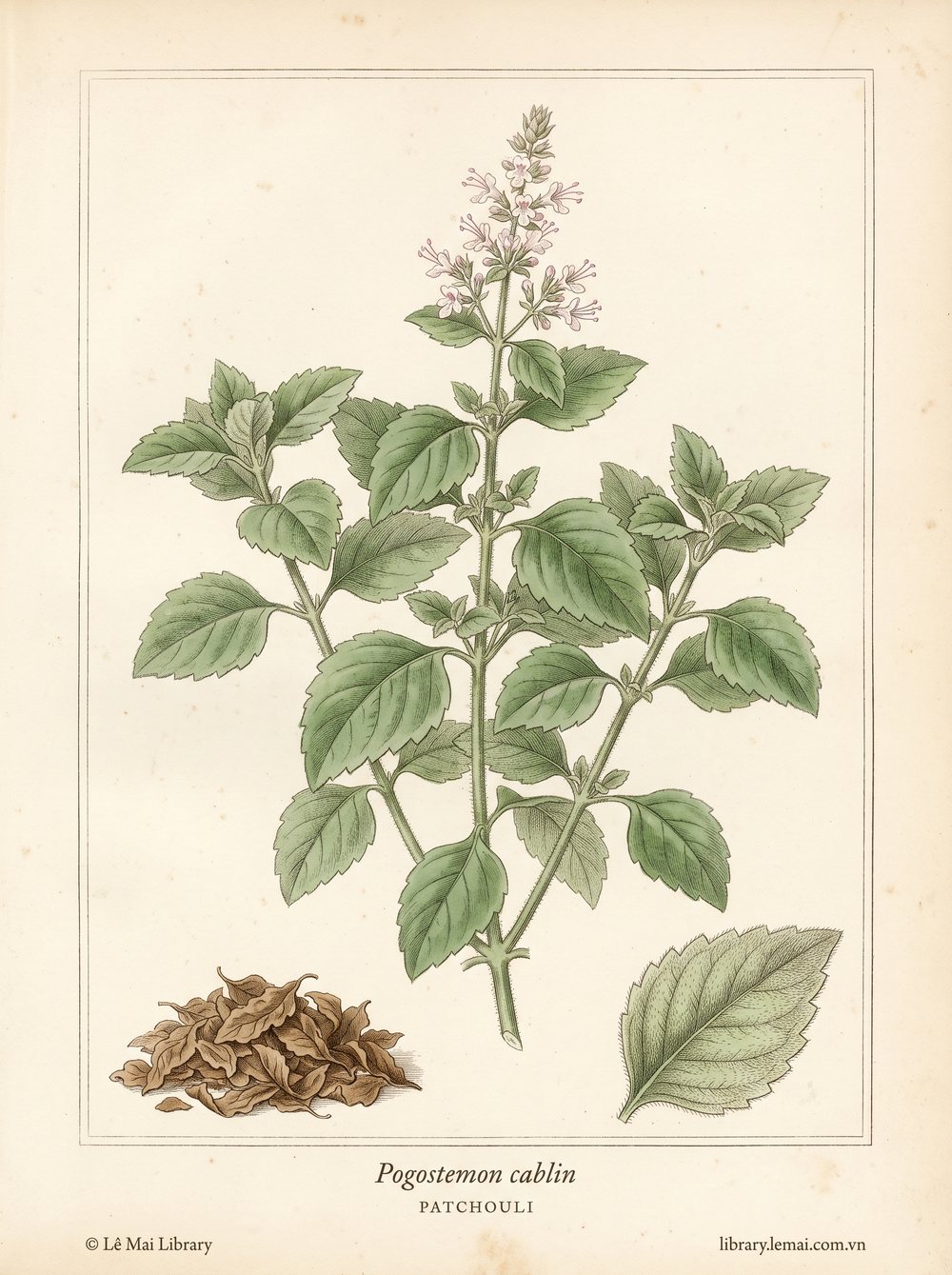
パチョリ
Hoắc hương
Pogostemon cablin
Pogostemon patchouly
Patchouli được xếp loại GRAS bởi FDA Hoa Kỳ. Không có giới hạn IFRA cụ thể.
Khả năng nhạy ứng da thấp. Trong 25 người tình nguyện thử với 10 phần trăm: không kích ứng hoặc nhạy ứng. Trong 1,606 bệnh nhân viêm da tiếp xúc thử với 10 phần trăm: 13 ca phản ứng (0.8 phần trăm).
Có thể ức chế kết tập tiểu cầu. Cẩn trọng khi dùng oral với thuốc chống đông, sau phẫu thuật lớn, hoặc có rối loạn đông máu.
Một số nghiên cứu cho thấy patchouli oil 'mildly phototoxic'; nghiên cứu khác không tìm thấy phototoxicity. Khuyến cáo thận trọng khi dùng nồng độ cao trên da tiếp xúc ánh nắng.
Không có dữ liệu cho thấy nguy hiểm cụ thể trong thai kỳ.
Patchouli oil được xem là một trong những tinh dầu an toàn nhất trong perfumery, phù hợp cho dùng lâu dài, leave-on products.
Patchouli is classified as GRAS by the US FDA. No specific IFRA restriction.
Low skin sensitization risk. In 25 volunteers tested at 10 percent: not irritating or sensitizing. In 1,606 contact dermatitis patients tested at 10 percent: 13 reactions (0.8 percent).
May inhibit platelet aggregation. Use orally with caution alongside anticoagulants, after major surgery, or with bleeding disorders.
Some studies report patchouli oil 'mildly phototoxic'; other studies found no phototoxicity. Caution at high concentrations on sun-exposed skin.
No data indicates specific hazard in pregnancy.
Patchouli oil is considered one of the safest essential oils in perfumery, suited to long-term, leave-on product use.
| Patchouli alcohol | 17.5 – 32.7 % |
| α-Bulnesene (δ-guaiene) | 8.7 – 20.7 % |
| α-Guaiene | 8.8 – 15.3 % |
| Seychellene | 0 – 9.6 % |
| β-Patchoulene | 2.0 – 9.3 % |
| α-Patchoulene | 4.5 – 8.5 % |
| γ-Patchoulene | 0 – 6.7 % |
| β-Caryophyllene | 2.1 – 4.2 % |
| (−)-allo-Aromadendrene | 0 – 5.0 % |
| 1(10)-Aromadendrene | 0 – 3.9 % |
| Pogostone | 0 – 3.8 % |
| Pogostol | 0 – 2.4 % |
| δ-Cadinene | 0 – 2.4 % |
Pogostemon cablin là cây thân thảo nhiệt đới Đông Nam Á, đặc biệt Indonesia (Sumatra), Malaysia, Philippines, Việt Nam. Cây nhỏ, lá rộng có lông tơ mịn, mùi đặc trưng.
Lá thu hoạch và phơi khô, sự phơi khô là yếu tố quyết định chất lượng mùi. Lá khô được lên men nhẹ trước chưng cất.
Năng suất tinh dầu khoảng 2-4 phần trăm trên khối lượng lá khô. Quá trình chưng cất kéo dài 8-24 giờ, chưng cất ngắn cho oil light hơn, chưng cất dài cho oil đậm và balsamic.
Indonesian patchouli (đặc biệt từ Sumatra) được coi là chuẩn vàng, chứa patchouli alcohol cao nhất (28-33 phần trăm).
Chinese patchouli rẻ hơn nhưng patchouli alcohol thấp hơn (17-32 phần trăm). Indian patchouli và Vietnamese patchouli cũng có sản lượng đáng kể.
Họ Lamiaceae (Labiatae), cùng họ với mint, basil, rosemary, lavender.
Pogostemon cablin is a tropical Southeast Asian herb, particularly from Indonesia (Sumatra), Malaysia, the Philippines, and Vietnam. A small plant with broad downy leaves and a distinctive aroma.
Leaves are harvested and dried, drying is the determining quality factor. Dried leaves are lightly fermented before distillation.
Oil yield is about 2-4 percent of dried leaf weight. Distillation lasts 8-24 hours, short distillation yields lighter oil, long distillation produces deeper, more balsamic oil.
Indonesian patchouli (especially from Sumatra) is regarded as the gold standard, highest patchouli alcohol content (28-33 percent).
Chinese patchouli is cheaper but lower in patchouli alcohol (17-32 percent). Indian and Vietnamese patchouli also have substantial production.
Family Lamiaceae (Labiatae), same family as mint, basil, rosemary, and lavender.
Patchouli oil bị làm giả thường xuyên. Adulterant phổ biến: gurjun balsam oil (sẽ xuất hiện α-gurjunene), copaiba balsam, cedarwood, vetiver, camphor distillate residues, hercolyn D, benzyl benzoate, propylene glycol, vegetable oils.
Indonesian patchouli cao cấp đôi khi bị trộn với Chinese patchouli rẻ hơn. Verify chất lượng bằng GC-MS, patchouli alcohol và α-bulnesene ratio là chỉ dấu chính.
Patchouli oil cũ (aged) được ưa chuộng hơn oil mới trong perfumery, cũ 5-10 năm cho mùi tinh tế, mượt mà hơn. Là một trong số ít essential oils được đánh giá cao khi 'aged'.
Mùi patchouli thật: gỗ, đất, ấm, sâu, không có nốt 'gắt', 'hóa chất' của adulteration. Mùi xanh non khi mới, chín và mượt mà khi để lâu.
Patchouli oil is frequently adulterated. Common adulterants: gurjun balsam oil (will show α-gurjunene), copaiba balsam, cedarwood, vetiver, camphor distillate residues, hercolyn D, benzyl benzoate, propylene glycol, vegetable oils.
Premium Indonesian patchouli is sometimes blended with cheaper Chinese patchouli. Verify quality by GC-MS, patchouli alcohol and α-bulnesene ratio are key indicators.
Aged patchouli oil is preferred over new in perfumery, 5-10 years aging produces a more refined, smoother aroma. One of the few essential oils valued for 'aging'.
True patchouli aroma: woody, earthy, warm, deep, without 'sharp' or 'chemical' notes of adulteration. Green and youthful when new, mature and smooth with age.
| Aromatics Elixir | Clinique · 1971 · nốt đáy base |
| Angel | Mugler · 1992 · nốt đáy base |
| Coco Mademoiselle | Chanel · 2001 · nốt đáy base |
| Bornéo 1834 | Serge Lutens · 2005 · nốt chính main note |
| Coromandel | Chanel · 2007 · nốt chính main note |
Theo danh sách nốt hương do nhà sản xuất công bố. Tên nước hoa và thương hiệu thuộc chủ sở hữu tương ứng.Based on note lists published by each house. Fragrance names and marks belong to their owners.
Patchouli là một trong những note nền (base note) quan trọng nhất trong perfumery. Trong fragrance 'oriental', 'chypre', 'fougère', và 'modern niche', patchouli xuất hiện gần như khắp nơi.
Patchouli alcohol là chất tạo mùi chính. Phân tử lớn, không bay hơi nhanh, đó là lý do patchouli có khả năng fixative (giữ mùi) tuyệt vời.
Trong văn hóa hippie thập niên 1960-1970, patchouli trở thành biểu tượng, mùi 'free spirit', 'anti-establishment'. Đến nay vẫn liên tưởng nhẹ tới văn hóa đó.
Trong y học truyền thống Trung Quốc và Việt Nam (huoxiang 藿香), lá patchouli được dùng cho tiêu hóa, cảm cúm, ẩm thấp.
Trong cosmetic, patchouli oil là nguyên liệu phổ biến cho perfume, body lotion, dầu massage, candle. Phù hợp với mọi loại da, không phototoxic ở nồng độ thông thường.
Patchouli được ưa chuộng đặc biệt trong men's fragrance, note nền cho aftershave và cologne hiện đại.
Patchouli oil cũ giá cao hơn oil mới, đôi khi gấp 2-3 lần. Đây là điểm độc đáo trong essential oil trade.
Patchouli is one of the most important base notes in perfumery. In oriental, chypre, fougère, and modern niche fragrances, patchouli appears almost everywhere.
Patchouli alcohol is the principal aroma compound. A large, slow-evaporating molecule, which is why patchouli has excellent fixative properties.
In 1960s-70s hippie culture, patchouli became a symbol, the scent of 'free spirit' and 'anti-establishment'. The association lingers today.
In traditional Chinese and Vietnamese medicine (huoxiang 藿香), patchouli leaves are used for digestion, colds, and dampness.
In cosmetics, patchouli oil is widely used in perfume, body lotion, massage oil, and candles. Suited to all skin types, not phototoxic at typical concentrations.
Patchouli is particularly prized in men's fragrance, a base note for aftershaves and modern cologne.
Aged patchouli oil is more expensive than new, sometimes 2-3 times. A rare attribute in the essential oil trade.