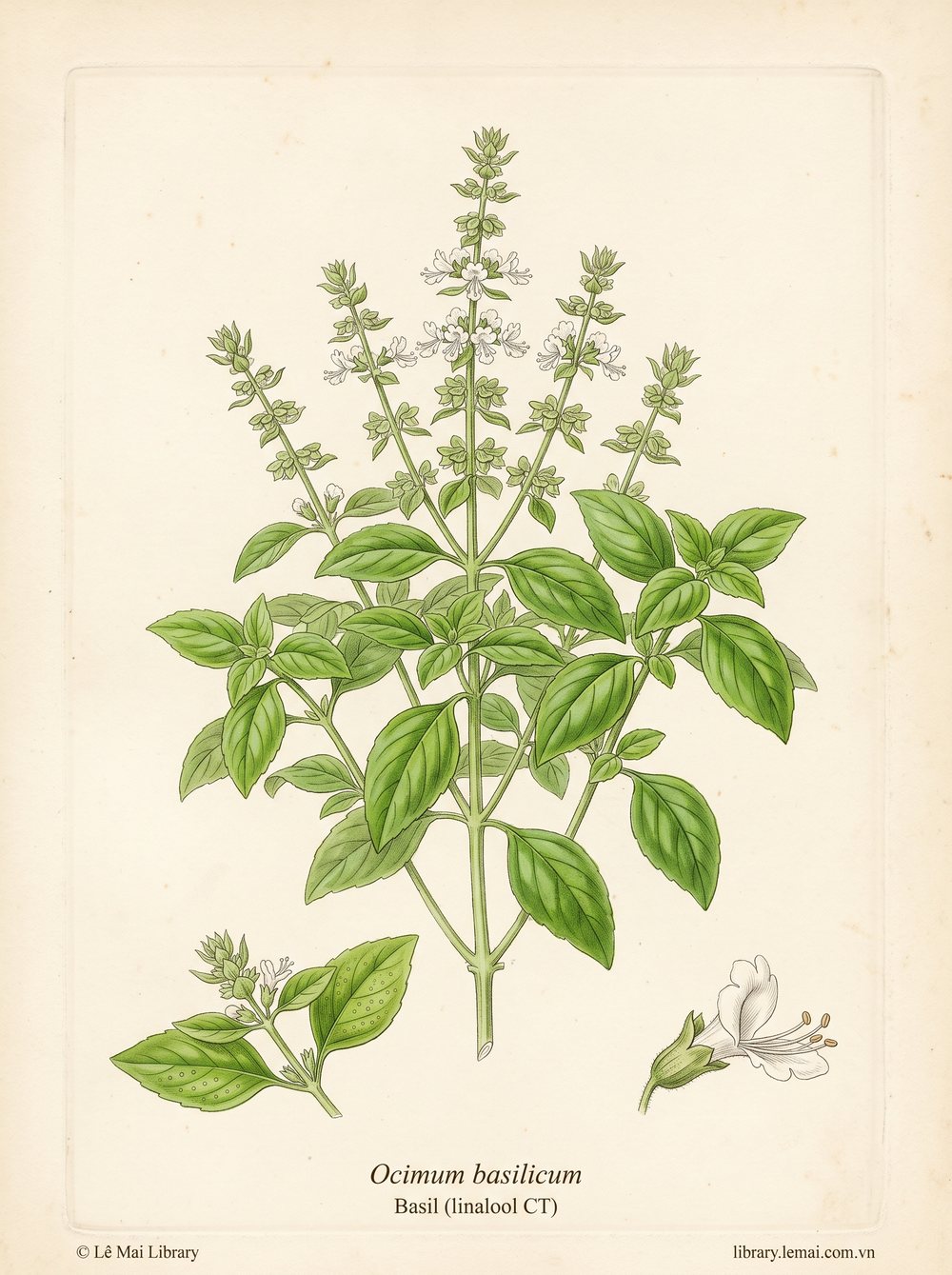
バジル リナロール CT
Húng quế
Ocimum basilicum
European basil, French basil, Sweet basil (culinary)
Nhạy ứng da rủi ro thấp. Sản phẩm oxy hóa của linalool có thể gây nhạy ứng, nhưng eugenol và 1,8-cineole trong tinh dầu này có tính chống oxy hóa.
Không có chống chỉ định cụ thể.
Nồng độ tối đa trên da 3.3 phần trăm, dựa trên 15.2 phần trăm eugenol và ngưỡng 0.5 phần trăm cho eugenol.
Mặc dù chứa estragole, tinh dầu này thể hiện hoạt tính chống đột biến và cảm ứng glutathione. Không cần giới hạn cụ thể về rủi ro carcinogen.
Low risk of skin sensitization. Oxidation products of linalool may sensitize, but eugenol and 1,8-cineole in this oil are antioxidants.
No specific contraindications.
Maximum dermal use level 3.3 percent, based on 15.2 percent eugenol and a limit of 0.5 percent for eugenol.
Although it contains estragole, this oil shows antimutagenic activity and induces glutathione. No specific limit for carcinogen risk.
| Linalool | 53.7 – 58.3 % |
| Eugenol | 9.4 – 15.2 % |
| 1,8-Cineole | 6.0 – 6.7 % |
| (E)-α-Bergamotene | 2.0 – 3.8 % |
| Germacrene D | 2.0 – 3.0 % |
| T-Cadinol | 2.6 – 3.0 % |
| Estragole | 0.2 – 2.0 % |
| α-Bulnesene | 1.3 – 1.8 % |
| β-Elemene | 0.9 – 1.5 % |
| δ-Cadinene | 0.9 – 1.4 % |
| (E)-β-Ocimene | 1.0 – 1.3 % |
| Bornyl acetate | 0.8 – 1.2 % |
| Methyleugenol | tr, 0.1 % |
Chemotype linalool của Ocimum basilicum được sản xuất chủ yếu ở châu Âu, Bắc Mỹ và một phần Bắc Phi. Đây là loại basil thông dụng nhất trong ẩm thực châu Âu, mang tên 'sweet basil' trong các cuốn sách nấu ăn.
Tinh dầu cất hơi từ lá. Có thể bị làm giả bằng linalool tổng hợp thêm vào.
Họ Lamiaceae. Cùng loài với chemotype estragole nhưng thành phần hóa học khác hẳn.
The linalool chemotype of Ocimum basilicum is produced primarily in Europe, North America and parts of North Africa. This is the basil most familiar in European cuisine, named 'sweet basil' in cookbooks.
The oil is steam-distilled from the leaves. May be adulterated by addition of synthetic linalool.
Family Lamiaceae. Same species as the estragole chemotype, but with markedly different chemistry.
Có thể bị làm giả bằng linalool tổng hợp. Yêu cầu chứng chỉ phân tích GC-MS từ nhà cung cấp.
May be adulterated by addition of synthetic linalool. Request a GC-MS certificate of analysis from the supplier.
| Azzaro pour Homme | Azzaro · 1978 · nốt đầu top |
| Aqua Allegoria Mandarine Basilic | Guerlain · 2007 · nốt chính main note |
| Eau Sauvage | Dior · 1966 · nốt đầu top |
| Erolfa | Creed · nốt đầu top |
| Buongiorno Eau de Parfum | Acqua di Parma · nốt đầu top |
Theo danh sách nốt hương do nhà sản xuất công bố. Tên nước hoa và thương hiệu thuộc chủ sở hữu tương ứng.Based on note lists published by each house. Fragrance names and marks belong to their owners.
Có cả dạng absolute (tách dung môi) với hàm lượng linalool 34.4 phần trăm và eugenol 33.7 phần trăm, cộng linoleic và linolenic acid 9.7 phần trăm.
An absolute (solvent-extracted) form is also produced, containing 34.4 percent linalool, 33.7 percent eugenol, and 9.7 percent linoleic plus linolenic acids.