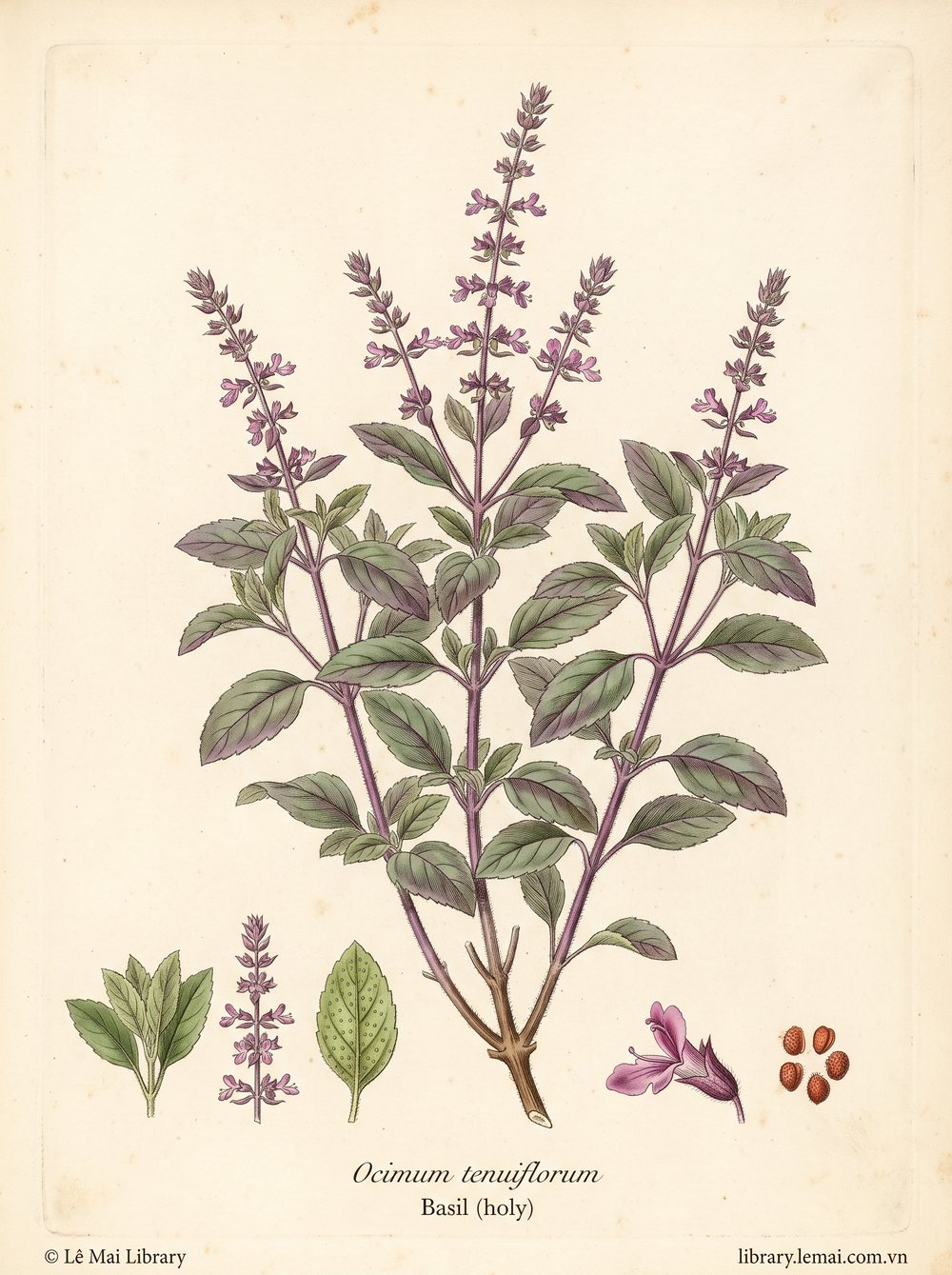
バジル ホーリー
Húng quế thiêng
Ocimum tenuiflorum
Sacred basil, Tulsi, Ocimum sanctum
Có thể chứa methyleugenol. Tương tác thuốc và có khả năng ức chế đông máu do eugenol.
Nhạy ứng da rủi ro trung bình. Kích ứng niêm mạc rủi ro thấp.
Đường uống: tránh khi dùng pethidine, MAOI, SSRI. Tránh khi dùng thuốc chống đông, trước phẫu thuật lớn, loét dạ dày tá tràng, máu khó đông.
Mặc dù chứa hai chất có khả năng gây ung thư là estragole và methyleugenol, holy basil cũng thể hiện hoạt tính chống ung thư đáng kể. Các nhà nghiên cứu cho rằng eugenol và các thành tố khác trung hòa rủi ro carcinogen.
Nồng độ tối đa trên da 1.0 phần trăm, dựa trên 50.4 phần trăm eugenol và ngưỡng dermal 0.5 phần trăm cho eugenol.
May contain methyleugenol. Drug interactions and potential to inhibit blood clotting due to eugenol.
Moderate risk of skin sensitization. Low risk of mucous membrane irritation.
Oral: avoid with pethidine, MAOIs, SSRIs. Avoid with anticoagulant medication, before major surgery, peptic ulcer, hemophilia.
Although holy basil contains two potential carcinogens, estragole and methyleugenol, it also shows significant anticarcinogenic activity. Researchers suggest eugenol and other constituents counteract the carcinogenic risk.
Maximum dermal use level 1.0 percent, based on 50.4 percent eugenol content and a dermal limit of 0.5 percent for eugenol.
| Eugenol | 31.9 – 50.4 % |
| 1,8-Cineole | 12.6 – 16.5 % |
| Estragole | 9.7 – 12.9 % |
| β-Bisabolene | 9.7 – 10.5 % |
| (Z)-α-Bisabolene | 6.5 – 6.8 % |
| (E)-β-Ocimene | 3.4 – 6.2 % |
| Chavicol | 0.7 – 2.0 % |
| β-Caryophyllene | 1.3 – 1.5 % |
| Camphene | 0.9 – 1.5 % |
| α-Caryophyllene | 0.4 – 1.5 % |
| Methyleugenol | 0.2 – 0.3 % |
Ocimum tenuiflorum, gọi là tulsi trong tiếng Hindi, là một cây thiêng trong đạo Hindu. Phân bố Ấn Độ và Đông Nam Á.
Tinh dầu thương mại hiện nay chủ yếu là chemotype eugenol. Có chemotype methyleugenol nhưng các nhà nghiên cứu cảnh báo vì rủi ro carcinogen rõ ràng hơn.
Tên botanical synonym Ocimum sanctum vẫn còn phổ biến trong sách cũ và nhãn sản phẩm. Họ Lamiaceae.
Ocimum tenuiflorum, called tulsi in Hindi, is a sacred plant in Hinduism. Distribution across India and Southeast Asia.
The current commercial oil is the eugenol chemotype. A methyleugenol chemotype exists but is flagged by researchers for clearer carcinogenic risk.
The botanical synonym Ocimum sanctum remains common in older literature and on product labels. Family Lamiaceae.
Có chemotype methyleugenol với hàm lượng vượt 70 phần trăm methyleugenol đang được phát triển thương mại theo Kothari et al (2005). Cần đọc kỹ chứng chỉ phân tích.
Nghiên cứu ghi nhận holy basil tăng glutathione S-transferase ở dạ dày, gan và thực quản chuột hơn 78 phần trăm, và ức chế đáng kể ung thư biểu mô vảy dạ dày do B[a]P gây ra.
A methyleugenol chemotype with over 70 percent methyleugenol is under commercial development. The certificate of analysis must be read carefully.
Research recorded that holy basil increased glutathione S-transferase activity in the stomach, liver and esophagus of mice by more than 78 percent, and significantly inhibited B[a]P-induced squamous cell stomach carcinoma.