(+)-Limonene
(R)-(+)-1-Methyl-4-(1-methylethenyl)cyclohexene
d-Limonene · (R)-(+)-Limonene · p-Mentha-1,8-diene · 1,8-p-Menthadiene · Cinene
化学組成 · Constituent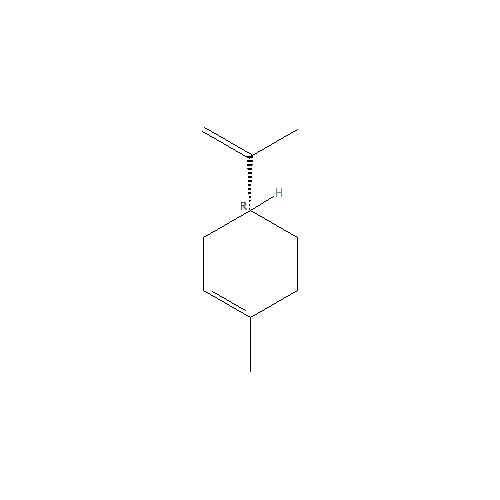
(R)-(+)-1-Methyl-4-(1-methylethenyl)cyclohexene
d-Limonene · (R)-(+)-Limonene · p-Mentha-1,8-diene · 1,8-p-Menthadiene · Cinene
化学組成 · Constituent
(+)-Limonene is one of the most abundant constituents in essential oils, dominant in the Citrus family. Pure material is safe at standard use levels, but oxidized limonene significantly increases skin sensitization risk.
Skin. A 8 percent patch test on 25 volunteers showed no sensitization. At 20 percent on 20 dermatitis patients, 98 percent pure (+)-limonene was non-irritating. At 1 to 3 percent across thousands of dermatitis patients, allergic reaction rates ranged 0 to 0.56 percent.
Oxidation increases allergenicity. Primary oxidation products include limonene 1,2-oxide, carvone, carveol and limonene-2-hydroperoxide, with the hydroperoxides acting as strong contact allergens. In studies on thousands of dermatitis patients, oxidized limonene at 3 percent caused allergic reactions in 0.9 to 2.8 percent. Combined data suggest oxidation may raise allergenicity roughly tenfold.
Oral. Acute oral LD50 in rats exceeded 5 g/kg. A single 100 mg/kg dose in healthy human volunteers was non-toxic.
Kidney. High oral doses cause renal injury in male Wistar and F344 rats through a2u-globulin accumulation. This effect is specific to male rats and does not occur in humans or other mammals.
Reproductive. High oral doses caused maternal toxicity and some skeletal ossification delays in rat and mouse fetuses, but no teratogenicity. Reproductive NOAEL was 591 mg/kg/day in mice and 250 mg/kg/day in rabbits.
Cancer. In long-term studies, limonene caused kidney cancer only in male F344/N rats through a mechanism not relevant to humans. In humans and other species, (+)-limonene shows broad anticancer activity including breast, stomach, pancreatic and lung cancers.
After oral dosing, (+)-limonene is rapidly absorbed and extensively metabolized. In rabbits, 72 percent of the dose is excreted in urine within 72 hours, with 7 percent in feces. No unchanged limonene is detected in urine, confirming complete metabolism to oxidation products and water-soluble conjugates.
In humans, the predominating circulating metabolites in descending order are perillic acid, dihydroperillic acid, limonene-1,2-diol, uroterpenol and an isomer of perillic acid. (+)-Limonene induces CYP enzymes and reduces HMG-CoA reductase activity.
Species differences exist in the oxidation pathway. In dogs, rabbits and guinea pigs, (+)-limonene converts to carveol, perillyl alcohol and carvone. In mice, rats, monkeys and humans, only carveol and perillyl alcohol are produced, with no carvone.
(+)-Limonene is one of 26 EU-listed fragrance allergens requiring label declaration. Cold dark storage in sealed containers prevents oxidation for up to 12 months. Addition of BHT or tocopherol extends shelf life but not indefinitely.
Limonene-rich oils should be paired with antioxidants and light-proof packaging. Once oxidation begins, the process progresses rapidly.