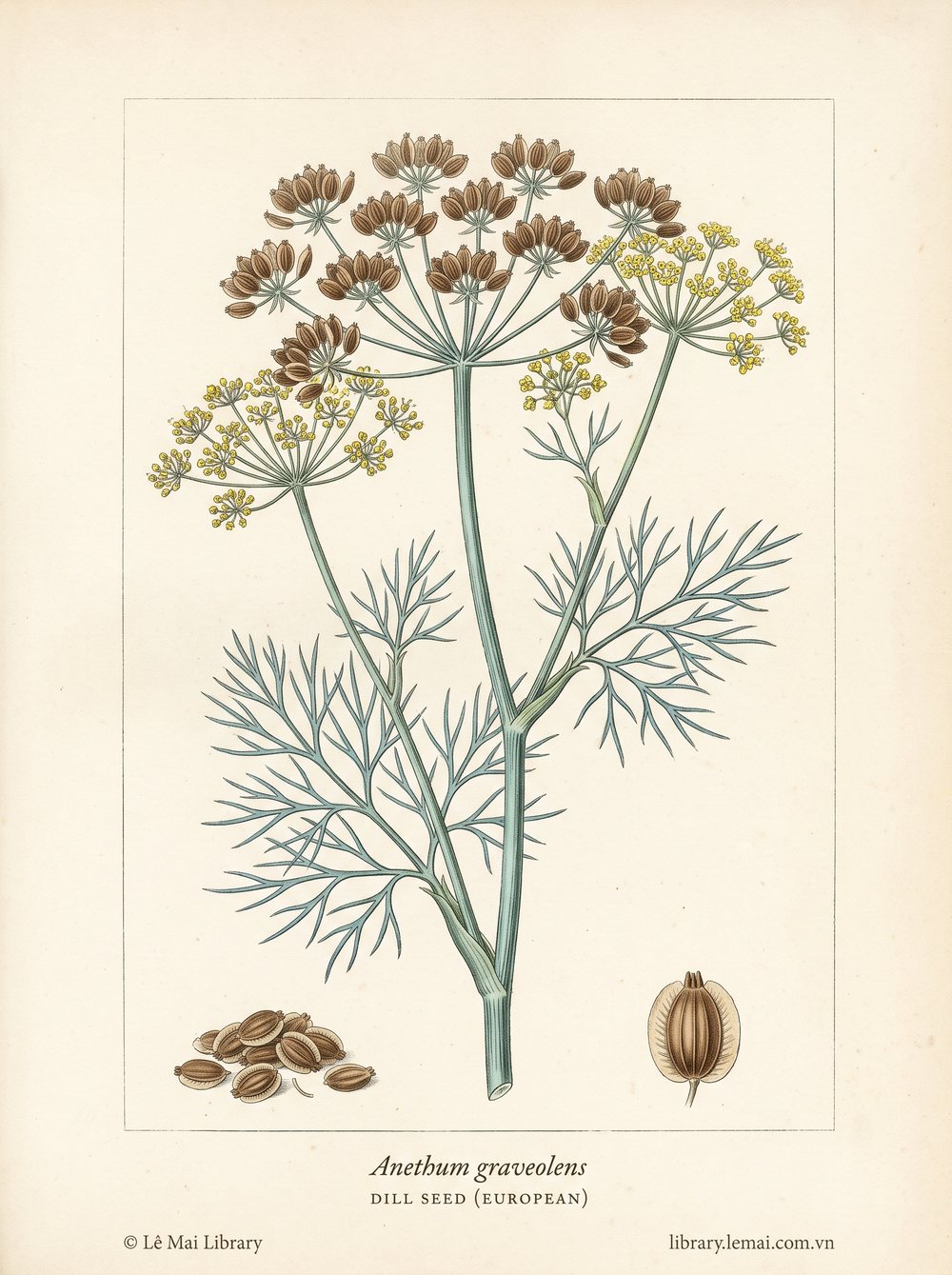
ヨーロピアンディルシード
Thì là (hạt) châu Âu
Anethum graveolens
Theoretical drug interaction. Oxidation products of (+)-limonene may sensitize skin.
Oral: caution with diabetes medication, dill oil lowers blood glucose in rat studies.
Store in dark, sealed, refrigerated container. Add an antioxidant to formulations.
No dermal concentration limit needed for carvone toxicity, the dermal threshold for (+)-carvone is 23 percent.
Unlike toxic apiole-rich Indian dill seed oil, European dill contains no dill apiole and is safe in a similar way to caraway oil.
| (+)-Limonene | 35.9 – 68.4 % |
| (+)-Carvone | 27.3 – 53.3 % |
| (Z)-Dihydrocarvone | 2.9 – 3.7 % |
| α-Phellandrene | 1.0 – 2.3 % |
| (E)-Dihydrocarvone | 1.7 – 1.8 % |
Anethum graveolens is an annual herb of southern and eastern Europe. Both seeds and leaves are used as spice, particularly in northern European (cured salmon, pickles) and Middle Eastern cuisines.
The oil is steam-distilled from the seeds. Produced mainly in Hungary, Germany and the Netherlands.
Family Apiaceae. Same family as caraway, anise, coriander.
May be adulterated with terpenes from distilled orange oil.