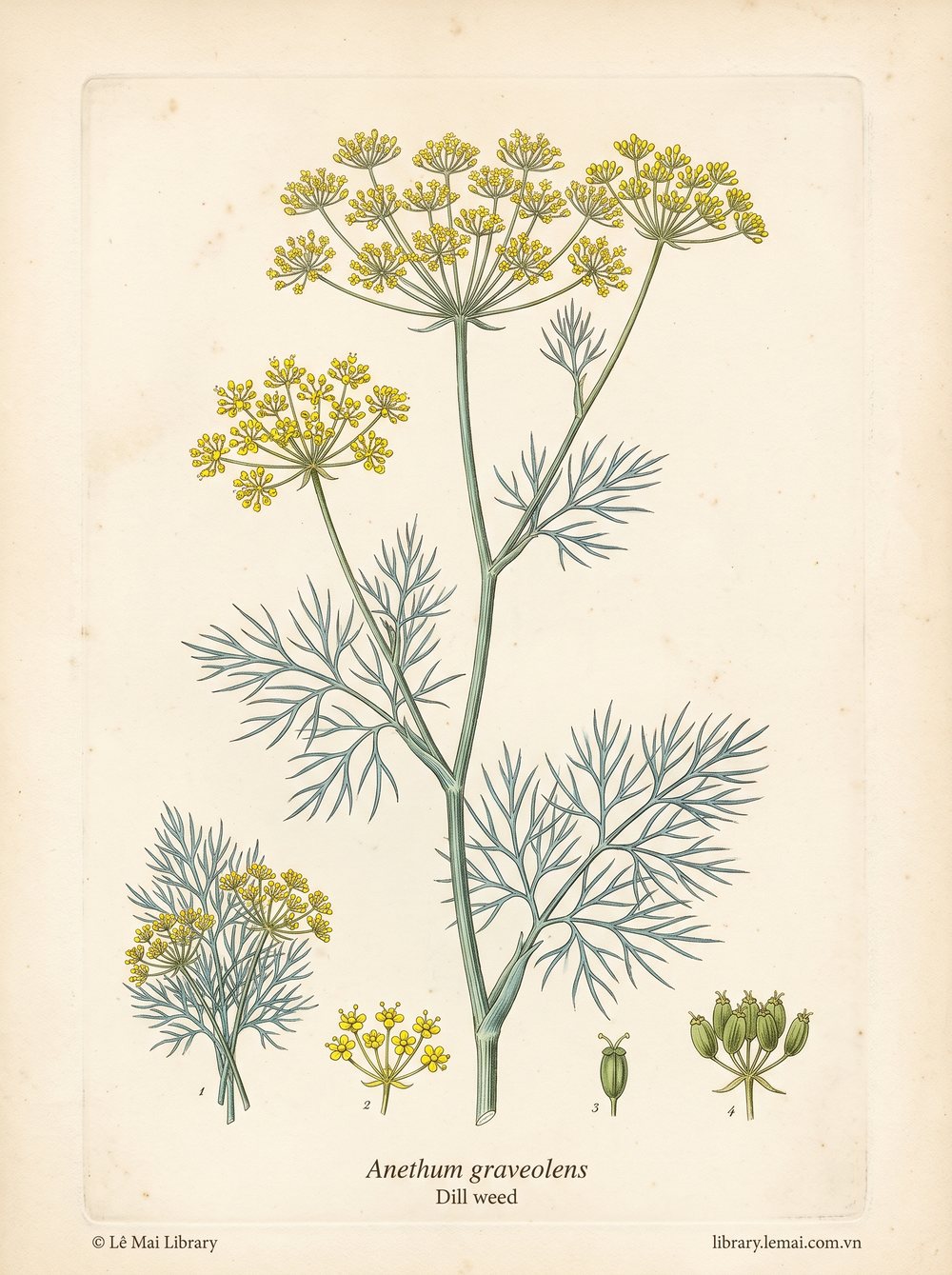
ディルウィード
Thì là (lá)
Anethum graveolens
Dill herb
Theoretical drug interaction.
Oral: caution with diabetes medication, dill oil lowers blood glucose in rat studies.
No irritation or sensitization at 4 percent test level. Non-phototoxic.
Dill weed oil requires no restriction, the dermal threshold for (+)-carvone is 23 percent, oil content around 31 to 42 percent.
| (+)-Carvone | 31.6 – 42.4 % |
| α-Phellandrene | 18.2 – 30.2 % |
| (+)-Limonene | 22.5 – 24.9 % |
| Anethofuran (dill ether) | 5.6 – 6.6 % |
| β-Phellandrene | 2.3 – 3.3 % |
| (E)-Dihydrocarvone | 0.5 – 1.9 % |
| (Z)-Dihydrocarvone | 0.8 – 1.4 % |
| p-Cymene | 1.0 – 1.1 % |
Same Anethum graveolens plant as European dill seed, but the oil is distilled from aerial parts (leaves, stems, flowers) rather than seeds.
Chemistry differs markedly from seed oil, dill weed has high α-phellandrene and a distinctive anethofuran (dill ether).
Family Apiaceae. Dill weed oil is widely used in pickles and European cuisine.