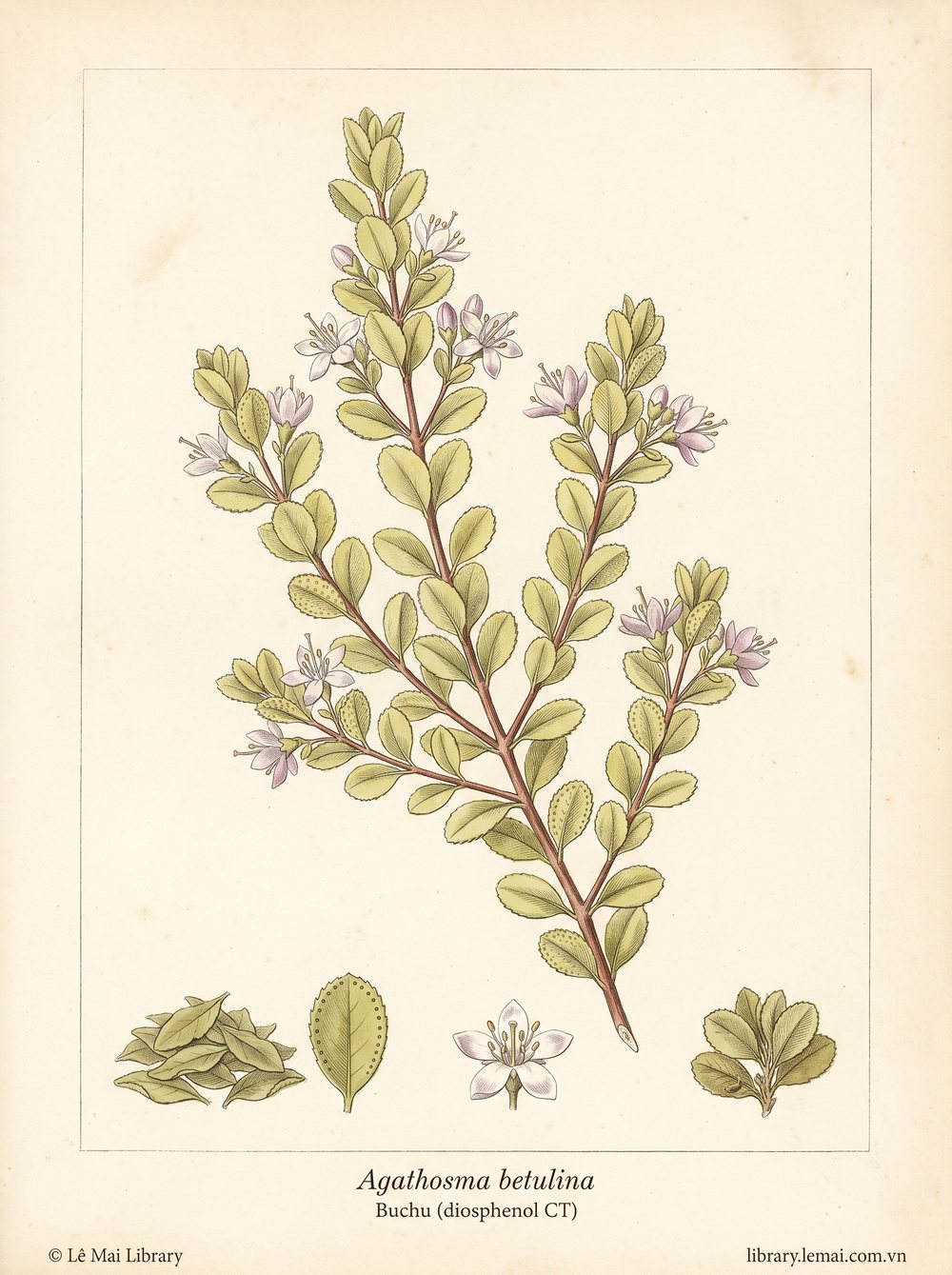
ブチュ ジオスフェノール CT
Buchu (CT diosphenol)
Agathosma betulina
Barosma betulina, Round leaf buchu
Low hepatotoxicity risk. Skin sensitization if oxidized.
Contraindications: pregnancy, breastfeeding.
Use with caution due to uncertain toxicity. Avoid old or oxidized oils.
Maximum adult oral dose 384 mg daily. Maximum dermal use level 11 percent.
Basis: 9.1 percent total pulegone, with limits of 0.5 mg per kg per day oral and 1 percent dermal.
Due to limonene content, prevent oxidation by storing in a dark, sealed, refrigerated container. Add an antioxidant to formulations.
| Isomenthone | 4.6 – 29.1 % |
| (+)-Limonene | 11.6 – 28.2 % |
| Diosphenol | 12.0 – 26.3 % |
| Menthone | 2.5 – 25.0 % |
| ψ-Diosphenol | 10.3 – 23.3 % |
| 8-Mercapto-p-menthan-3-one (cis + trans) | 0.7 – 6.6 % |
| α-Pulegone [(E)- + (Z)-] | 0.4 – 4.6 % |
| (1S)-(−)-β-Pulegone | 0.6 – 4.5 % |
| 1,8-Cineole | tr, 4.4 % |
| β-Myrcene | 0.2 – 2.8 % |
| Sabinene | tr, 1.2 % |
Agathosma betulina is a small shrub endemic to the Cape region of South Africa. The small round leaves carry oil glands visible to the naked eye when held to light.
This is the more common of the two main commercial buchu sources. At least four buchu types are on the market: A. betulina (diosphenol CT), A. crenulata (pulegone CT), a hybrid between the two, and an isomenthone chemotype (39 to 49 percent isomenthone) of A. betulina.
Family Rutaceae. The botanical synonym Barosma betulina remains common in older literature.
May be adulterated with synthetic monoterpene sulfides, such as p-mentan-8-thiol-3-one.
The British Herbal Compendium lists pregnancy as a contraindication for buchu leaves generally.
Sulfur compounds (mercapto, thiol) give buchu its distinctive blackcurrant-like note, at once leafy and fruity.