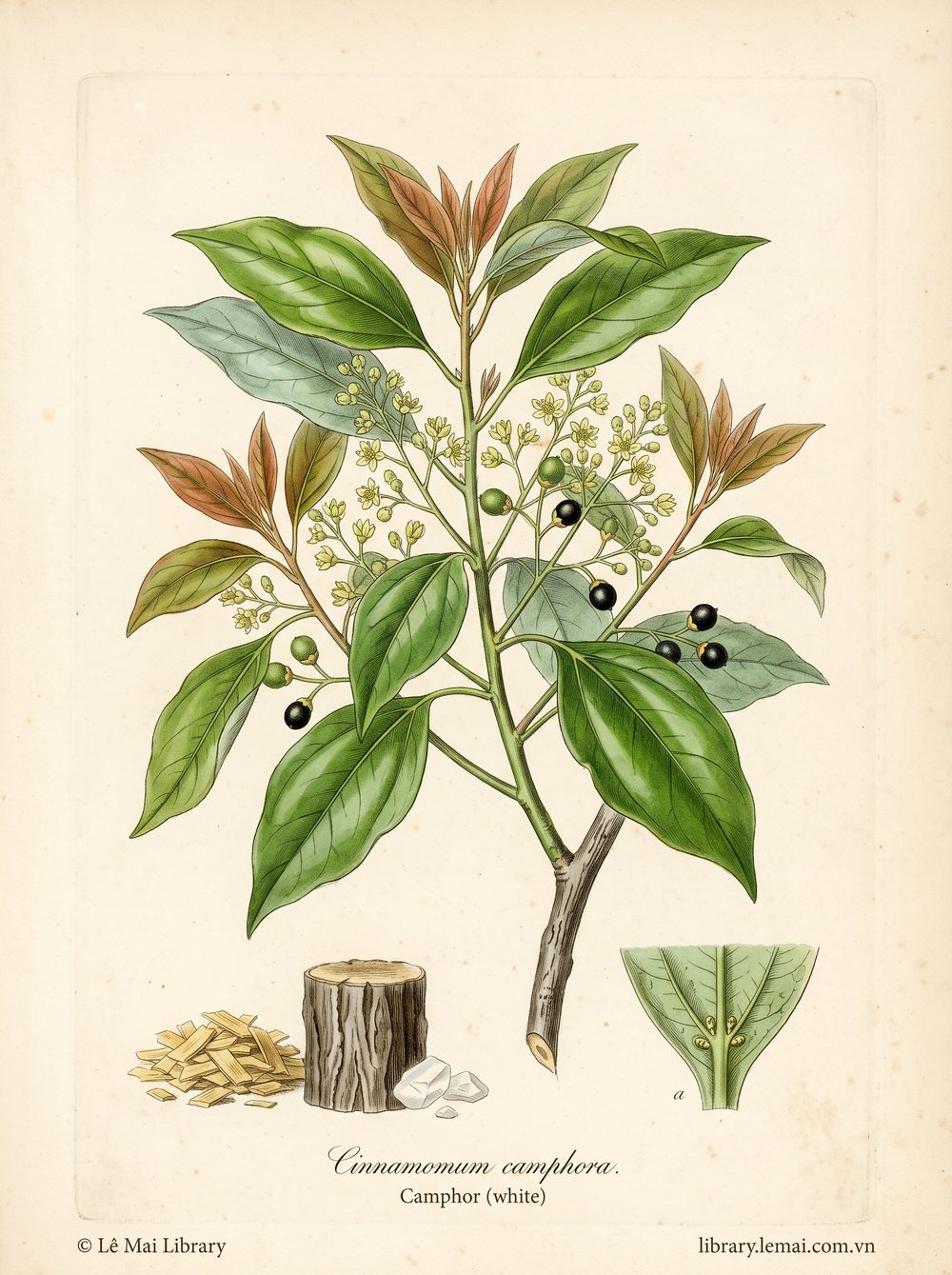
ホワイトカンファー
Long não trắng
Cinnamomum camphora
Hon-sho, True camphor, Laurus camphora
Oxidation products of (+)-limonene and α-pinene may sensitize skin.
1,8-Cineole has antioxidant properties, reducing this risk.
Store in dark, sealed, refrigerated container. Add an antioxidant to formulations.
Safrole content in white camphor is only trace, insufficient for carcinogen concern.
Likely not hazardous in pregnancy based on data for the major constituents.
| (+)-Limonene | 44.2 % |
| p-Cymene | 24.2 % |
| α-Pinene | 8.9 % |
| 1,8-Cineole | 6.5 % |
| Sabinene | 4.2 % |
| β-Pinene | 4.0 % |
| Camphene | 3.0 % |
| Camphor | 2.4 % |
| Safrole | tr |
Camphor is the name of the tree, the name of its essential oil, and the name of a chemical constituent found in this and other oils.
The crude exudate contains approximately 50 percent camphor. The oil is separated into four fractions by fractional distillation, after the crude camphor crystals are filtered out: white (a light fraction), brown (medium), yellow (another medium), blue (heavy).
Due to this fractionation process, none of these can be classed strictly as a true essential oil. White camphor, the most widely used therapeutically, contains very little camphor.
White camphor oil is not subject to adulteration.
The camphor plant exists in five chemotypes: borneol, nerolidol, camphor, 1,8-cineole and linalool. Only the last three are commercially available. Oils from the leaves of these are known as ho leaf oils.