カナディアンファーニードル
Linh sam Canada (kim)
Abies balsamea
Balsam fir, Fir balsam
Oxidation products of (+)-limonene, α-pinene and δ-3-carene may sensitize skin.
Store in dark, sealed, refrigerated container. Add an antioxidant.
No irritation or sensitization at 10 percent test level. Non-phototoxic.
In vitro research: Canadian fir needle oil shows anticarcinogenic activity against multiple human cancer cell lines (breast MCF-7, prostate PC-3, lung A-549, colon DLD-1, melanoma M4BEU, colon CT-26). The activity is mainly due to α-caryophyllene, although it makes up only 0.06 to 0.6 percent of the oil.
| β-Pinene | 28.1 – 56.1 % |
| δ-3-Carene | 0 – 27.3 % |
| Bornyl acetate | 4.9 – 16.2 % |
| α-Pinene | 6.2 – 14.3 % |
| (+)-Limonene | 1.8 – 15.6 % |
| β-Phellandrene | 4.4 – 12.6 % |
| Camphene | 3.5 – 9.7 % |
| α + β-Terpineol | 0.6 – 4.5 % |
| Thymol | 0 – 2.9 % |
| β-Myrcene | 0.6 – 2.3 % |
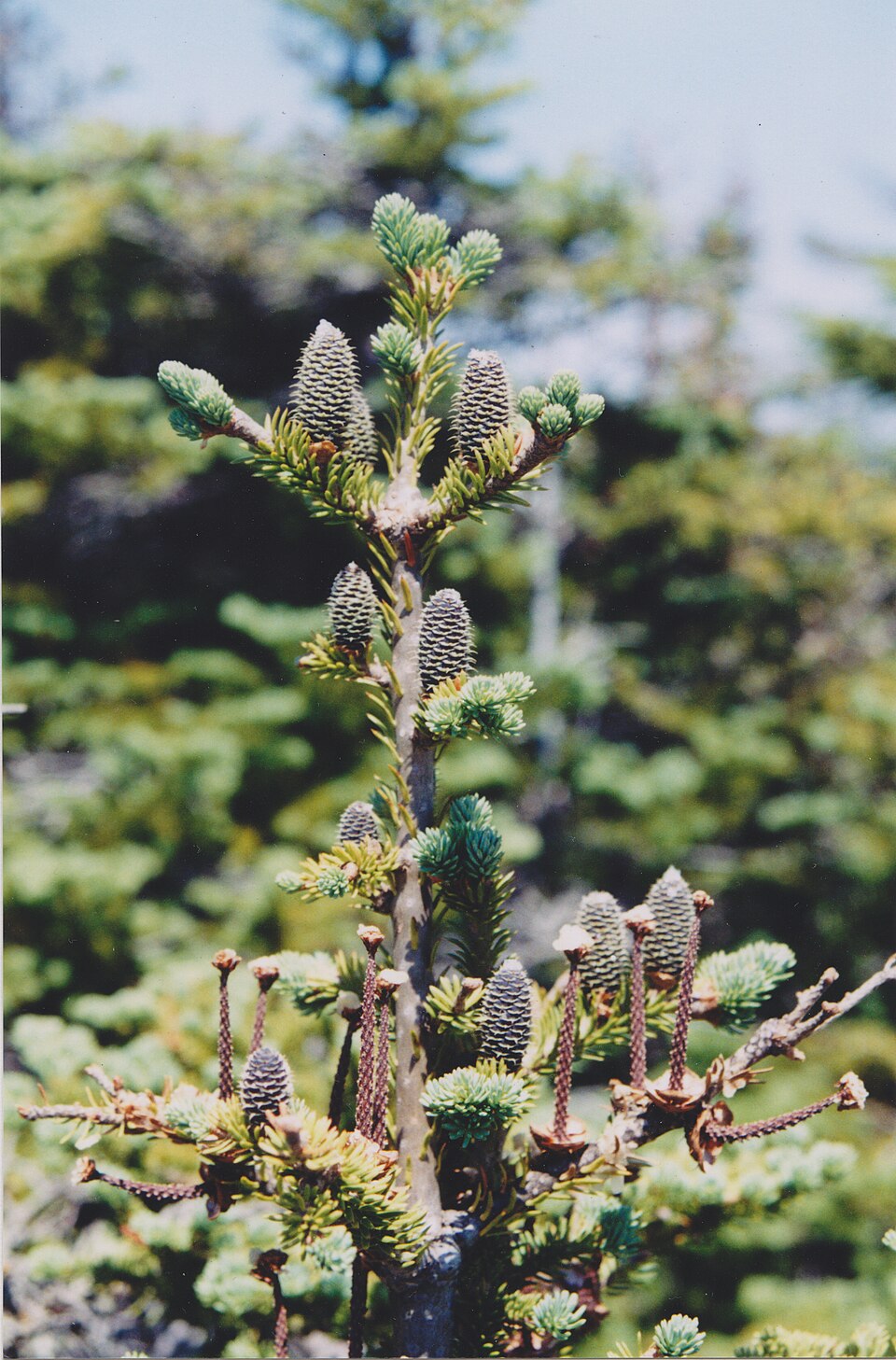
Abies balsamea is the balsam fir of North America. The tree produces thick resin blisters on its bark containing Canada balsam, a clear yellow fluid used traditionally in indigenous medicine and later in optical microscopy.
The needle oil is steam-distilled from leaves and twigs. Canada balsam oil (distinct from Canadian fir needle oil) is distilled from the resin.
Family Pinaceae.
May be adulterated with turpentine oil fractions, mixtures of camphene and bornyl acetate.