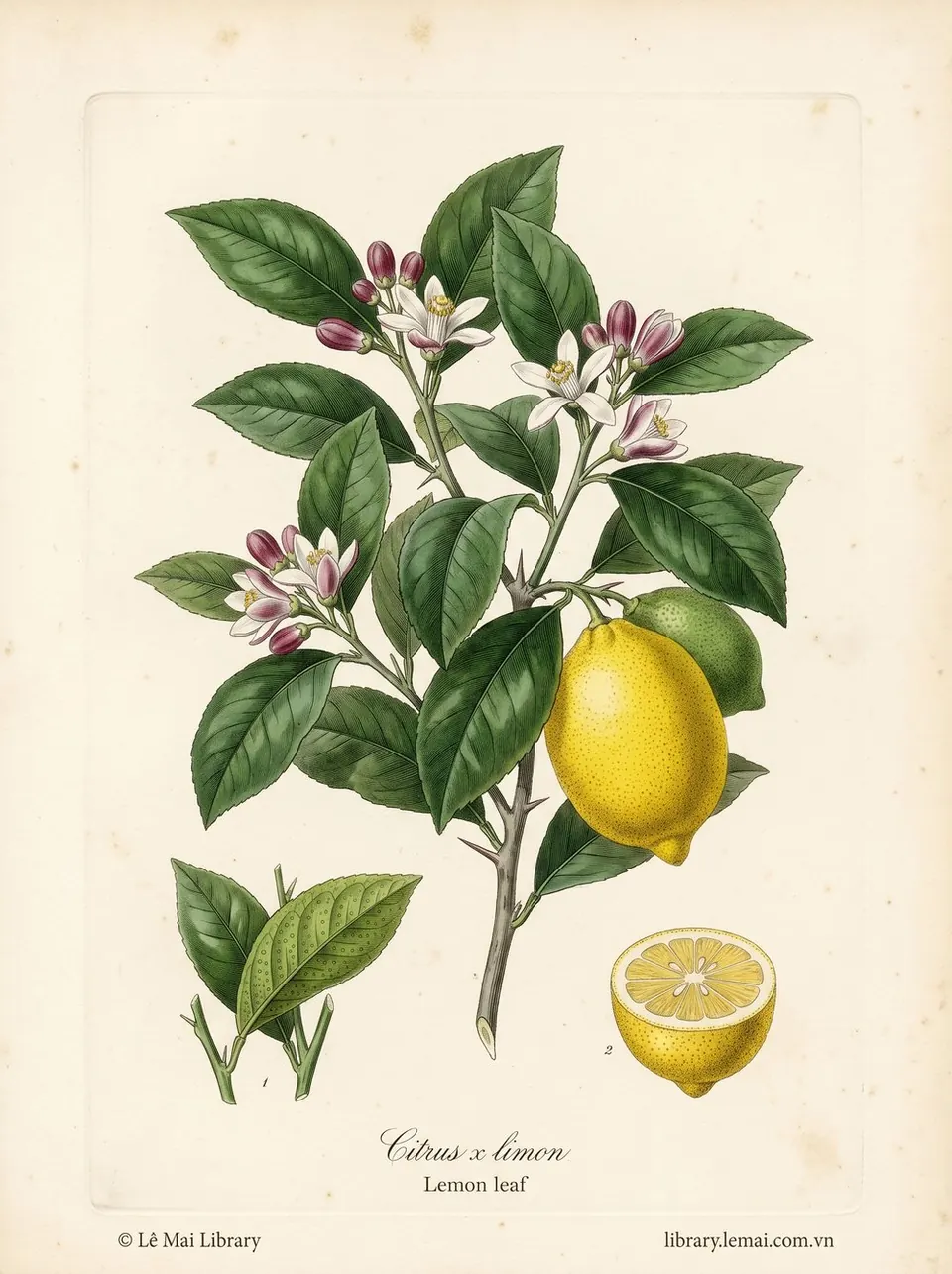
レモンリーフ
Lá chanh vàng
Citrus x limon
Lemon petitgrain, Citrus limonum
Lemon leaf essential oil, also called lemon petitgrain, is steam-distilled from the leaves and young twigs of Citrus x limon in the citrus family, mainly in Italy as a byproduct of pruning. It smells fresh and leafy with a herbaceous note; its main components are geranial (about 25 to 35%) and neral. Because it is rich in citral, dilute it for skin use and store it tightly closed.
Updated 6 Nov 2026 · Lê Mai Team
Citral and geraniol may sensitize skin at high concentrations. Dermal limit recommended.
Drug interactions through CYP2B6 inhibition by citral and geraniol.
Store to prevent oxidation.
| Geranial | 25.0 – 35.0 % |
| Neral | 18.0 – 26.0 % |
| Geranyl acetate | 5.0 – 9.0 % |
| Geraniol | 2.0 – 5.0 % |
| (+)-Limonene | 2.0 – 5.0 % |
| β-Caryophyllene | 1.0 – 3.0 % |
Lemon leaf (lemon petitgrain) is distilled from leaves and young twigs of Citrus x limon. Distinct from lemon oil expressed from fruit peel.
Production is mainly in Italy. Small scale, primarily a byproduct of lemon tree pruning.
Family Rutaceae.
Fresh, leafy aroma, less citrus than lemon peel oil. Has a herbaceous note.
Traditional petitgrain refers to petitgrain bigarade (Citrus aurantium bitter orange leaves). Lemon petitgrain is the lemon version.