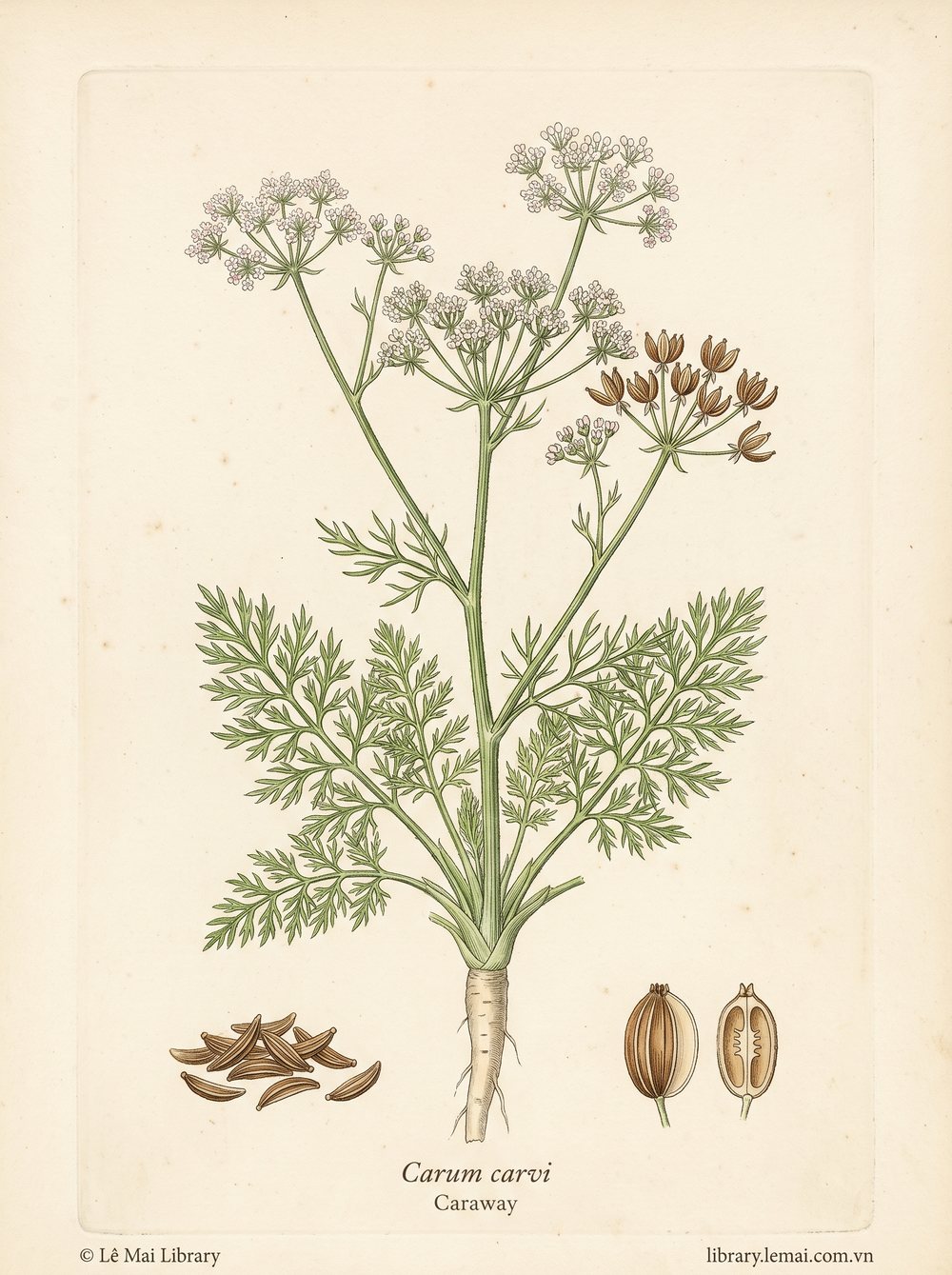
キャラウェイ
Thì là Tây
Carum carvi
Oxidation products of (+)-limonene may sensitize skin.
Store in dark, sealed, refrigerated container. Add an antioxidant to formulations.
Low-level phototoxic effects reported, not considered significant.
Caraway oil requires no specific restriction for (+)-carvone as the dermal threshold for (+)-carvone is 23 percent for toxicity.
GRAS status. Caraway capsules are used in gastrointestinal treatment, often paired with peppermint oil.
| (+)-Carvone | 47.3 – 59.5 % |
| (+)-Limonene | 36.9 – 48.8 % |
| β-Myrcene | 0.2 – 1.0 % |
Carum carvi is a biennial herb of northern Europe and western Asia. The small, slightly curved seeds carry a distinctive flavor.
The oil is steam-distilled from the seeds. Family Apiaceae, same family as anise, fennel, dill, a botanical family rich in apiol and carvone.
Caraway seeds are a common spice in German, Austrian, Hungarian and Scandinavian cuisines.
May be adulterated with synthetic carvone and limonene.
Caraway oil significantly inhibited DMBA-induced and croton oil-induced skin tumors in mice. (+)-Carvone is not a rodent carcinogen, and both carvone and (+)-limonene display anticarcinogenic activity.