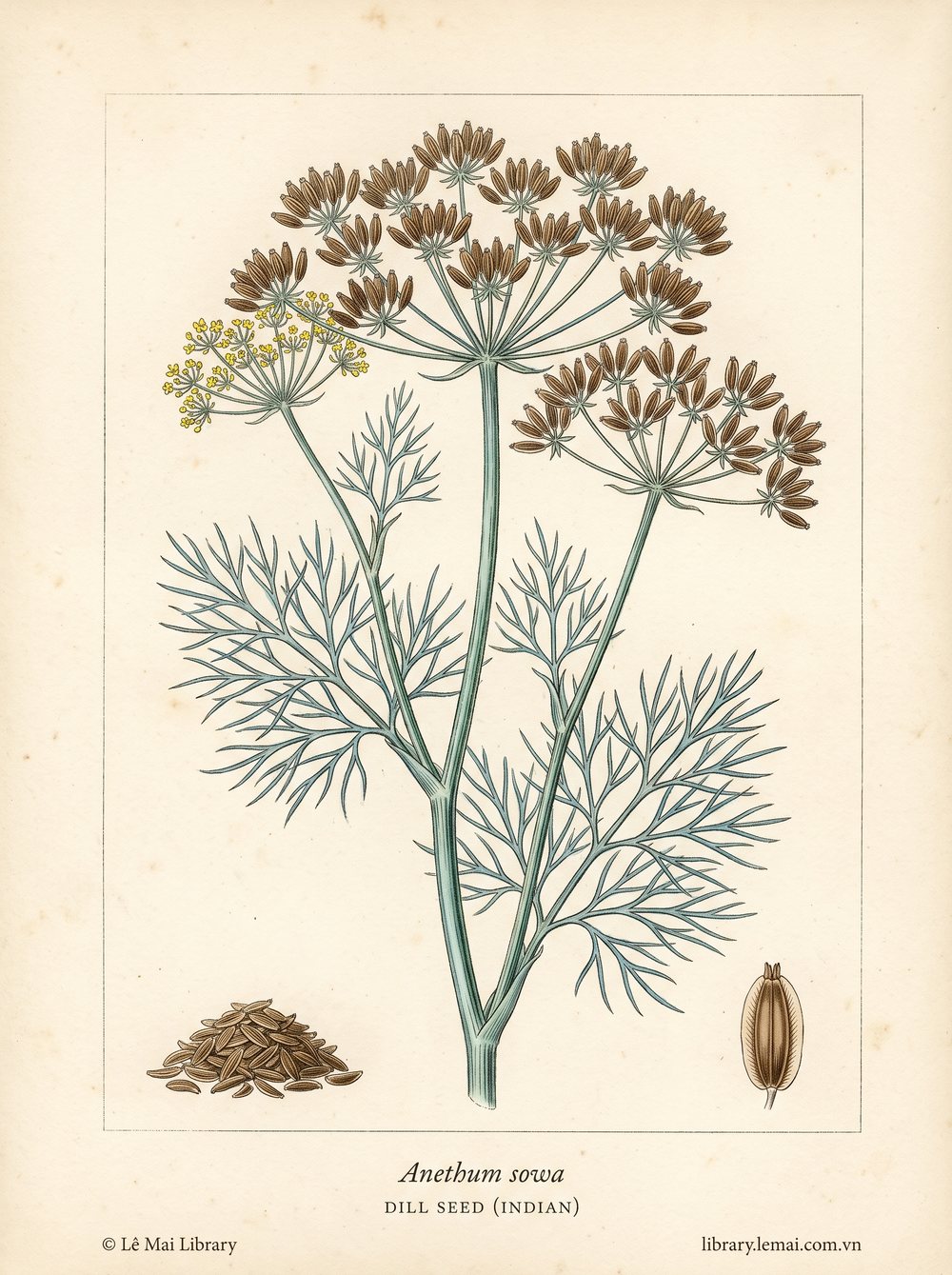
インディアンディルシード
Thì là (hạt) Ấn Độ
Anethum sowa
Sowa, East Indian dill, Satapashpi
Hepatotoxic. Nephrotoxic. May be abortifacient.
Broad contraindications: pregnancy, breastfeeding.
Maximum adult oral dose 53 mg daily. Maximum dermal use level 1.4 percent.
Basis: 52.5 percent dill apiole, with oral limit 0.4 mg per kg and dermal 0.76 percent.
Apiole and parsley preparations have been used for years to procure illegal abortions in Italy. Effects are cumulative, apiole taken daily for 2 to 8 days before death or abortion. Lowest dose inducing abortion: 0.9 g daily for 8 consecutive days.
Not to be confused with European dill seed oil, Indian contains toxic dill apiole, European does not.
| Dill apiole | 20.7 – 52.5 % |
| (+)-Limonene | 5.9 – 45.0 % |
| (+)-Carvone | 17.4 – 23.1 % |
| (E)-Dihydrocarvone | 4.2 – 16.6 % |
| α-Phellandrene | tr – 6.5 % |
| (Z)-Dihydrocarvone | 0.8 – 5.2 % |
Anethum sowa is a distinct dill species of South Asia, particularly India and Pakistan. The Hindi name 'sowa' and Sanskrit 'satapashpi' reflect traditional use as both spice and medicine.
The oil is steam-distilled from the seeds. Differs markedly from European dill (Anethum graveolens) in chemistry because of its dill apiole content, a phenylpropene similar to parsley apiole.
Family Apiaceae.
Oils rich in parsley apiole or dill apiole are among the most hazardous essential oils when taken orally. Documented human fatal dose: 4.2 g total apiole (2.1 g daily for 2 days). Lowest daily fatal dose: 770 mg over 14 days.