Elemi
エレミ
Nhựa Elemi
Canarium luzonicum, Canarium vulgare
Canarium commune
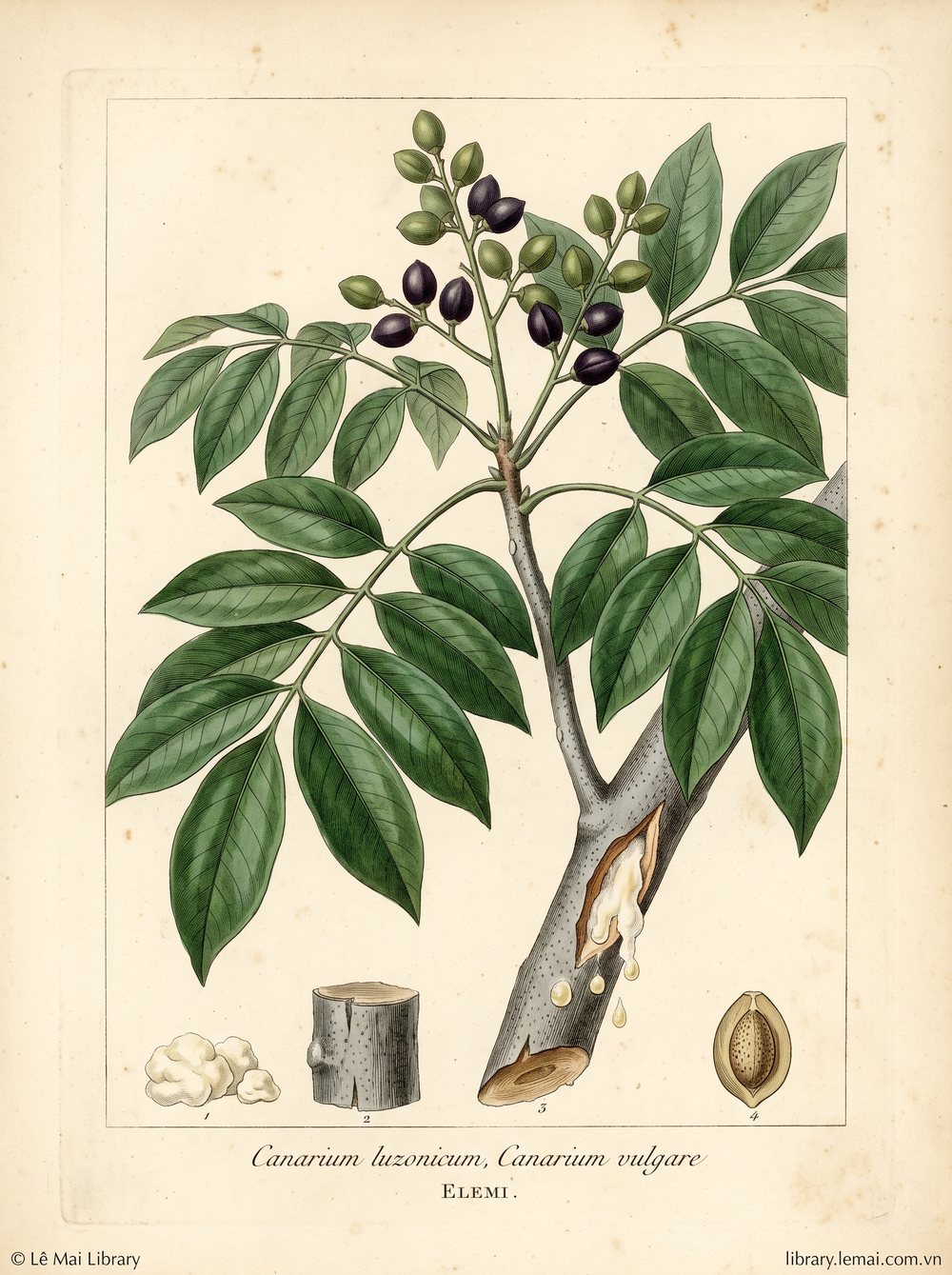
エレミ
Nhựa Elemi
Canarium luzonicum, Canarium vulgare
Canarium commune
May contain methyleugenol at low levels (0.2 to 0.3 percent).
Oxidation products of (+)-limonene may sensitize skin. Store in dark, sealed, refrigerated container; add an antioxidant to formulations.
No dermal limit imposed: although 0.3 percent methyleugenol theoretically calls for a 6.7 percent restriction, the anticarcinogenic activity of (+)-limonene (27 to 65 percent of the oil) likely counters the risk.
No irritation or sensitization at 4 percent test level. Non-phototoxic.
| (+)-Limonene | 26.9 – 65.0 % |
| Elemol | 2.8 – 17.3 % |
| α-Phellandrene | 4.3 – 15.1 % |
| Elemicin | 1.8 – 10.6 % |
| p-Cymene | 1.4 – 7.7 % |
| α-Pinene | 0.4 – 5.4 % |
| Sabinene | 1.3 – 5.9 % |
| 1,8-Cineole | < 2.5 % |
| β-Myrcene | 0.6 – 2.4 % |
| β-Phellandrene | 0.8 – 1.6 % |
| β-Pinene | 0.3 – 1.0 % |
| Methyleugenol | 0.2 – 0.3 % |
Canarium luzonicum is a tropical tree of the Philippines. The gum is collected by drilling into the trunk, similar to frankincense production.
The oil is steam-distilled from the gum. Family Burseraceae, same family as myrrh and frankincense.
UNEP-WCMC has proposed that CITES add Canarium luzonicum to its list of threatened plant species. Sourcing should require sustainability certification.
May be adulterated by addition of (+)-limonene and α-phellandrene.
Elemi oil tends to resinify with age. Store cold and sealed.