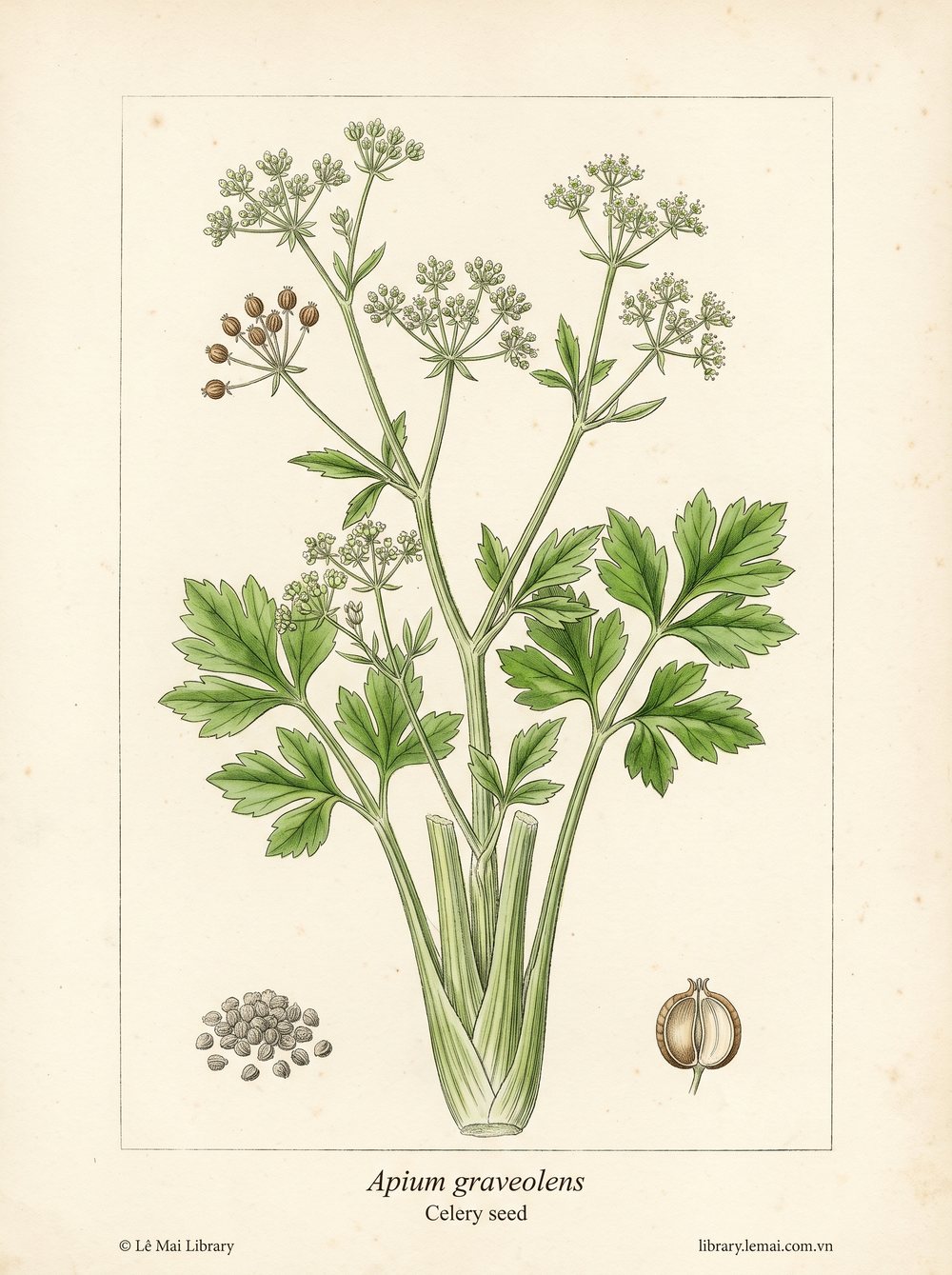
セロリシード
Cần tây (hạt)
Apium graveolens
Oxidation products of (+)-limonene may sensitize skin.
Store in dark, sealed, refrigerated container. Add an antioxidant to formulations.
GRAS status. No irritation or sensitization at tested levels. Non-phototoxic.
Likely not hazardous in pregnancy based on data for the major constituents.
Sedanolide and 3-butyl phthalide reduced forestomach cancer incidence in mice.
| (+)-Limonene | 68.0 – 75.0 % |
| β-Selinene | 2.0 – 12.5 % |
| α-Selinene | 2.0 – 12.1 % |
| Butylidene phthalide | 2.3 – 8.0 % |
| Sedanolide | 2.3 – 3.8 % |
| 3-Butyl phthalide | 2.1 – 3.0 % |
| Ligustilide | 0 – 2.4 % |
| Sedanenolide | 2.2 – 2.3 % |
| Pentylbenzene | 1.7 – 2.0 % |
| Linalool | 0 – 1.5 % |
| β-Myrcene | 1.0 – 1.2 % |
| α-Pinene | 0.1 – 1.0 % |
Celery seed oil is steam-distilled from dried seeds. The distinctive note comes from phthalides, a compound group rare in other essential oils.
Family Apiaceae. Produced mainly in India and China.
Phthalides have anticarcinogenic activity demonstrated in vivo in rat studies.
Limonene is the most common adulterant in commercial celery seed oil.