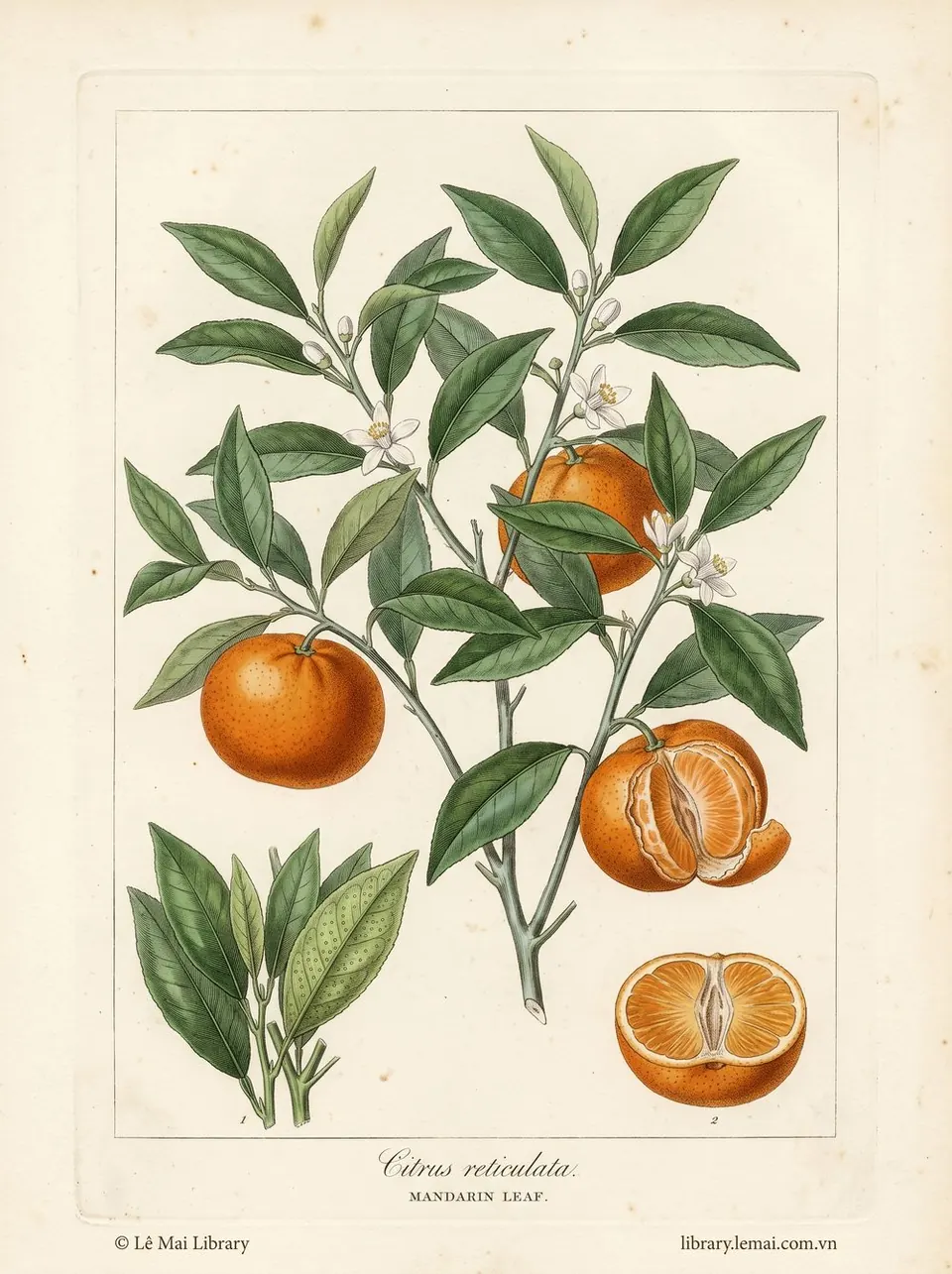
マンダリンリーフ
Lá quýt
Citrus reticulata
Mandarin petitgrain
Mandarin leaf essential oil, or mandarin petitgrain, is steam-distilled from the leaves of Citrus reticulata in the citrus family, mainly in Italy and on the Iberian Peninsula as a byproduct of pruning. Its scent is quite unlike mandarin peel oil: green, sweet and distinctive, shaped by methyl N-methylanthranilate (about 40 to 65%) and γ-terpinene. It is often used in perfume, soap and room fragrance.
Updated 4 Nov 2026 · Lê Mai Team
Methyl N-methylanthranilate makes up a large portion, the characteristic mandarin leaf aroma, distinct from mandarin peel oil.
Low risk of skin sensitization.
No data indicates hazard in pregnancy.
| Methyl N-methylanthranilate | 40.0 – 65.0 % |
| γ-Terpinene | 8.0 – 18.0 % |
| Linalool | 5.0 – 12.0 % |
| α-Terpineol | 2.0 – 5.0 % |
| p-Cymene | 1.0 – 4.0 % |
Mandarin leaf (mandarin petitgrain) is distilled from the leaves of Citrus reticulata. Markedly different in chemistry and aroma from mandarin peel oil.
Main production: Italy, Spain. Small scale, a byproduct of mandarin tree pruning.
Family Rutaceae.
Green, floral, lightly sweet aroma. A characteristic 'grape' note from methyl anthranilate.
Used in fine fragrance for green floral notes.